Study Notes
Overview
This study guide explores the complex and highly debated topic of how society should tackle poverty. For your OCR GCSE Sociology exam, you are expected to move beyond common-sense ideas and engage with formal sociological theories and evidence. The core of this topic revolves around the tension between different ideological approaches to welfare. We will analyse the historical shift from the post-war consensus of universalism, embodied by the Beveridge Report and the creation of the Welfare State, to the modern emphasis on means-testing, exemplified by Universal Credit. Examiners will be looking for your ability to apply sociological perspectives — particularly the New Right and Social Democratic views — to evaluate the effectiveness of state, voluntary, and informal solutions. Credit is given for understanding not just what policies do, but the sociological arguments for and against them, including their unintended consequences like the 'poverty trap'.
Key Developments & Policies
The Beveridge Report & The Welfare State
Date(s): 1942 (Report), 1945-1948 (Implementation)
What happened: Sir William Beveridge published his report, identifying 'Five Giants' holding back society: Want (poverty), Disease, Ignorance, Squalor (poor housing), and Idleness (unemployment). The post-war Labour government implemented his recommendations, creating the NHS, expanding education, and establishing a comprehensive system of National Insurance benefits.
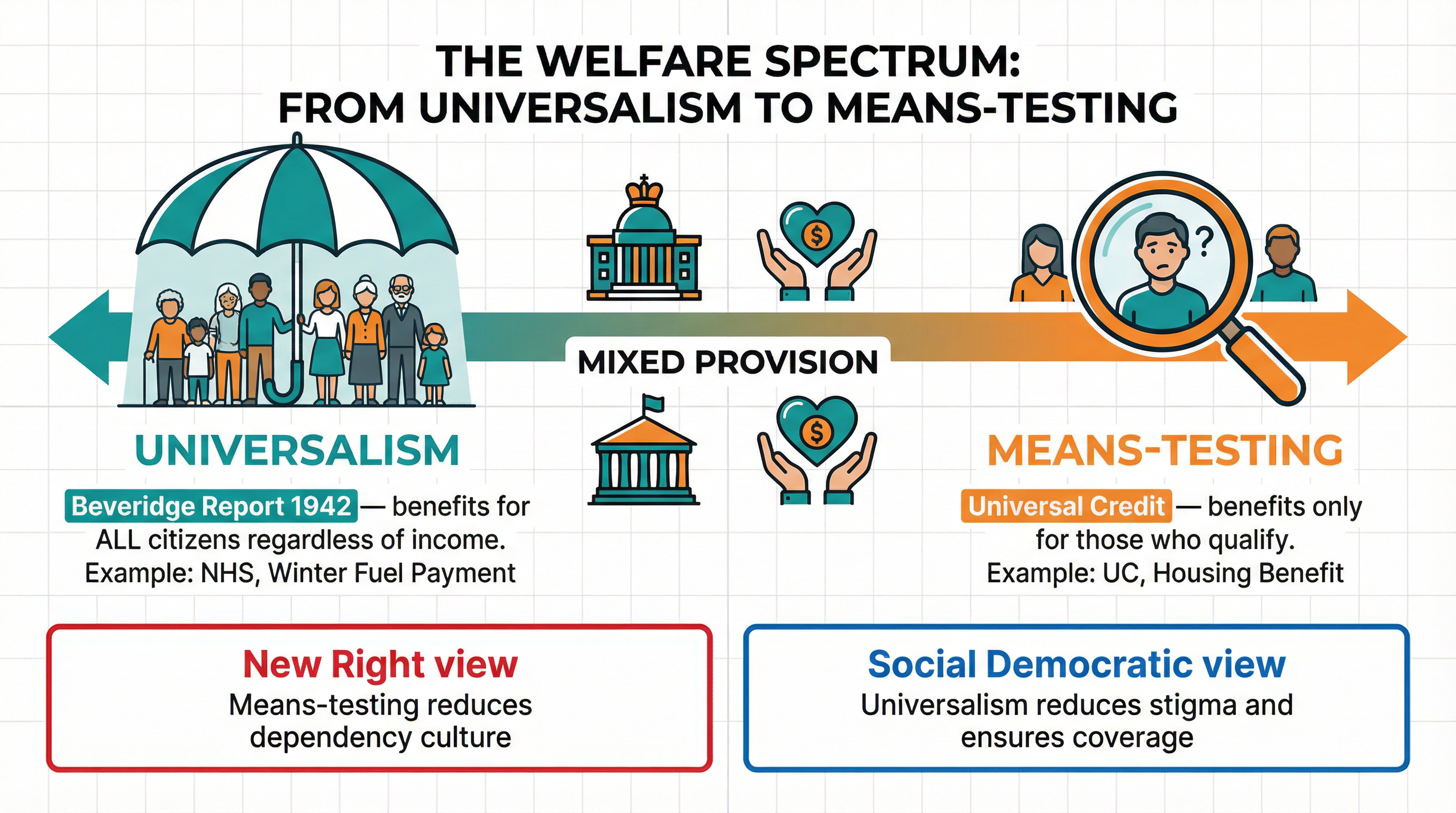
Why it matters: This established the principle of universalism — welfare for all, 'from the cradle to the grave'. It represents the high point of the Social Democratic approach, viewing welfare as a right of citizenship. For the exam, this is your key example of a universalist system designed to tackle absolute poverty and reduce inequality.
Specific Knowledge: William Beveridge, Five Giants, NHS (1948), National Insurance Act.
The New Right & The Critique of Dependency
Date(s): 1980s onwards
What happened: Sociologists and politicians from the New Right perspective, most notably Charles Murray, began to argue that the welfare state had gone too far. They claimed it created a 'dependency culture' where people lost the incentive to work.
Why it matters: This ideological shift provided the justification for scaling back the welfare state and moving towards means-testing. It introduced key concepts like the 'underclass' and 'perverse incentives' into the debate. You MUST use this perspective to provide the main critique (AO3) of the universal welfare state.
Specific Knowledge: Charles Murray, 'The Underclass', dependency culture, perverse incentives.
Universal Credit & The Rise of Means-Testing
Date(s): 2013 onwards
What happened: The government introduced Universal Credit (UC) to replace six existing means-tested benefits with a single monthly payment. The aim was to simplify the system and 'make work pay'.
Why it matters: UC is the primary example of a modern, means-tested solution. It is central to debates about the 'poverty trap'. Evidence from organisations like The Trussell Trust and the Joseph Rowntree Foundation is crucial for evaluating its effectiveness. Candidates must be able to contrast the aims of UC with its real-world impacts.
Specific Knowledge: Universal Credit, means-testing, The Trussell Trust, Joseph Rowntree Foundation, five-week wait.
Key Individuals
William Beveridge
Role: Economist and social reformer
Key Actions: Authored the 1942 Beveridge Report.
Impact: Provided the blueprint for the post-war British welfare state, based on principles of universalism and collective responsibility.
Charles Murray
Role: American New Right sociologist
Key Actions: Developed the theory of the 'underclass' and 'dependency culture'. Argued that generous welfare creates 'perverse incentives' that discourage work and marriage.
Impact: His ideas have been highly influential in shaping welfare reforms in both the US and the UK, providing the intellectual basis for policies aimed at reducing benefits.
Second-Order Concepts
Causation
The move from universalism to means-testing was caused by a combination of economic pressures (the rising cost of the welfare state) and ideological shifts (the rise of New Right thinking). The immediate trigger for the creation of Universal Credit was the desire to simplify a complex legacy benefit system and reduce welfare spending after the 2008 financial crisis.
Consequence
The primary consequence of the shift to means-testing has been the targeting of resources, but also the creation of the poverty trap and increased reliance on food banks. The move has also led to greater stigmatisation of benefit claimants, a key concern for Social Democratic sociologists.
Change & Continuity
Change: The major change is the move away from the universalist principle of the original welfare state. Continuity: The state remains the primary provider of welfare, and certain universal benefits (like the state pension and NHS) remain.
Significance
The debate over how to solve poverty is significant because it reveals fundamental disagreements about the role of the state, individual responsibility, and the nature of a fair society. It is a core battleground for sociological perspectives.
Source Skills
When presented with a source on poverty (e.g., a news article about food banks, government statistics on benefit claimants), you must analyse it critically. Consider its provenance: who created it and for what purpose? A report from The Trussell Trust will have a different perspective from a government press release. Use the source's content to illustrate a sociological point, but also evaluate its limitations and potential biases.
"