Study Notes
Overview
Welcome to your definitive guide to Wealth for OCR GCSE Sociology. This topic is a cornerstone of social stratification, and examiners expect a nuanced understanding of how wealth, distinct from income, shapes life in modern Britain. This guide will equip you with the core knowledge, theoretical perspectives, and exam technique needed to analyse the distribution of wealth and its profound impact on life chances. We will explore the crucial difference between wealth as a 'stock' of assets and income as a 'flow' of earnings, a distinction that is fundamental to achieving high marks. You will learn to apply Functionalist, Marxist, and Weberian theories to explain wealth inequality and to critique the concept of meritocracy using hard evidence from sources like the ONS. By mastering this material, you will be prepared to tackle any question on wealth with confidence and precision.
Key Concepts & Theoretical Perspectives
Wealth vs. Income: The Core Distinction
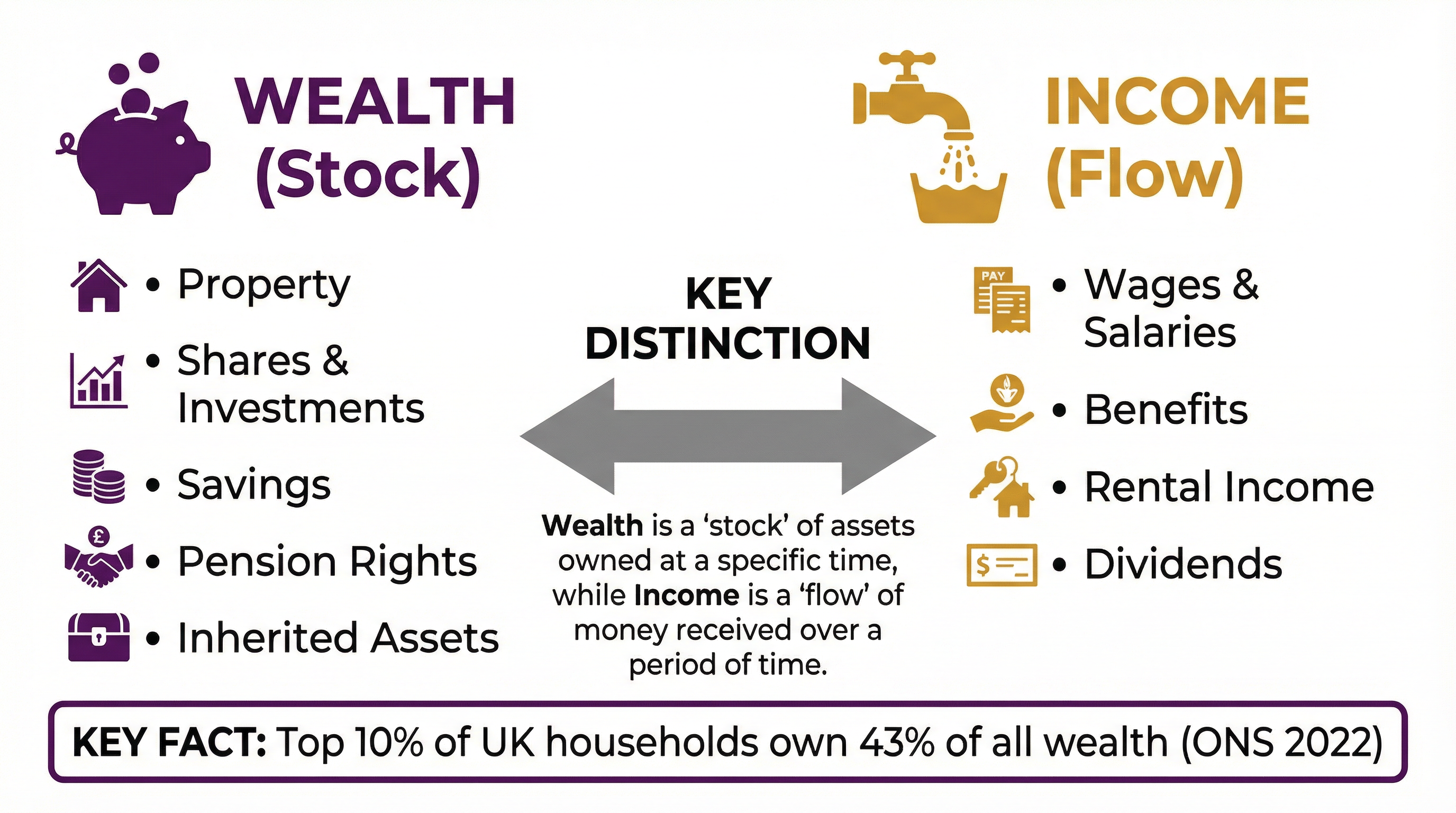
What it is: The single most important concept to master. Wealth is a stock of assets owned at a single point in time. It includes property, savings, shares, and pension rights. Income is a flow of money received over a period, such as wages or benefits. A high-income individual may have low wealth, and vice-versa. Examiners award significant credit for a clear and accurate application of this distinction.
Why it matters: Conflating the two is a common error that limits marks. Understanding this difference is the foundation for analysing inequality. For instance, the 'cost of living crisis' has a far greater impact on those with low wealth, regardless of their income, as they lack a financial buffer.
Specific Knowledge: Candidates should be able to define and give examples of both. For higher marks, distinguish between marketable assets (e.g., property, which can be sold) and non-marketable assets (e.g., occupational pension rights, which cannot be sold but provide security).
Theoretical Perspectives on Wealth Inequality
Functionalism:
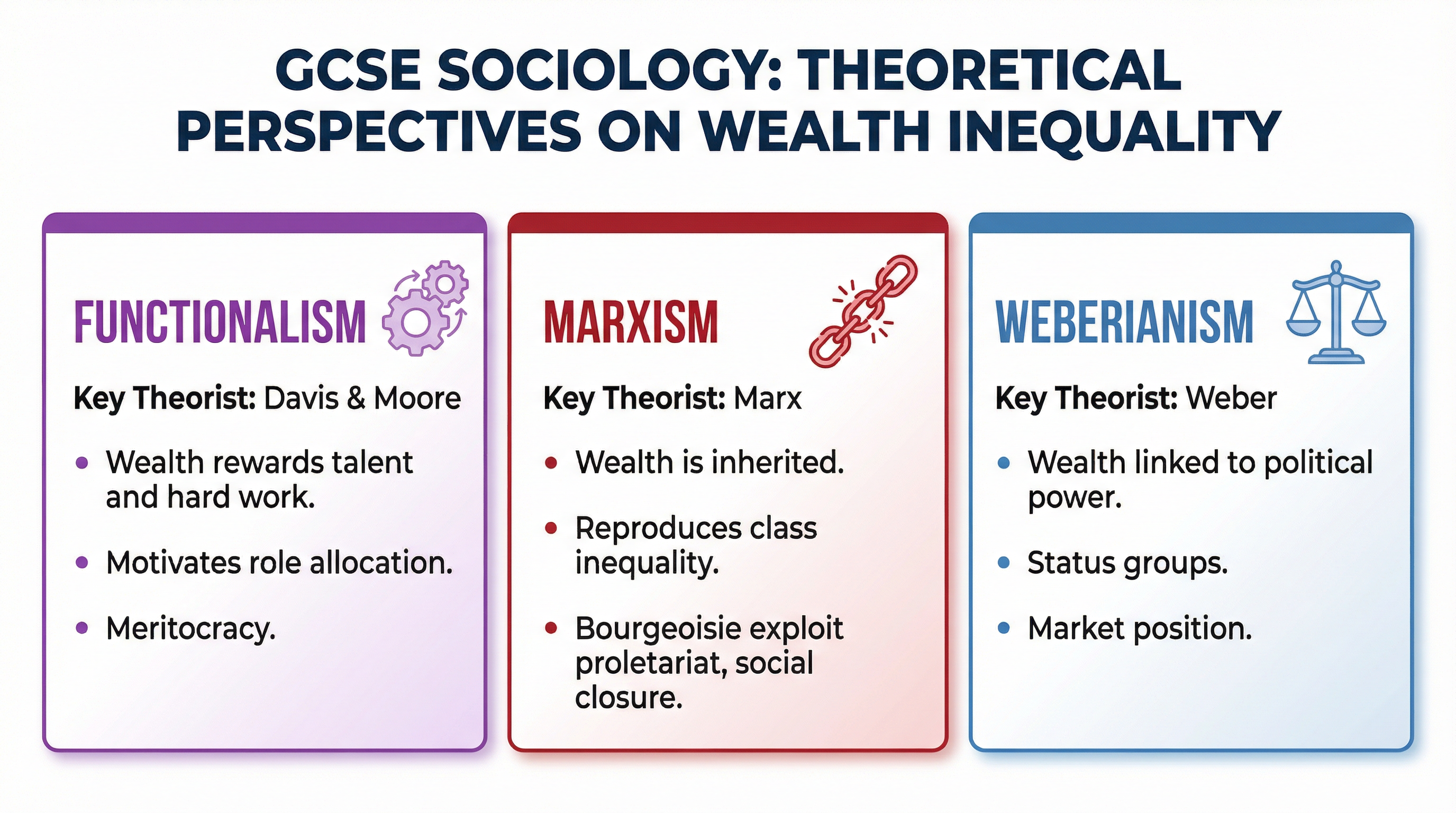
- Key Theorists: Davis and Moore
- Core Idea: Inequality is necessary and functional for society. High rewards (wealth) motivate the most talented individuals to take on the most important and difficult roles (e.g., surgeons, engineers). This system of 'role allocation' ensures society runs efficiently. They view society as a meritocracy, where wealth and status are earned through talent and effort.
- Critique: This view is heavily criticised for ignoring the role of inheritance. If wealth is passed down, it is not being 'earned' through merit in the current generation. It also fails to account for the vast inequalities that seem disproportionate to the 'functional importance' of certain roles (e.g., a CEO earning 300x their average employee).
Marxism:
- Key Theorist: Karl Marx
- Core Idea: Wealth inequality is the inevitable result of a capitalist system built on exploitation. The bourgeoisie (ruling class) own the means of production (factories, land, capital) and accumulate wealth by extracting surplus value from the proletariat (working class). Wealth is not earned; it is taken. The system is designed to reproduce class inequality through mechanisms like inheritance and social closure, where the wealthy restrict access to opportunities.
- Exam Relevance: This is the primary critical perspective. Use it to challenge Functionalist ideas of meritocracy. Link it to the concentration of wealth statistics from the ONS.
Weberianism:
- Key Theorist: Max Weber
- Core Idea: Weber agreed with Marx on the importance of economic class but added two other dimensions of inequality: Status (social prestige) and Party (political power). For Weber, wealth is not just about money; it is a source of political influence. The wealthy can use their resources to fund political parties, lobby governments, and control the media, shaping society in their interests. This creates a powerful elite that may not be directly based on owning the means of production.
- Application: Use this to analyse the link between wealth and political power. For example, how might a wealthy business owner influence government policy on taxation or environmental regulation?
Wealth and Life Chances
Definition: 'Life chances' (a Weberian concept) refers to the opportunities each individual has to improve their quality of life. Examiners expect candidates to explicitly link wealth to life chances in key areas:
- Health: Wealthier individuals have longer life expectancy and better health outcomes. They can afford private healthcare, better nutrition, and live in less polluted areas with better access to green space. The gap in life expectancy between the most and least deprived areas in the UK is nearly a decade.
- Education: Wealth provides access to elite private schools, private tuition, and extra-curricular activities that boost university applications. Research by The Sutton Trust consistently shows that privately educated pupils are vastly over-represented at top universities, which leads to higher-paying jobs and the accumulation of further wealth, creating a cycle of privilege.
- Housing: Wealth allows for home ownership, which is itself a key asset that grows in value. Those without wealth are often trapped in the private rental sector, facing high costs and housing insecurity, making it difficult to save and accumulate their own wealth.