Environmental impact

    This study guide for OCR GCSE Food Preparation and Nutrition unpacks the critical topic of the environmental impact of food. It focuses on the 'Farm to Fork' journey, equipping candidates with the precise terminology and analytical skills needed to evaluate the sustainability of food production, from food miles and carbon footprints to the trade-offs of packaging and farming methods.

    5
    Min Read
    3
    Examples
    3
    Questions
    6
    Key Terms
    πŸŽ™ Podcast Episode
    Environmental impact
    11:24
    0:00-11:24

    Study Notes

    Header image for Environmental Impact of Food.

    Overview

    This topic explores the environmental consequences of modern food production, a core component of the OCR J309 specification. Examiners expect candidates to move beyond simplistic statements and demonstrate a nuanced understanding of the entire food lifecycle. This involves analysing the 'Farm to Fork' journey, from agricultural practices and processing to transport, retail, and consumer waste. Key concepts include the critical distinction between food miles and carbon footprint, the environmental costs of intensive farming (such as eutrophication and methane emissions), the complex role of packaging, and the benefits of seasonality. Marks are awarded for using precise scientific language, evaluating trade-offs, and applying knowledge to unfamiliar scenarios. This guide will provide the detailed knowledge and exam technique required to achieve high marks.
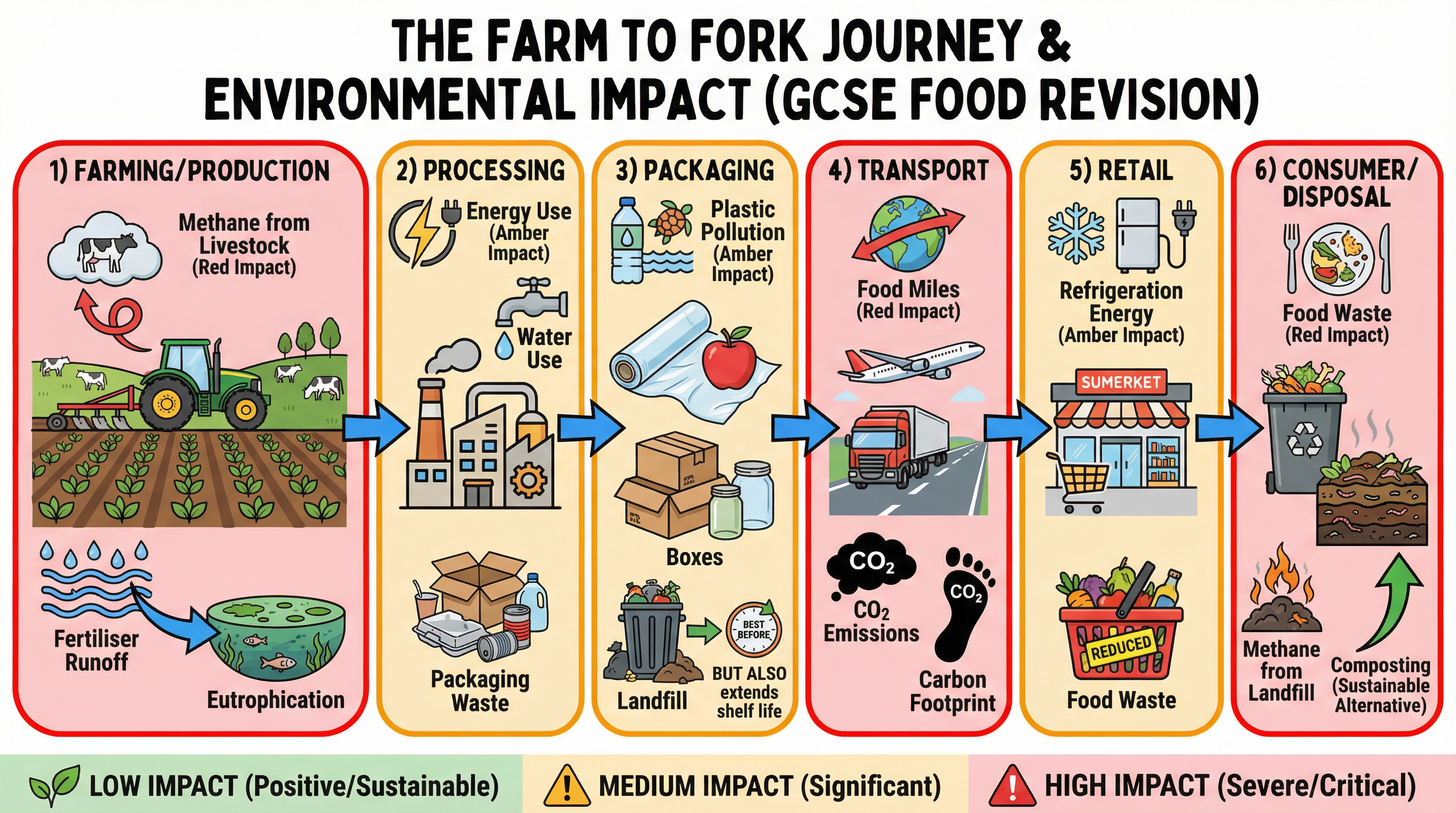
    The Farm to Fork Journey & Environmental Impact.

    Key Concepts & Issues

    Food Miles vs. Carbon Footprint

    What it is: A common point of confusion that must be understood. Food miles refer only to the distance food travels from producer to consumer. Carbon footprint, however, is a much broader measure of the total greenhouse gas emissions (e.g., carbon dioxide, methane) generated throughout a product's entire lifecycle.

    Why it matters: Examiners frequently test this distinction. A classic example is comparing a UK-grown tomato produced in a heated greenhouse during winter with a Spanish tomato grown in natural sunlight and transported by lorry. The UK tomato has zero food miles but its carbon footprint may be significantly higher due to the energy required for heating. Credit is given for explaining this trade-off.

    Specific Knowledge: Greenhouse gases (GHGs), lifecycle assessment, energy consumption.

    Intensive Farming

    What happened: The post-war drive for cheap, plentiful food led to intensive farming methods. This includes high-density livestock farming, heavy reliance on synthetic nitrogen fertilisers and pesticides, and the practice of growing single crops over vast areas (monoculture).

    Why it matters: This has severe environmental consequences that candidates must be able to explain.

    • Methane Emissions: Livestock, particularly cattle, release methane (a potent GHG) through digestion (enteric fermentation).
    • Eutrophication: Excess fertiliser runs off fields into rivers, causing algal blooms that deplete oxygen and kill aquatic life. Using the term 'eutrophication' is essential for top marks.
    • Biodiversity Loss: Monocultures and pesticides destroy habitats for wildlife, including essential pollinators like bees.

    Specific Knowledge: Methane (CH4), Nitrous Oxide (N2O) from fertilisers, eutrophication, biodiversity, monoculture.

    Packaging & Food Waste

    What it is: A complex issue of balancing preservation against pollution. Plastic packaging is a major contributor to landfill and marine pollution. However, it also plays a crucial role in extending the shelf life of food, thereby reducing food waste.

    Why it matters: This is a classic 'evaluate' topic. A high-level response will acknowledge both the negative environmental impact of plastic and its positive role in preventing food waste. Food waste itself is a major environmental issue, as decomposing food in landfill releases methane.

    Specific Knowledge: Use By vs. Best Before dates, WRAP (Waste and Resources Action Programme) statistics, methane from anaerobic decomposition, landfill.
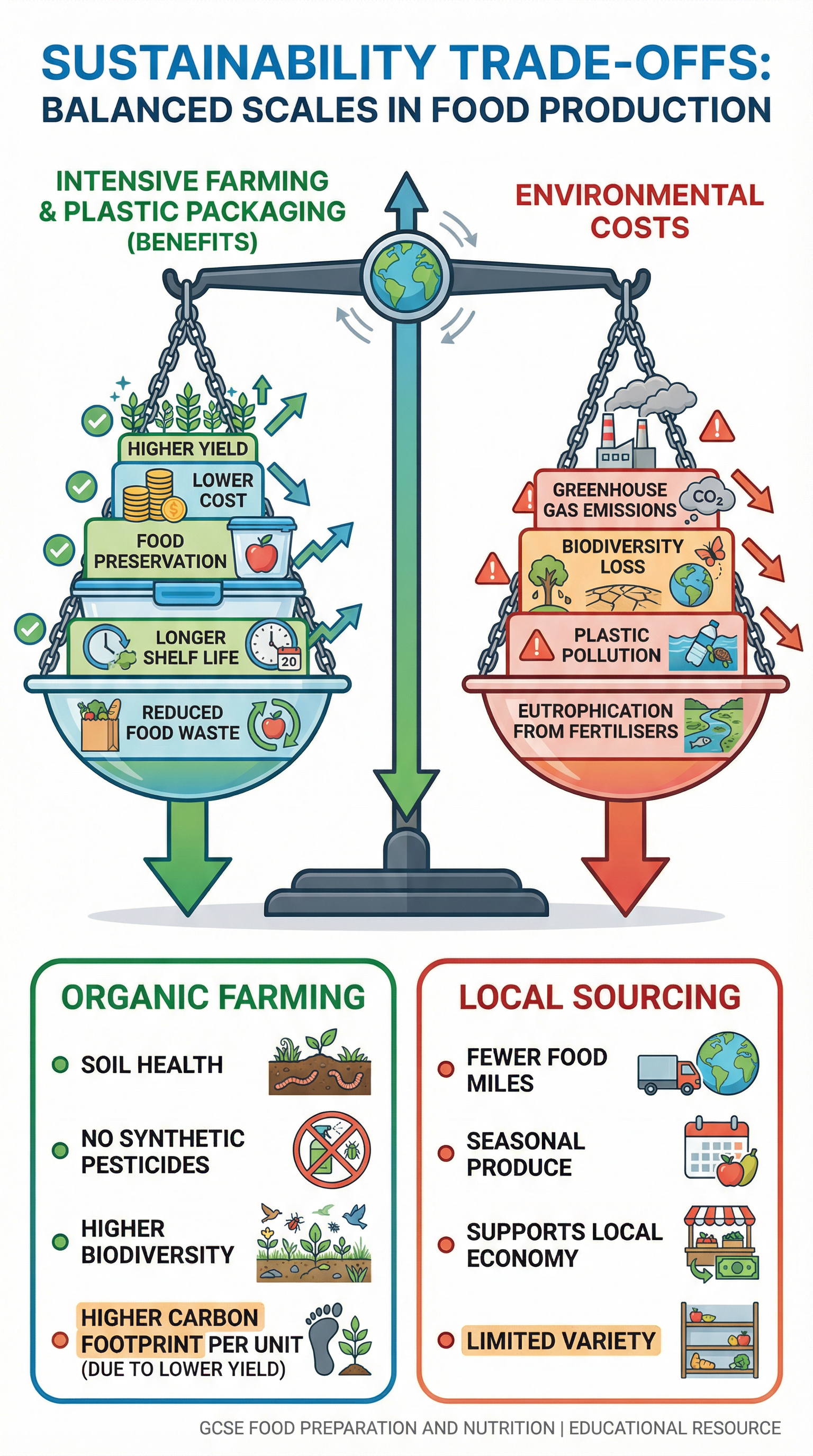
    Sustainability Trade-offs in Food Production.

    Seasonality

    What it is: Eating food that is naturally in season in your country. This reduces the need for energy-intensive heated greenhouses or long-distance transport (air freight being the worst offender for emissions).

    Why it matters: Demonstrates an understanding of sustainable food choices. Candidates should be able to name specific UK seasonal produce to support their answers.

    Specific Knowledge: UK seasonal calendar (e.g., strawberries in June, asparagus in April, apples in September), air freight vs. sea freight emissions.

    Podcast Episode

    Listen to our 10-minute audio guide covering all the key concepts, exam tips, and a quick-fire quiz to test your knowledge.

    Podcast: OCR GCSE Food - Environmental Impact Deep Dive.

    Visual Resources

    2 diagrams and illustrations

    The Farm to Fork Journey & Environmental Impact.
    The Farm to Fork Journey & Environmental Impact.
    Sustainability Trade-offs in Food Production.
    Sustainability Trade-offs in Food Production.

    Interactive Diagrams

    2 interactive diagrams to visualise key concepts

    Fertiliser RunoffFarmingRivers & LakesEutrophicationAlgal BloomOxygen DepletionDeath of Aquatic Life

    The process of Eutrophication caused by fertiliser runoff from farms.

    Diagram could not be rendered

    A simplified Gantt chart showing the peak seasons for some common UK produce.

    Worked Examples

    3 detailed examples with solutions and examiner commentary

    Practice Questions

    Test your understanding β€” click to reveal model answers

    Q1

    Describe two ways in which food waste has a negative environmental impact. (4 marks)

    4 marks
    standard

    Hint: Think about where food waste ends up and what happens to it. Think also about the resources used to produce it in the first place.

    Q2

    Explain why eating seasonal food can help to reduce the environmental impact of our diet. (6 marks)

    6 marks
    standard

    Hint: Think about energy and transport. What do we have to do to provide consumers with non-seasonal food?

    Q3

    Discuss the statement: 'Organic farming is always better for the environment than intensive farming.' (8 marks)

    8 marks
    hard

    Hint: This is a 'discuss' question, so you need to look at both sides. What are the pros of organic? Are there any cons?

    Key Terms

    Essential vocabulary to know

    More Food Preparation and Nutrition Study Guides

    View all

    Food additives

    OCR
    GCSE

    This guide delves into the science of food additives, a critical component of the OCR GCSE Food Preparation and Nutrition exam. It explores how substances like preservatives and emulsifiers work, why they are essential for modern food production, and how to critically evaluate their use, ensuring you can secure maximum marks.

    Safe food handling practices

    OCR
    GCSE

    Mastering safe food handling is non-negotiable for a high grade in OCR GCSE Food Preparation and Nutrition. This guide moves beyond basic hygiene, delving into the microbiological principles and precise temperature controls that examiners reward. Understanding this science is the key to unlocking top-level marks and ensuring food is safe.

    Dietary Reference Values (DRVs)

    OCR
    GCSE

    Master Dietary Reference Values (DRVs) for your OCR GCSE Food Preparation and Nutrition exam. This guide breaks down the science of nutritional requirements, showing you how to apply DRV knowledge to different life stages and analyse diets like a pro to secure top marks.

    Pastry making

    OCR
    GCSE

    Pastry making is a cornerstone of the OCR GCSE Food Preparation and Nutrition specification, testing candidates' scientific understanding of ingredient functionality, chemical processes, and practical technique. Examiners award marks for precise knowledge of fat-to-flour ratios, accurate explanation of shortening and plasticity, and the ability to link functional properties to sensory outcomes. Mastering this topic demonstrates your grasp of food science principles that underpin professional culinary practice.

    Ethical considerations and Fair Trade

    OCR
    GCSE

    This study guide delves into the critical topic of ethical considerations and Fair Trade in food production, a key area of the OCR GCSE Food Preparation and Nutrition specification. It provides a detailed examination of how consumer choices impact global food supply chains, animal welfare, and the livelihoods of producers in Low Income Countries (LICs), equipping students with the analytical skills needed to excel in their exams."

    Diet-related health issues

    OCR
    GCSE

    This study guide provides a comprehensive, exam-focused overview of diet-related health issues for OCR GCSE Food Preparation and Nutrition. It decodes the science behind conditions like CHD and Type 2 Diabetes, equipping students with the precise knowledge and terminology required to achieve top marks.