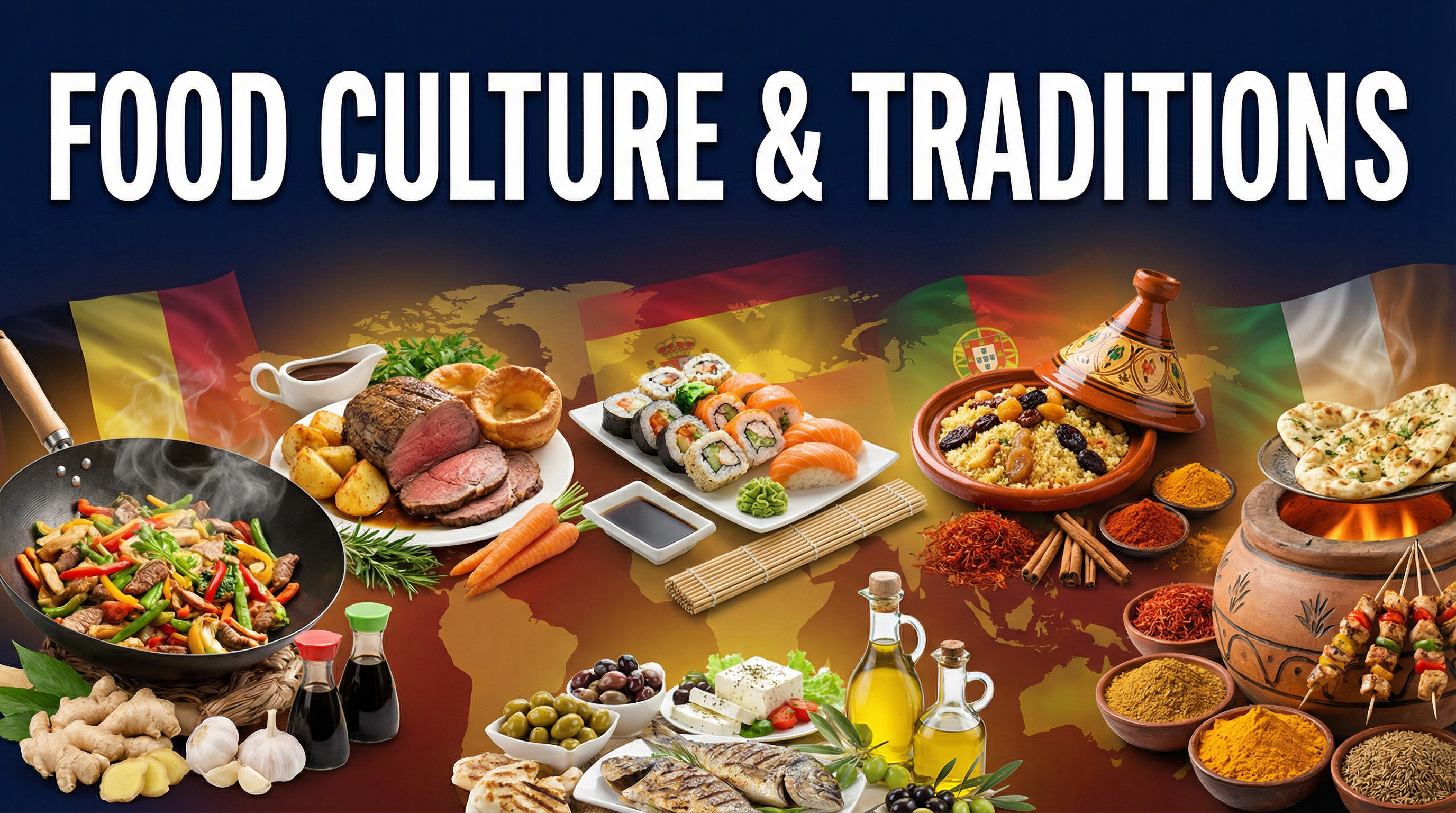
Food culture and traditions.

    Explore the vibrant tapestry of global food culture, from the science of cooking to the traditions that shape what we eat. This guide is your key to unlocking top marks in the OCR GCSE Food Preparation and Nutrition exam by understanding the 'why' behind the world's cuisines.

    5
    Min Read
    3
    Examples
    5
    Questions
    6
    Key Terms
    🎙 Podcast Episode
    Food culture and traditions.
    14:49
    0:00-14:49

    Study Notes

    A collage of international foods and ingredients.

    Overview

    This study delves into the rich and diverse world of food culture and traditions, a core component of the OCR J309 specification. It moves beyond simple descriptions of dishes to explore the deep-rooted connections between food, geography, religion, and history. Examiners expect candidates to analyse how these factors have shaped cuisines and eating patterns across the globe. You will be required to demonstrate precise knowledge of ingredients, cooking methods, and the scientific principles of heat transfer. High-level responses will evaluate the nutritional implications of different dietary traditions and provide specific, named examples to support their points. This is a topic that rewards analytical thinking and a genuine curiosity about the world's foodways, bridging practical food skills with cultural understanding.

    Podcast: OCR GCSE Food Culture & Traditions

    Global Cuisines: Key Influences

    Geographical Factors

    What it is: The climate, soil, and physical landscape of a region fundamentally determine which crops can be grown and which animals can be reared. This forms the basis of a region's staple foods.

    Why it matters: For the exam, you must be able to link specific geographical features to staple foods and cuisines. For example, the temperate climate and fertile soils of the UK are ideal for growing wheat, leading to a diet rich in bread and baked goods. In contrast, the hot, humid climate and river deltas of Southeast Asia are perfect for cultivating rice.

    Specific Knowledge:

    • UK: Wheat, potatoes, barley. Staple dishes: Sunday roast, fish and chips.
    • Mediterranean: Olives, grapes, citrus fruits, fish. Key ingredient: Olive oil. Staple dishes: Paella (Spain), Ratatouille (France).
    • China: Rice (south), wheat/noodles (north). Staple dishes: Stir-fries, dim sum.
    • India: Rice, lentils, wheat (north). Key ingredients: Spices like turmeric, cumin, coriander.
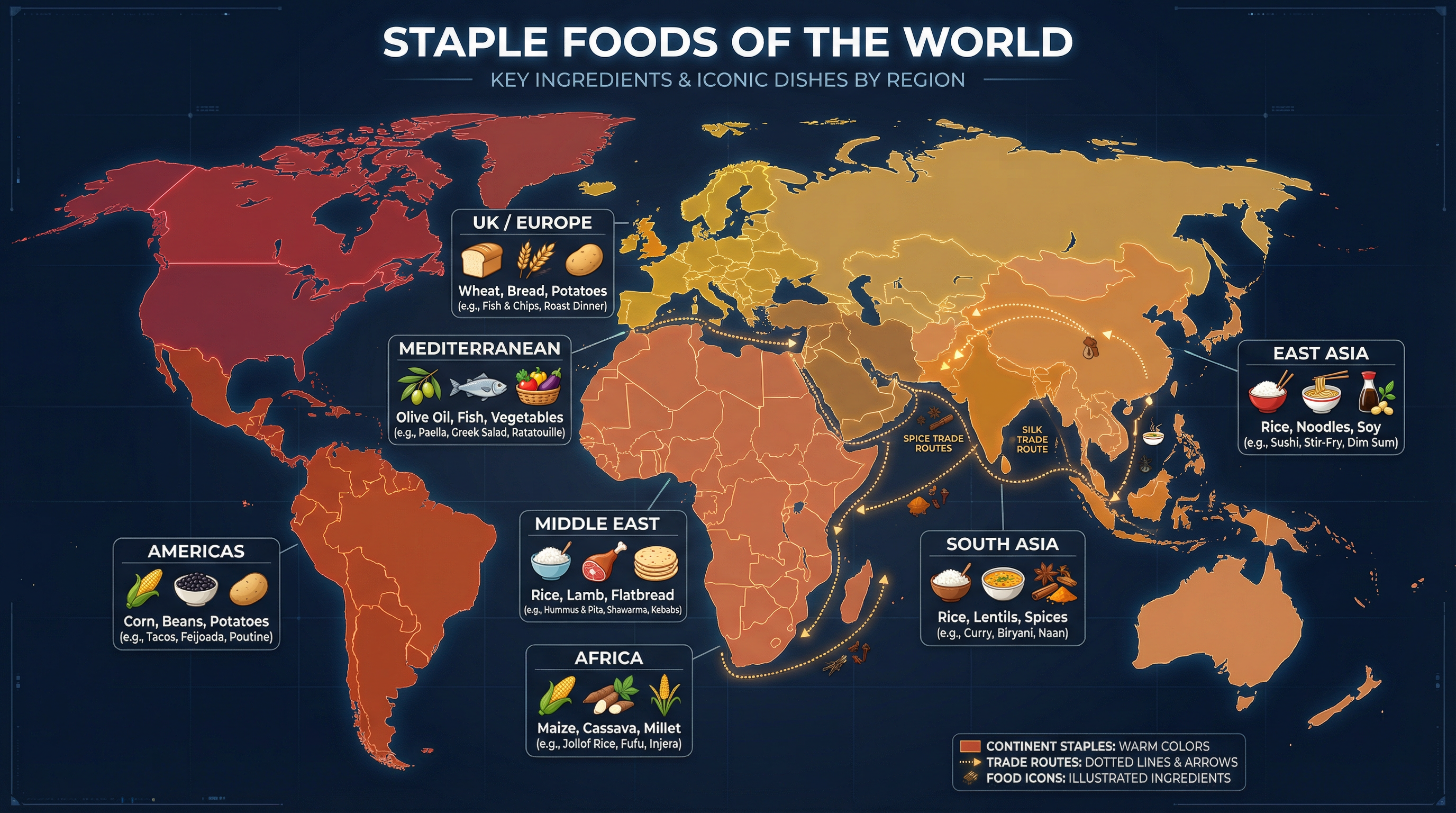
    Staple Foods of the World

    Religious & Cultural Factors

    What it is: Religion and cultural beliefs create rules and traditions around food, including dietary laws, fasting, and celebratory meals. These are distinct from food intolerances, which are physiological.

    Why it matters: Candidates must demonstrate precise knowledge of religious dietary laws, including what is permitted and what is forbidden. Marks are awarded for using correct terminology (Halal, Kosher) and explaining the reasons behind the rules.

    Specific Knowledge:

    • Islam (Halal): Forbids pork, alcohol, and blood. Meat must be slaughtered in a specific way (Halal).
    • Judaism (Kosher): Forbids pork and shellfish. Prohibits mixing meat and dairy.
    • Hinduism: Most are vegetarian. Beef is strictly forbidden as the cow is sacred.
    • Buddhism: Encourages vegetarianism based on the principle of non-violence.
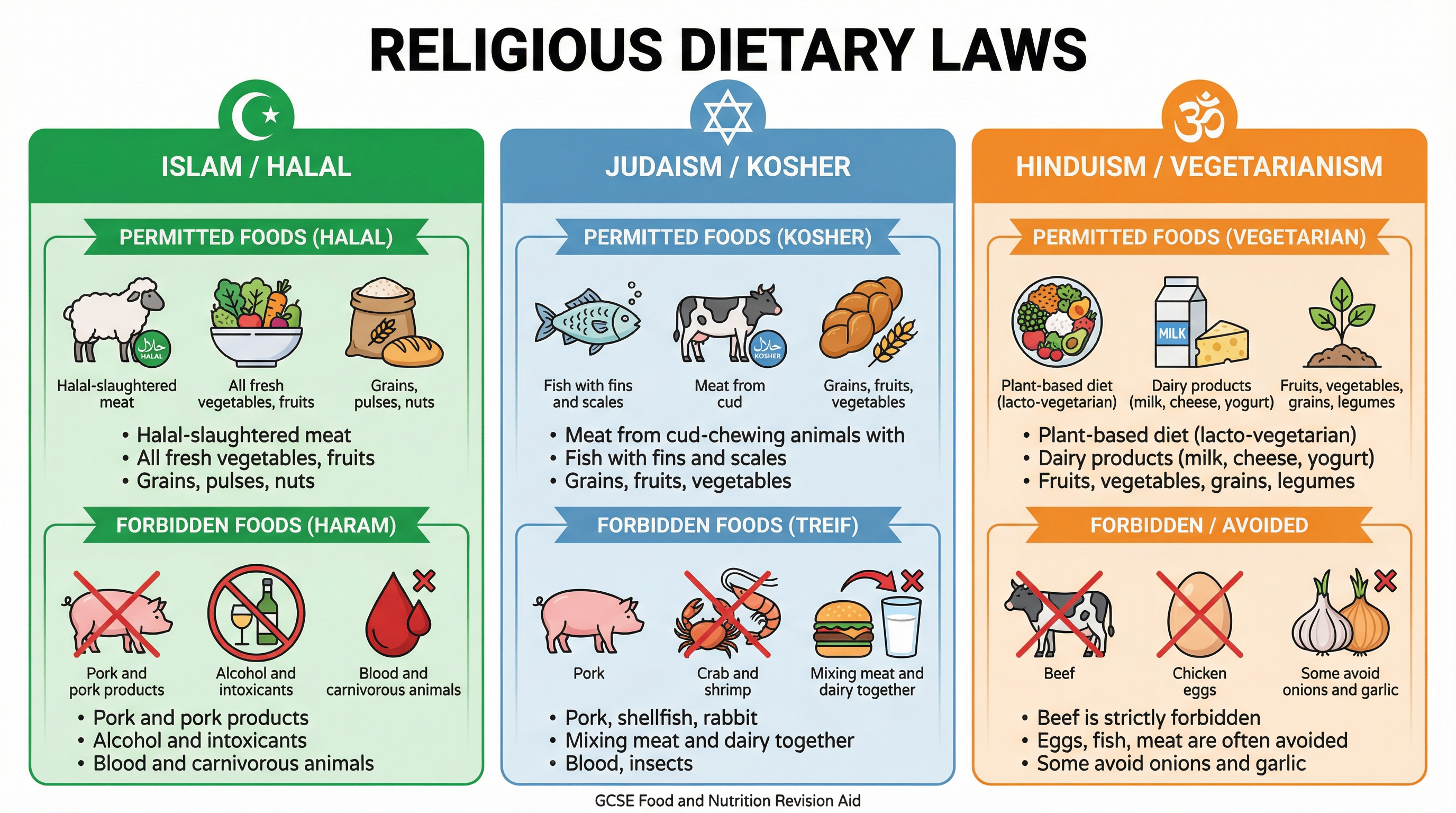
    Comparison of Religious Dietary Laws

    Traditional Cooking Methods & Heat Transfer

    What it is: Different cultures have developed unique cooking methods and equipment based on available resources and culinary needs. Understanding the science of heat transfer is crucial.

    Why it matters: Examiners expect you to explain the mechanism of heat transfer for different cooking methods. This demonstrates AO1 (knowledge) and AO2 (application of science).

    Specific Knowledge:

    • Wok (Stir-frying): Conduction. Heat is transferred directly from the hot metal of the wok to the food.
    • Tandoor Oven (Baking/Roasting): Convection. Hot air circulates within the clay oven, cooking the food.
    • Tagine (Braising/Stewing): Convection via steam. The conical lid traps steam, which circulates and cooks the food slowly.
    • Grilling/Barbecue: Radiation. Heat radiates from the hot coals to the food.
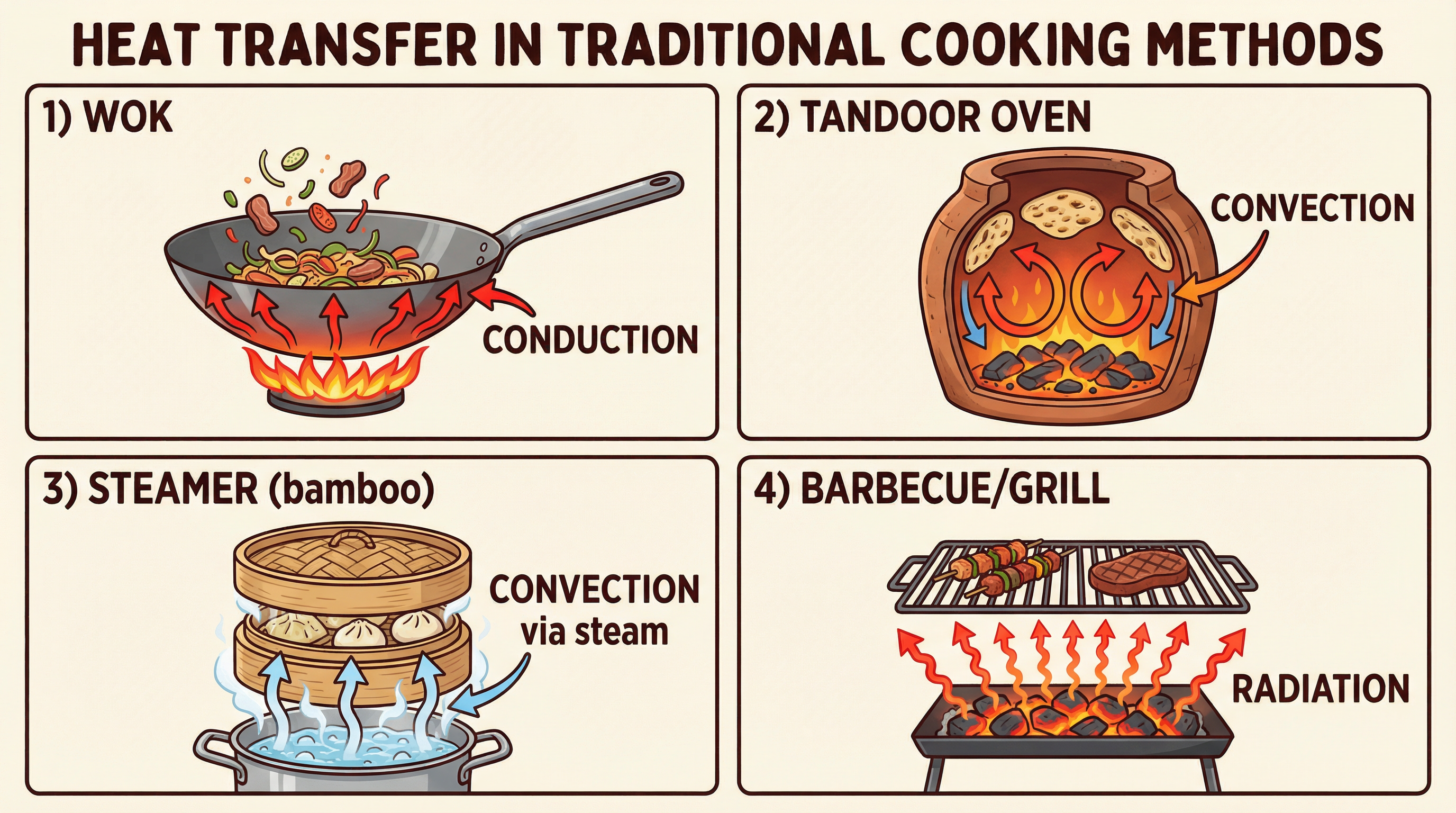
    Heat Transfer in Traditional Cooking

    Second-Order Concepts

    Causation

    Food culture is caused by a combination of factors. The staple foods of a region are a direct result of its climate and geography. Religious beliefs cause specific dietary laws to be followed. Historical events like trade and migration cause the introduction of new ingredients and culinary techniques, leading to fusion cuisines.

    Consequence

    Dietary traditions have significant nutritional consequences. The Mediterranean diet, rich in monounsaturated fats from olive oil and omega-3 from fish, is linked to lower rates of heart disease. Conversely, diets high in processed foods and saturated fats can lead to increased rates of obesity and type 2 diabetes.

    Change & Continuity

    Food cultures are not static. Change occurs through globalization, migration, and technological advancements (e.g., refrigeration, air freight). Continuity is seen in the preservation of traditional recipes, religious dietary laws, and celebratory meals passed down through generations.

    Significance

    Food is historically significant because it is central to identity, community, and health. It reflects the history of trade, migration, and agricultural development. Understanding food culture provides insight into the social and economic structures of different societies.

    Visual Resources

    3 diagrams and illustrations

    Staple Foods of the World
    Staple Foods of the World
    Comparison of Religious Dietary Laws
    Comparison of Religious Dietary Laws
    Heat Transfer in Traditional Cooking
    Heat Transfer in Traditional Cooking

    Interactive Diagrams

    1 interactive diagram to visualise key concepts

    Food CultureGeographical FactorsReligious & Cultural FactorsHistorical & Trade FactorsClimate & SoilStaple Foods e.g., Wheat, RiceDietary Laws e.g., Halal, KosherFood Choices & ProhibitionsMigration & Trade RoutesIntroduction of New Ingredients e.g., Spices, Tomatoes

    Key factors influencing food culture.

    Worked Examples

    3 detailed examples with solutions and examiner commentary

    Practice Questions

    Test your understanding — click to reveal model answers

    Q1

    Explain two reasons why the cuisine of the Mediterranean is considered healthy. (4 marks)

    4 marks
    standard

    Hint: Think about the types of fats and food groups that are prominent in the diet.

    Q2

    Compare the use of a wok with a tagine, referring to the method of cooking and heat transfer. (6 marks)

    6 marks
    hard

    Hint: For each piece of equipment, describe it, state the main heat transfer method, and the type of cooking it is used for.

    Q3

    Evaluate the impact of migration on British food culture. (8 marks)

    8 marks
    hard

    Hint: Consider both positive impacts (diversity, new dishes) and potential challenges. Use specific examples of cuisines.

    Q4

    State two staple foods grown in China. (2 marks)

    2 marks
    easy

    Hint: Think about the different climates in the north and south of the country.

    Q5

    Explain the difference between a food intolerance and a religious dietary law. (4 marks)

    4 marks
    standard

    Hint: One is a physiological reaction, the other is a choice based on faith.

    Key Terms

    Essential vocabulary to know

    More Food Preparation and Nutrition Study Guides

    View all

    Food additives

    OCR
    GCSE

    This guide delves into the science of food additives, a critical component of the OCR GCSE Food Preparation and Nutrition exam. It explores how substances like preservatives and emulsifiers work, why they are essential for modern food production, and how to critically evaluate their use, ensuring you can secure maximum marks.

    Safe food handling practices

    OCR
    GCSE

    Mastering safe food handling is non-negotiable for a high grade in OCR GCSE Food Preparation and Nutrition. This guide moves beyond basic hygiene, delving into the microbiological principles and precise temperature controls that examiners reward. Understanding this science is the key to unlocking top-level marks and ensuring food is safe.

    Dietary Reference Values (DRVs)

    OCR
    GCSE

    Master Dietary Reference Values (DRVs) for your OCR GCSE Food Preparation and Nutrition exam. This guide breaks down the science of nutritional requirements, showing you how to apply DRV knowledge to different life stages and analyse diets like a pro to secure top marks.

    Pastry making

    OCR
    GCSE

    Pastry making is a cornerstone of the OCR GCSE Food Preparation and Nutrition specification, testing candidates' scientific understanding of ingredient functionality, chemical processes, and practical technique. Examiners award marks for precise knowledge of fat-to-flour ratios, accurate explanation of shortening and plasticity, and the ability to link functional properties to sensory outcomes. Mastering this topic demonstrates your grasp of food science principles that underpin professional culinary practice.

    Ethical considerations and Fair Trade

    OCR
    GCSE

    This study guide delves into the critical topic of ethical considerations and Fair Trade in food production, a key area of the OCR GCSE Food Preparation and Nutrition specification. It provides a detailed examination of how consumer choices impact global food supply chains, animal welfare, and the livelihoods of producers in Low Income Countries (LICs), equipping students with the analytical skills needed to excel in their exams."

    Diet-related health issues

    OCR
    GCSE

    This study guide provides a comprehensive, exam-focused overview of diet-related health issues for OCR GCSE Food Preparation and Nutrition. It decodes the science behind conditions like CHD and Type 2 Diabetes, equipping students with the precise knowledge and terminology required to achieve top marks.