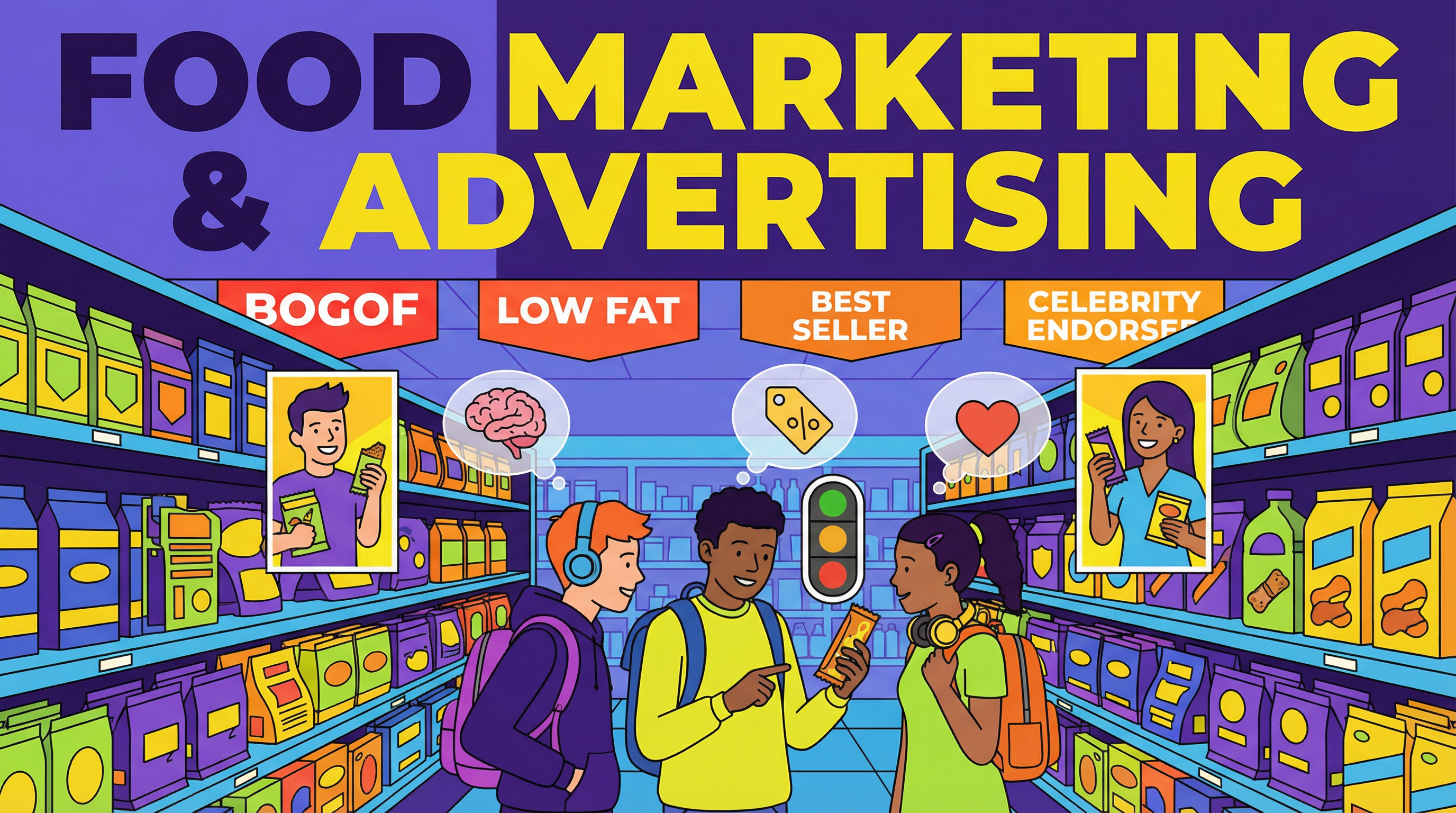
Food marketing and advertising.

    This study guide delves into the persuasive world of food marketing and advertising, a critical topic for OCR GCSE Food Preparation and Nutrition. It unpacks the psychological tactics manufacturers use to influence what we buy and provides the specific knowledge needed to analyse and evaluate their strategies for top marks.

    5
    Min Read
    3
    Examples
    5
    Questions
    6
    Key Terms
    πŸŽ™ Podcast Episode
    Food marketing and advertising.
    0:00-0:00

    Study Notes

    The psychology of food shopping: how marketing influences our choices.

    Overview

    Food marketing and advertising are powerful forces shaping our dietary choices, health, and culture. For OCR candidates, this topic is not just about recognising adverts; it’s about conducting a forensic analysis of the commercial and psychological factors that drive the food industry. Examiners expect you to dissect marketing techniques, from overt TV campaigns to subtle in-store promotions, and evaluate their impact on different demographics. A high-level response requires a firm grasp of UK labelling laws, the ability to distinguish between statutory requirements and voluntary claims, and the confidence to debate the ethical implications of marketing foods high in fat, salt, and sugar (HFSS). This guide will equip you with the precise terminology, analytical frameworks, and specific knowledge required to deconstruct any marketing strategy an examiner throws at you.

    Listen to our expert tutor break down Food Marketing for your GCSE.

    Key Marketing & Advertising Techniques

    The Marketing Mix: The 4 Ps

    Manufacturers use a framework known as the 'Marketing Mix' or the '4 Ps' to bring a product to market. Understanding this provides a strong structure for analysis.

    • Product: This refers not just to the food itself, but the branding, packaging, and overall experience. Is it positioned as a luxury item, a budget basic, or a healthy alternative?
    • Price: The pricing strategy is crucial. Techniques include competitive pricing (matching rivals), promotional pricing (BOGOF, discounts), and premium pricing (for luxury goods).
    • Place: This is where the product is sold. Supermarkets, corner shops, online retailers, and vending machines all offer different opportunities to reach consumers.
    • Promotion: This covers all forms of advertising and communication, from TV adverts and social media campaigns to loyalty schemes and product placement.
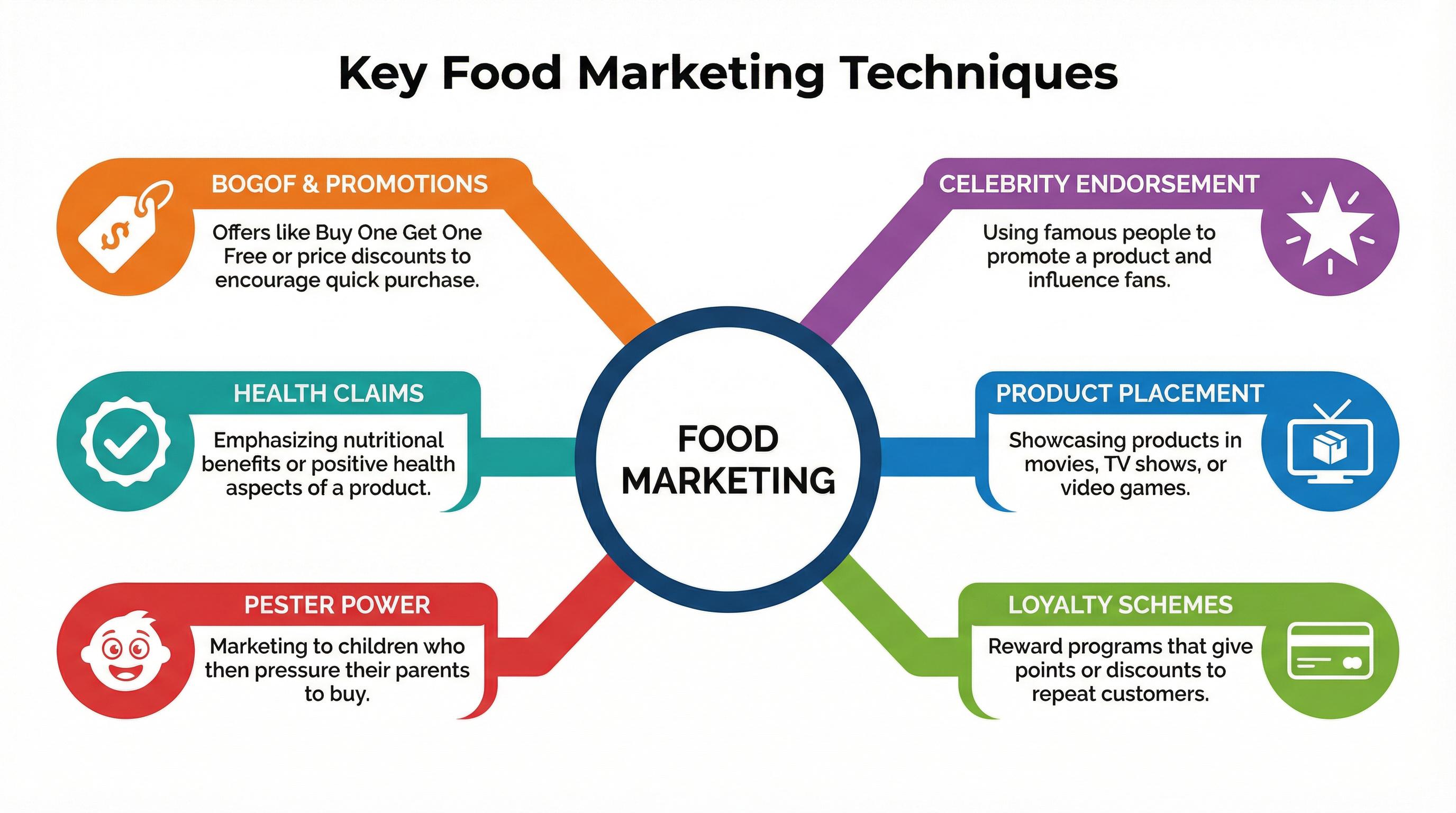
    Key Food Marketing Techniques at a glance.

    Specific Promotional Techniques

    Examiners will award marks for identifying and explaining the following specific techniques:

    • Buy One Get One Free (BOGOF): A price promotion that creates a sense of urgency and 'perceived value'. It encourages bulk buying and can persuade a consumer to choose one brand over another.
    • Celebrity Endorsement: Using a famous person to promote a product. This works through aspiration; consumers associate the product with the celebrity's success, lifestyle, or perceived health, a powerful tool for influencing younger demographics.
    • Product Placement: Subtly featuring products in films, TV shows, or video games. This is effective because it bypasses the audience's critical filter for advertising.
    • Loyalty Schemes: Rewarding repeat custom with points or discounts (e.g., Tesco Clubcard). This builds 'brand loyalty' and provides retailers with valuable data on consumer habits for targeted marketing.
    • Pester Power: Marketing directly to children using cartoons, bright colours, and free gifts, knowing they will pressure their parents to make a purchase. This is ethically contentious, especially when used for HFSS foods.
    • Health & Nutrition Claims: Using phrases like 'Low Fat', 'High Fibre', or 'Source of Vitamin D' on packaging. While these claims are regulated, they can sometimes be misleading. For example, a 'low fat' product may be very high in sugar.

    Food Labelling: Law vs. Marketing

    It is vital to distinguish between the information that is legally required on packaging and the information that is added for marketing purposes.

    Statutory (Legal) Requirements

    By law, all pre-packaged food in the UK must display:

    1. Product Name: What the food is.
    2. Ingredients List: In descending order of weight.
    3. Allergen Information: Highlighted in the ingredients (e.g., in bold).
    4. Net Quantity: The weight or volume.
    5. 'Use By' or 'Best Before' Date: 'Use By' is for safety; 'Best Before' is for quality.
    6. Storage Instructions.
    7. Name and Address of the manufacturer or seller.
    8. Nutritional Declaration: Typically per 100g/ml, showing Energy (kJ/kcal), Fat, Saturates, Carbohydrate, Sugars, Protein, and Salt.

    Voluntary (Marketing) Information

    Manufacturers often add extra information to persuade consumers:

    • Traffic Light Labelling: The red, amber, and green system shows at a glance if a product is high, medium, or low in fat, saturates, sugars, and salt. While voluntary, it is widely used and a key tool for analysis.
    • Reference Intakes (RIs): These show how much of an adult's daily recommended intake for a nutrient is provided by a portion of the food.
    • Marketing Claims: Such as 'No added sugar', 'Gluten-free', or 'One of your 5-a-day'. These are regulated but are designed to give a product a 'health halo'.
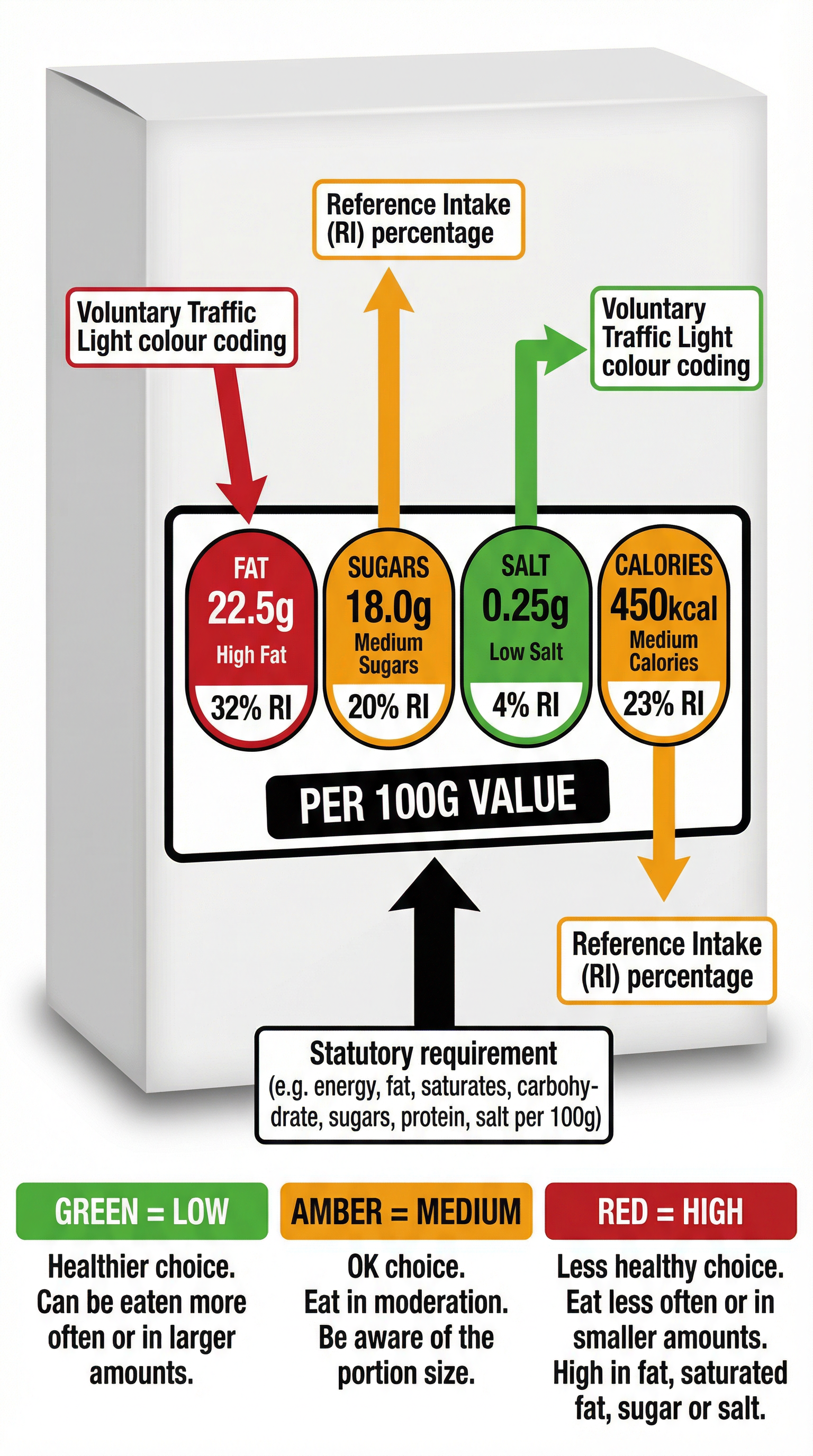
    How to read and interpret a Traffic Light food label.

    Visual Resources

    2 diagrams and illustrations

    Key Food Marketing Techniques at a glance.
    Key Food Marketing Techniques at a glance.
    How to read and interpret a Traffic Light food label.
    How to read and interpret a Traffic Light food label.

    Interactive Diagrams

    1 interactive diagram to visualise key concepts

    Marketing MixFood ProductThe 4 PsProductPricePlacePromotionCelebrity EndorsementBOGOFPester PowerLoyalty Schemes

    A diagram showing the relationship between the Marketing Mix and specific promotional techniques.

    Worked Examples

    3 detailed examples with solutions and examiner commentary

    Practice Questions

    Test your understanding β€” click to reveal model answers

    Q1

    Describe two ways packaging can be used to market a food product. (4 marks)

    4 marks
    easy

    Hint: Think about colours, images, and words used on the front of a pack.

    Q2

    Explain the difference between 'low fat' and 'reduced fat'. (4 marks)

    4 marks
    standard

    Hint: One is an absolute measure, the other is a relative comparison.

    Q3

    Analyse the nutritional information on the label for a chicken and mushroom pie. [Image of a label is shown with several red traffic lights]. (6 marks)

    6 marks
    standard

    Hint: Use the traffic light colours and the %RI values to make judgements about the pie's place in a balanced diet.

    Q4

    To what extent is the marketing of food and drink products the main cause of obesity in the UK? (12 marks)

    12 marks
    hard

    Hint: This is a 'how far do you agree' question. You need to argue for and against the statement and reach a judgement. Consider other factors that cause obesity.

    Q5

    A food company wants to launch a new yoghurt aimed at health-conscious adults. Recommend and justify two marketing strategies they could use. (6 marks)

    6 marks
    standard

    Hint: Choose strategies that would appeal to this specific target demographic.

    Key Terms

    Essential vocabulary to know

    More Food Preparation and Nutrition Study Guides

    View all

    Food additives

    OCR
    GCSE

    This guide delves into the science of food additives, a critical component of the OCR GCSE Food Preparation and Nutrition exam. It explores how substances like preservatives and emulsifiers work, why they are essential for modern food production, and how to critically evaluate their use, ensuring you can secure maximum marks.

    Safe food handling practices

    OCR
    GCSE

    Mastering safe food handling is non-negotiable for a high grade in OCR GCSE Food Preparation and Nutrition. This guide moves beyond basic hygiene, delving into the microbiological principles and precise temperature controls that examiners reward. Understanding this science is the key to unlocking top-level marks and ensuring food is safe.

    Dietary Reference Values (DRVs)

    OCR
    GCSE

    Master Dietary Reference Values (DRVs) for your OCR GCSE Food Preparation and Nutrition exam. This guide breaks down the science of nutritional requirements, showing you how to apply DRV knowledge to different life stages and analyse diets like a pro to secure top marks.

    Pastry making

    OCR
    GCSE

    Pastry making is a cornerstone of the OCR GCSE Food Preparation and Nutrition specification, testing candidates' scientific understanding of ingredient functionality, chemical processes, and practical technique. Examiners award marks for precise knowledge of fat-to-flour ratios, accurate explanation of shortening and plasticity, and the ability to link functional properties to sensory outcomes. Mastering this topic demonstrates your grasp of food science principles that underpin professional culinary practice.

    Ethical considerations and Fair Trade

    OCR
    GCSE

    This study guide delves into the critical topic of ethical considerations and Fair Trade in food production, a key area of the OCR GCSE Food Preparation and Nutrition specification. It provides a detailed examination of how consumer choices impact global food supply chains, animal welfare, and the livelihoods of producers in Low Income Countries (LICs), equipping students with the analytical skills needed to excel in their exams."

    Diet-related health issues

    OCR
    GCSE

    This study guide provides a comprehensive, exam-focused overview of diet-related health issues for OCR GCSE Food Preparation and Nutrition. It decodes the science behind conditions like CHD and Type 2 Diabetes, equipping students with the precise knowledge and terminology required to achieve top marks.