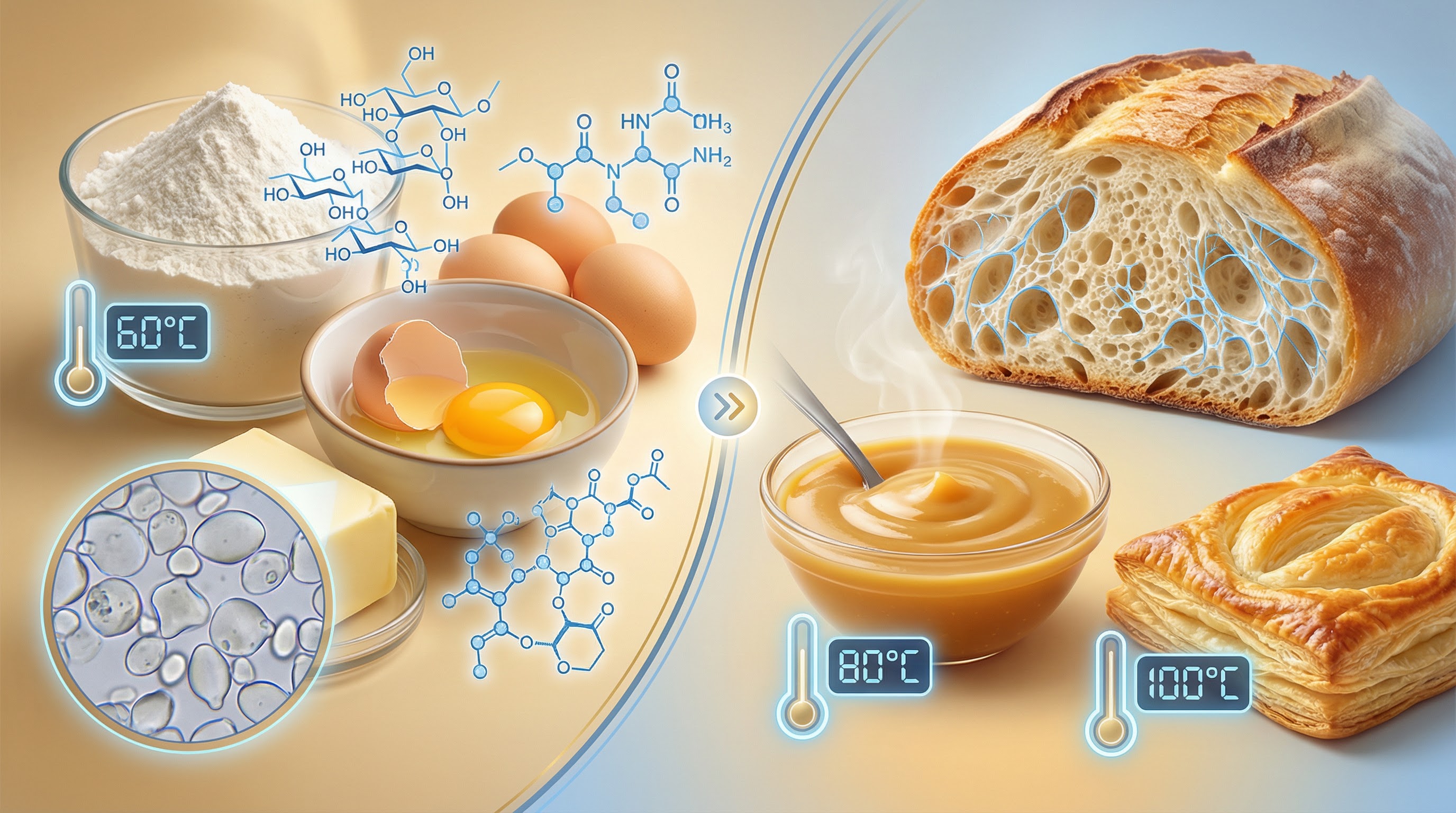
Functional and chemical properties of ingredients

    Unlock top marks in your OCR GCSE Food Preparation and Nutrition exam by mastering the science behind cooking. This guide demystifies the functional and chemical properties of ingredients, showing you how everyday cooking processes are rooted in fascinating chemical reactions that examiners love to test."

    5
    Min Read
    3
    Examples
    3
    Questions
    0
    Key Terms
    🎙 Podcast Episode
    Functional and chemical properties of ingredients
    0:00-0:00

    Study Notes

    header_image.png

    Overview

    This study guide focuses on the core scientific principles that underpin all food preparation, a cornerstone of the OCR GCSE specification. Understanding the functional and chemical properties of ingredients is not just about knowing what happens, but why it happens. Examiners expect candidates to articulate these changes with scientific precision, moving beyond simple descriptions to detailed explanations. This guide will equip you with the language and concepts to explain how carbohydrates like starch behave (gelatinisation, dextrinisation) and how proteins in flour and eggs transform (gluten formation, coagulation). Mastering this topic is crucial for achieving high grades, as it demonstrates the deeper, analytical understanding required for top-level responses. We will break down these complex processes into clear, memorable steps, complete with the critical temperatures and terminology that will earn you credit.

    functional_chemical_properties_podcast.wav

    Key Chemical Processes

    Carbohydrates: Starch & Sugar

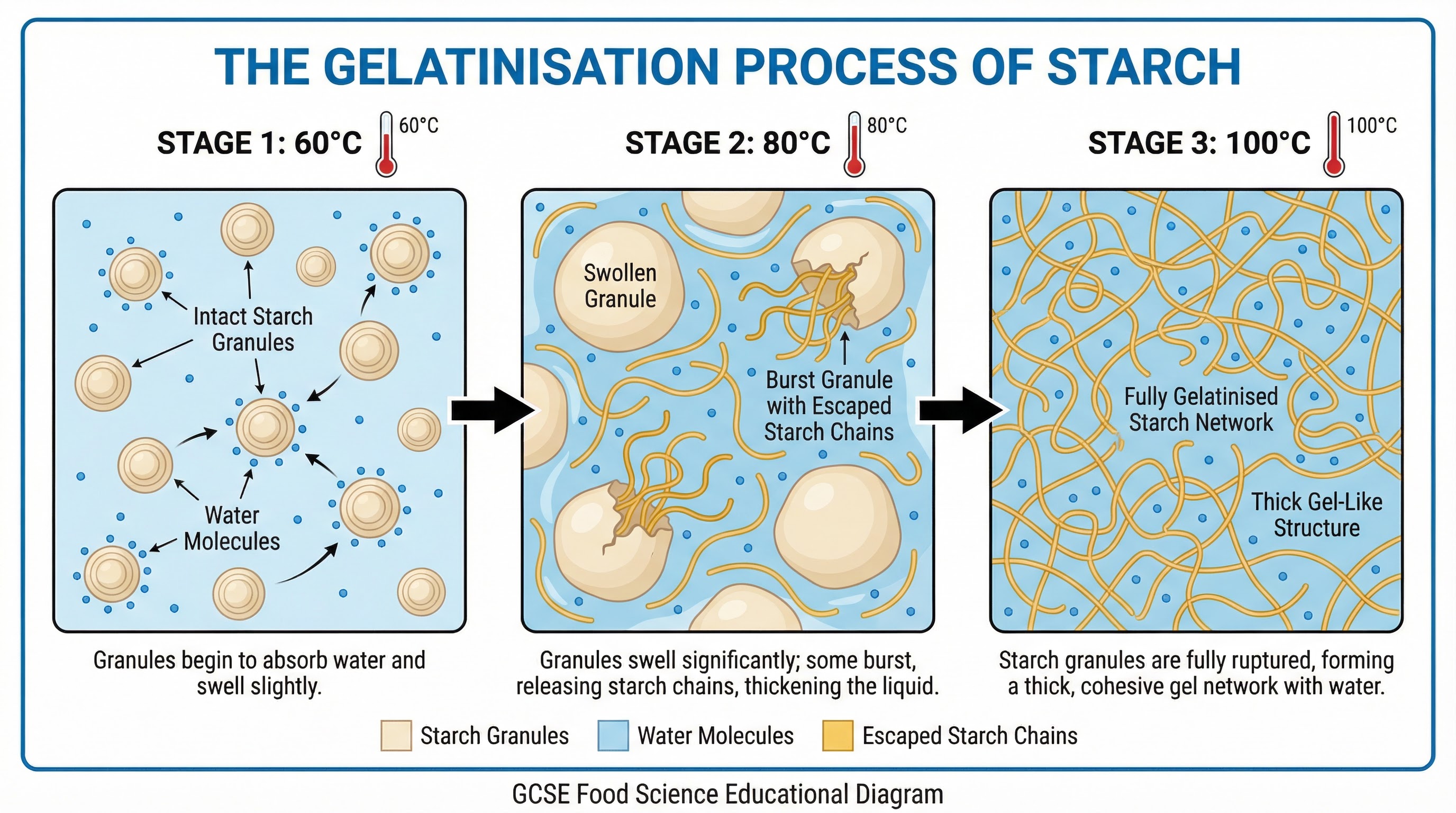
    Gelatinisation: This is the process where starch thickens a liquid. It is fundamental to making sauces, custards, and gravies. Candidates must know the specific temperature points for full marks.
    gelatinisation_process.png

    • Process: Starch granules are heated in a liquid.
    • Reaction: At 60°C, granules start to absorb water and swell. At 80°C, they burst, releasing long starch molecules that tangle and trap water. The process is complete at 100°C, forming a thick, viscous gel.
    • Outcome: A thickened, smooth sauce or gel.

    Dextrinisation: This is the browning of starch with dry heat. It is responsible for the colour and flavour of toast and baked goods.

    • Process: Starch is exposed to dry heat (e.g., grilling, baking).
    • Reaction: The long starch molecules break down into smaller molecules called dextrins.
    • Outcome: A golden-brown colour and a slightly sweet, nutty flavour.

    Caramelisation: This is the browning of sugar with heat. It is distinct from dextrinisation.

    • Process: Sugar is heated to a high temperature (around 160-180°C).
    • Reaction: The sugar molecules break down and reform into new compounds.
    • Outcome: A rich brown colour and complex caramel flavour.

    Proteins: Gluten & Coagulation

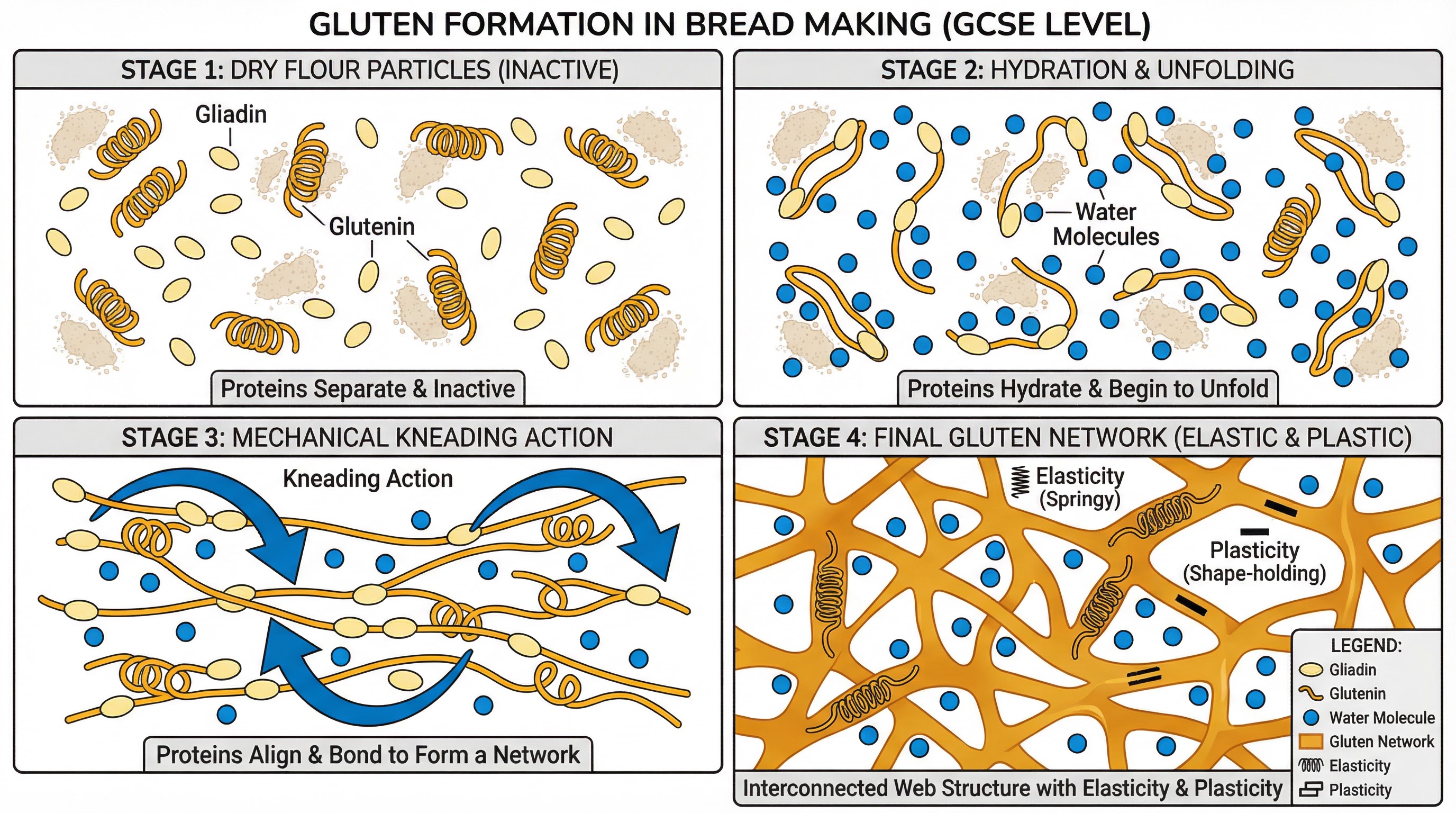
    Gluten Formation: Essential for bread-making, this process creates the structure needed for dough to rise.
    gluten_formation.png

    • Process: Wheat flour (containing proteins gliadin and glutenin) is mixed with water and kneaded.
    • Reaction: Hydration allows the gliadin and glutenin proteins to unwind. Mechanical action (kneading) stretches and aligns these proteins, causing them to link together and form a viscoelastic network called gluten.
    • Outcome: A dough that is both elastic (can spring back) and plastic (can be moulded), capable of trapping CO2 gas from yeast.

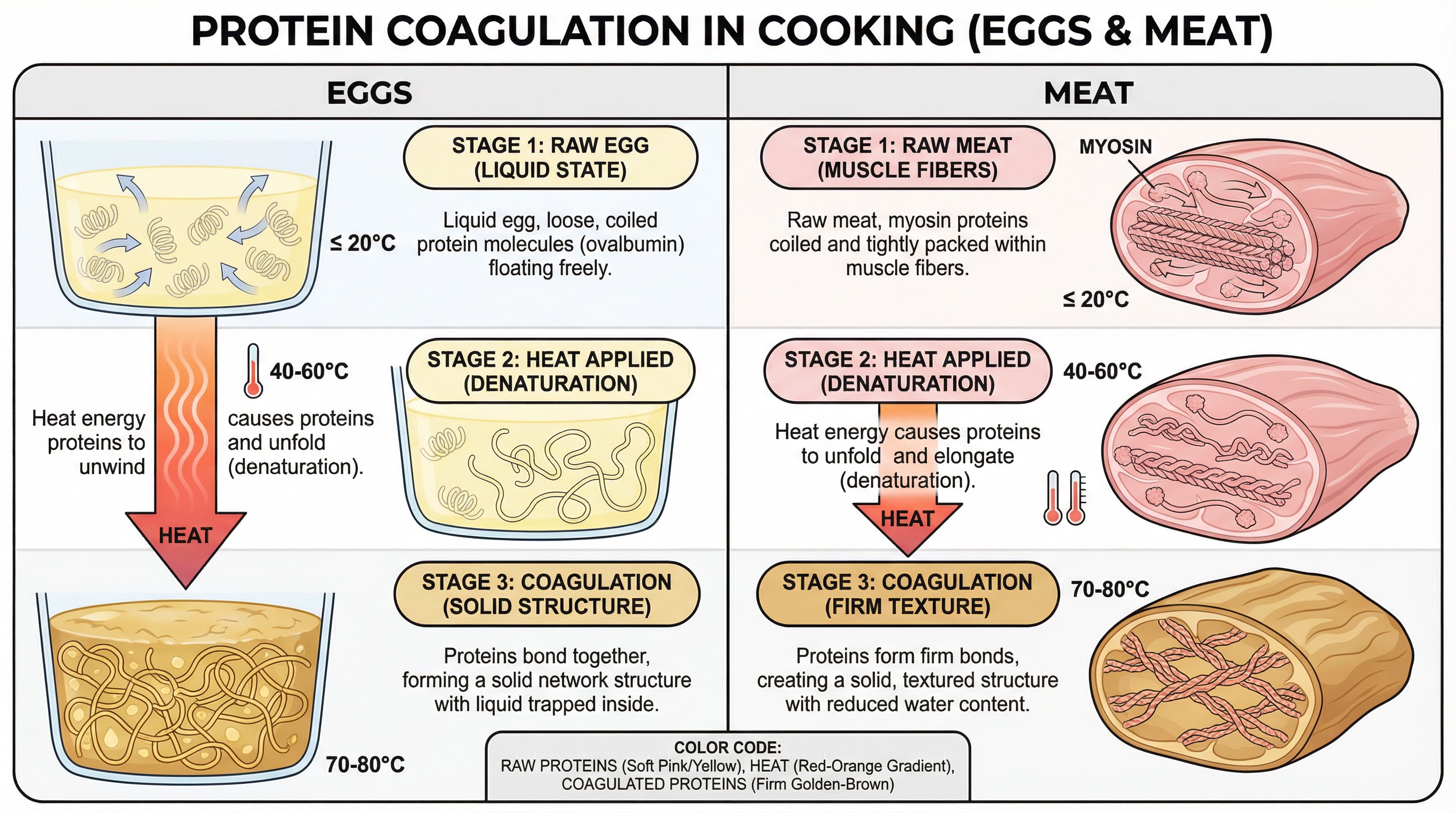
    Coagulation: This is the setting or solidifying of proteins when heated. It is vital for cooking eggs, meat, and fish.
    protein_coagulation.png

    • Process: Proteins are heated or exposed to acid.
    • Reaction: The long, coiled protein chains first unwind (denaturation). As heating continues, these unfolded chains bond together, forming a solid 3D network that traps water.
    • Outcome: The food changes from a liquid or soft state to a solid, firm texture. For example, a liquid egg becomes a solid fried egg.

    Fats: Shortening & Emulsification

    Shortening: This is the ability of fat to create a crumbly, flaky texture in pastry and biscuits.

    • Process: Fat is rubbed into flour.
    • Reaction: The fat coats the flour particles, creating a waterproof barrier. This prevents the flour's proteins (gliadin and glutenin) from absorbing water and forming long gluten strands.
    • Outcome: A 'short', crumbly texture rather than a chewy, elastic one.

    Emulsification: This is the process of mixing two liquids that do not normally mix, like oil and water.

    • Process: An emulsifier (like lecithin in egg yolk) is used to create a stable mixture.
    • Reaction: The emulsifier molecule has a hydrophilic (water-loving) head and a hydrophobic (water-hating) tail. The tail embeds in the oil droplets, while the head faces the water, preventing the oil droplets from coalescing.
    • Outcome: A stable, smooth mixture, such as mayonnaise or hollandaise sauce."

    Worked Examples

    3 detailed examples with solutions and examiner commentary

    Practice Questions

    Test your understanding — click to reveal model answers

    Q1

    Explain the process of dextrinisation and give one example of a food product where it occurs. (4 marks)

    4 marks
    standard

    Hint: Think about what happens to starch with DRY heat.

    Q2

    Describe the three main types of raising agent used in food preparation. (6 marks)

    6 marks
    standard

    Hint: Think: Air, Bubbles, Living things.

    Q3

    Evaluate the use of butter as a fat for making puff pastry. (8 marks)

    8 marks
    hard

    Hint: Think about the properties of butter (flavour, melting point) and the requirements of puff pastry (lamination).

    More Food Preparation and Nutrition Study Guides

    View all

    Food additives

    OCR
    GCSE

    This guide delves into the science of food additives, a critical component of the OCR GCSE Food Preparation and Nutrition exam. It explores how substances like preservatives and emulsifiers work, why they are essential for modern food production, and how to critically evaluate their use, ensuring you can secure maximum marks.

    Safe food handling practices

    OCR
    GCSE

    Mastering safe food handling is non-negotiable for a high grade in OCR GCSE Food Preparation and Nutrition. This guide moves beyond basic hygiene, delving into the microbiological principles and precise temperature controls that examiners reward. Understanding this science is the key to unlocking top-level marks and ensuring food is safe.

    Dietary Reference Values (DRVs)

    OCR
    GCSE

    Master Dietary Reference Values (DRVs) for your OCR GCSE Food Preparation and Nutrition exam. This guide breaks down the science of nutritional requirements, showing you how to apply DRV knowledge to different life stages and analyse diets like a pro to secure top marks.

    Pastry making

    OCR
    GCSE

    Pastry making is a cornerstone of the OCR GCSE Food Preparation and Nutrition specification, testing candidates' scientific understanding of ingredient functionality, chemical processes, and practical technique. Examiners award marks for precise knowledge of fat-to-flour ratios, accurate explanation of shortening and plasticity, and the ability to link functional properties to sensory outcomes. Mastering this topic demonstrates your grasp of food science principles that underpin professional culinary practice.

    Ethical considerations and Fair Trade

    OCR
    GCSE

    This study guide delves into the critical topic of ethical considerations and Fair Trade in food production, a key area of the OCR GCSE Food Preparation and Nutrition specification. It provides a detailed examination of how consumer choices impact global food supply chains, animal welfare, and the livelihoods of producers in Low Income Countries (LICs), equipping students with the analytical skills needed to excel in their exams."

    Diet-related health issues

    OCR
    GCSE

    This study guide provides a comprehensive, exam-focused overview of diet-related health issues for OCR GCSE Food Preparation and Nutrition. It decodes the science behind conditions like CHD and Type 2 Diabetes, equipping students with the precise knowledge and terminology required to achieve top marks.