Study Notes
Overview
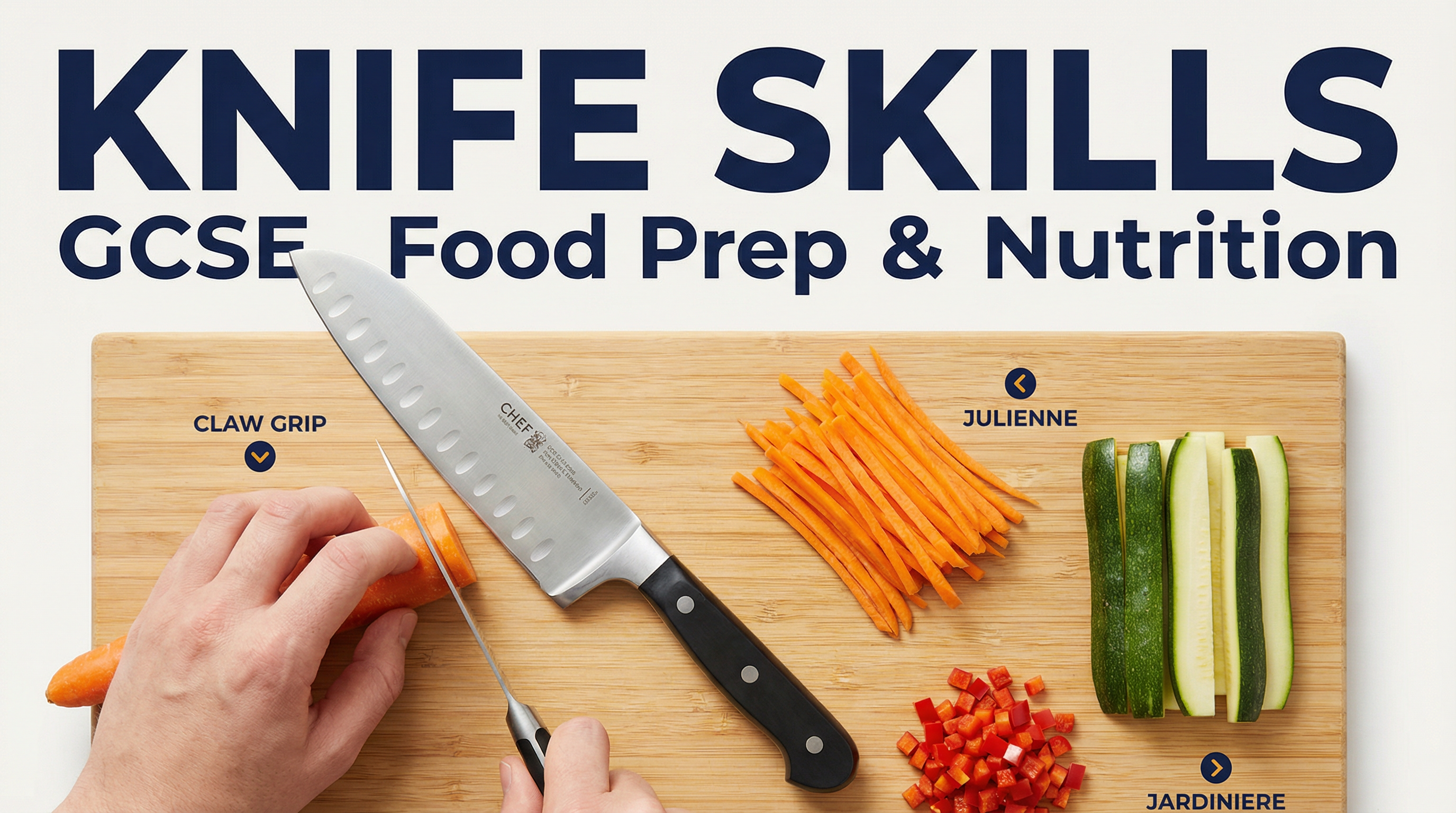
In OCR GCSE Food Preparation and Nutrition, knife skills are a core technical skill assessed in both the written examination (Section B) and the Non-Exam Assessment (NEA 2). Examiners expect candidates to not only perform these skills competently but also to understand the science and safety principles behind them. This involves justifying the choice of knife for a specific task, explaining the importance of uniform cuts for even cooking, and demonstrating secure handling techniques like the claw grip and bridge hold. Mastery in this area is not just about creating visually appealing dishes; it is about demonstrating a professional-level understanding of food science, safety, and culinary precision. This guide will provide the specific terminology, dimensions, and reasoning required to access the highest mark bands.
Key Techniques & Safety
The Claw Grip
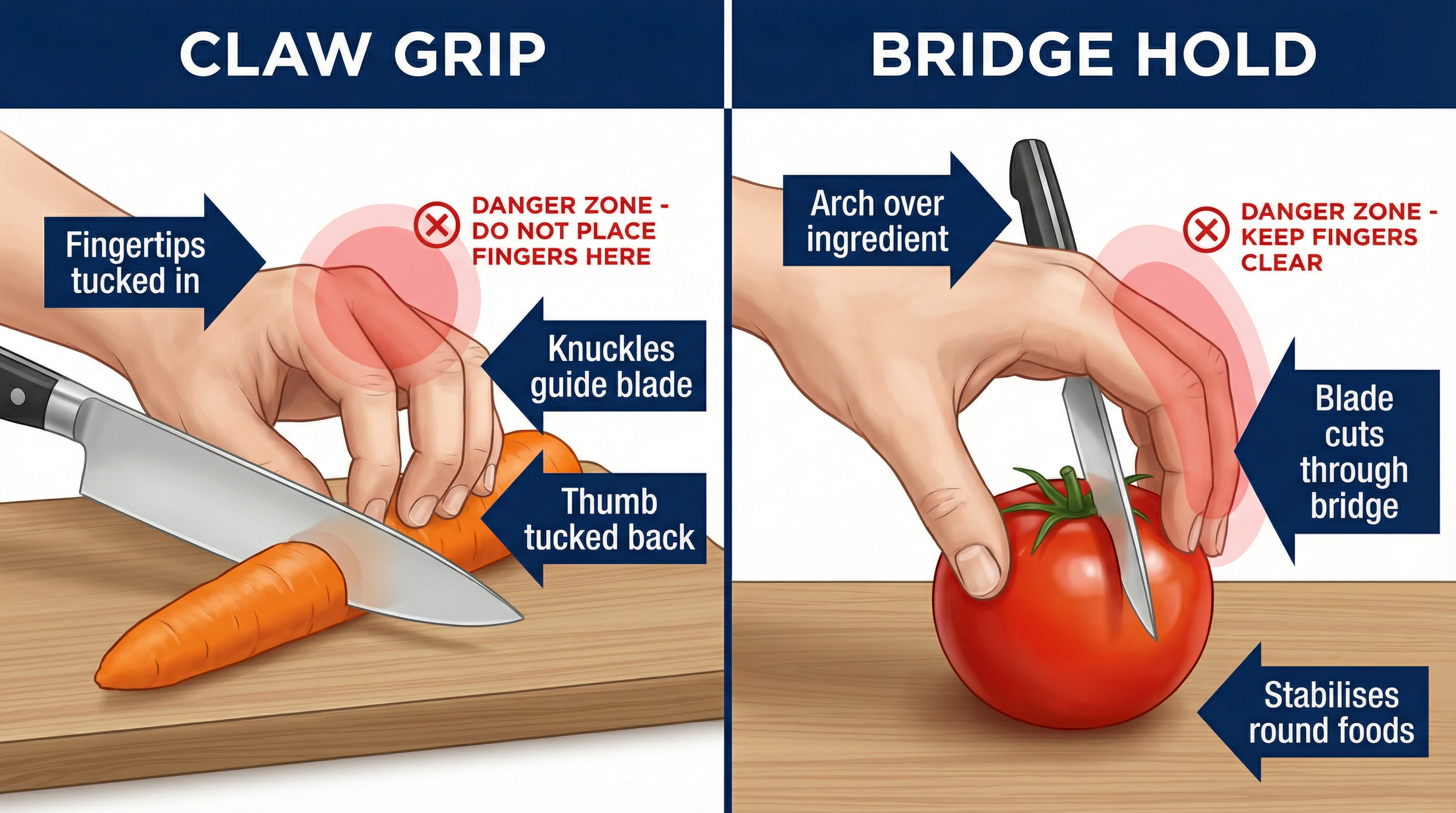
What it is: A safety grip used for slicing and chopping. The hand holding the food is formed into a 'claw' shape, with fingertips curled inwards and knuckles pushing the food forward towards the blade.
Why it matters: This technique is critical for safety. By keeping fingertips tucked away, the knuckles act as a guide for the side of the knife blade, making it virtually impossible to cut them. Examiners award specific marks for mentioning this grip by name and explaining its function.
Specific Knowledge: Candidates must state that the 'fingertips are tucked in' and the 'knuckles guide the blade'.
The Bridge Hold
What it is: A safety grip used to stabilise round or irregular-shaped foods (like tomatoes, onions, or apples) for the first cut.
Why it matters: It prevents food from rolling, which is a primary cause of knife slips and injuries. The hand forms a 'bridge' over the food, and the knife blade passes underneath the bridge to make a clean, safe cut. It is a prerequisite for safely preparing many fruits and vegetables.
Specific Knowledge: Use this grip to halve or quarter round items before switching to the claw grip for further chopping or slicing.
Knife Selection
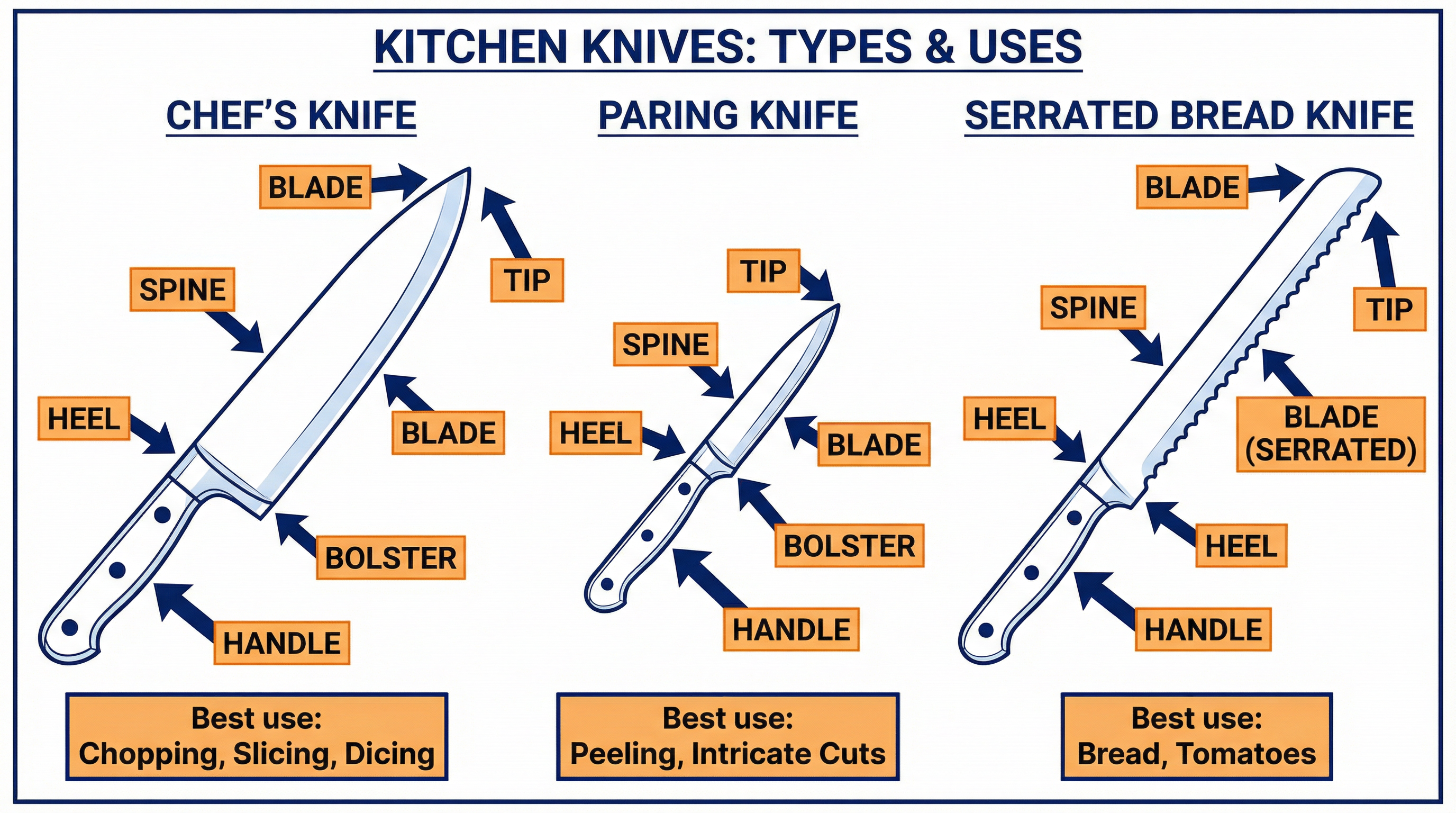
Chef's Knife
Description: A large, all-purpose knife with a broad blade, typically 20-25cm long.
Use: The workhorse of the kitchen. Ideal for chopping, slicing, and dicing a wide variety of foods. Its weight and size provide momentum and control for repetitive tasks.
Exam Link: Justify its use for tasks requiring significant force or for processing large quantities of vegetables.
Paring Knife
Description: A small knife with a thin blade, typically 7-10cm long.
Use: For intricate and delicate tasks like peeling, trimming, and creating garnishes. Not suitable for chopping.
Exam Link: Credit is given for selecting this knife for tasks that require high levels of precision and control over small items.
Serrated Knife
Description: A knife with a toothed or saw-like blade.
Use: Essential for cutting foods with a hard or waxy exterior and a soft interior, such as bread, tomatoes, and citrus fruits. The serrations grip the surface without crushing the delicate inside.
Exam Link: Explaining why a serrated knife is superior for a tomato (i.e., it cuts rather than crushes) demonstrates strong technical understanding.
Precision Cuts: The French Classics
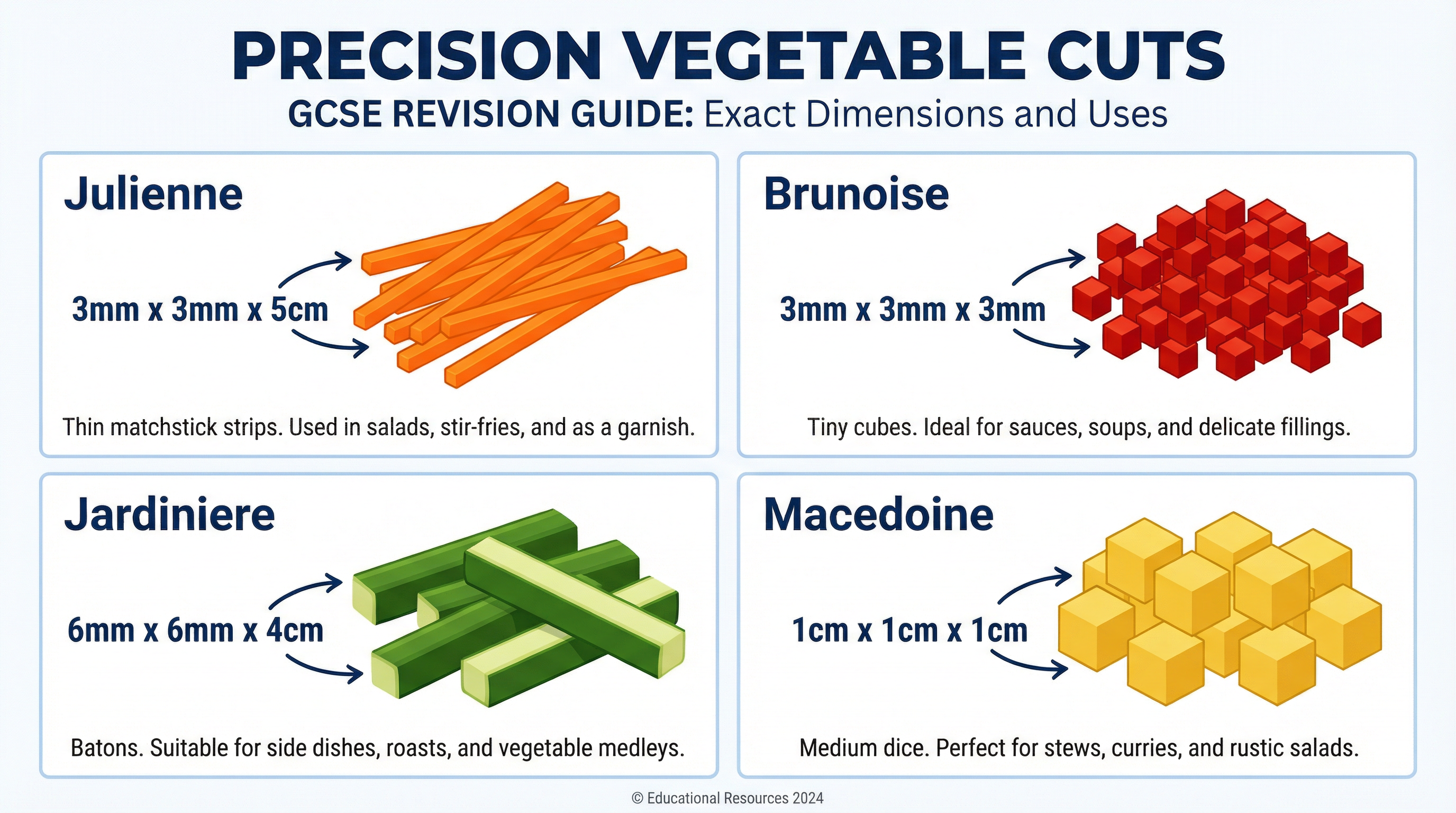
Examiners reward the use of correct French terminology for precision cuts. It demonstrates a higher level of culinary knowledge. The uniformity of these cuts is not just for presentation; it is essential for ensuring even cooking.
Julienne
Dimensions: Approx. 3mm x 3mm x 5cm (a thin matchstick).
Use: Salads, stir-fries, garnishes. The large surface area means it cooks very quickly.
Brunoise
Dimensions: Approx. 3mm x 3mm x 3mm (a tiny cube).
Use: Soups and sauces. The small size allows it to soften and almost dissolve, releasing flavour into the dish.
Jardinière
Dimensions: Approx. 6mm x 6mm x 4cm (a baton).
Use: Side vegetables, crudités. Large enough to retain texture after cooking.
Macédoine
Dimensions: Approx. 1cm x 1cm x 1cm (a medium dice).
Use: Stews, casseroles, and fruit salads. The classic 'diced' vegetable.
Second-Order Concepts
Causation
Why are sharp knives safer? A blunt knife requires more pressure to cut, increasing the likelihood of it slipping and causing injury. A sharp knife cuts cleanly with minimal force, giving the user more control.
Consequence
What is the consequence of uneven cuts? Unevenly cut vegetables will cook at different rates. Smaller pieces will become overcooked and mushy while larger pieces remain hard and undercooked, resulting in a poor final texture and taste.
Change & Continuity
While the basic principles of knife safety (claw grip, bridge hold) are timeless (continuity), the availability of specialised knives for specific tasks has become more widespread (change), allowing for greater precision.
Significance
Mastering knife skills is significant as it directly impacts the two key assessment areas: safety (preventing injury) and quality of the final dish (even cooking, texture, and presentation). It is a foundational skill that unlocks access to more complex culinary techniques."