Microorganisms

    This guide provides a comprehensive overview of microorganisms in food, a critical topic for OCR GCSE Food Preparation and Nutrition. It covers pathogenic bacteria, conditions for growth, and control measures, equipping students with the precise scientific knowledge and exam technique needed to achieve top marks.

    4
    Min Read
    3
    Examples
    5
    Questions
    6
    Key Terms
    🎙 Podcast Episode
    Microorganisms
    0:00-0:00

    Study Notes

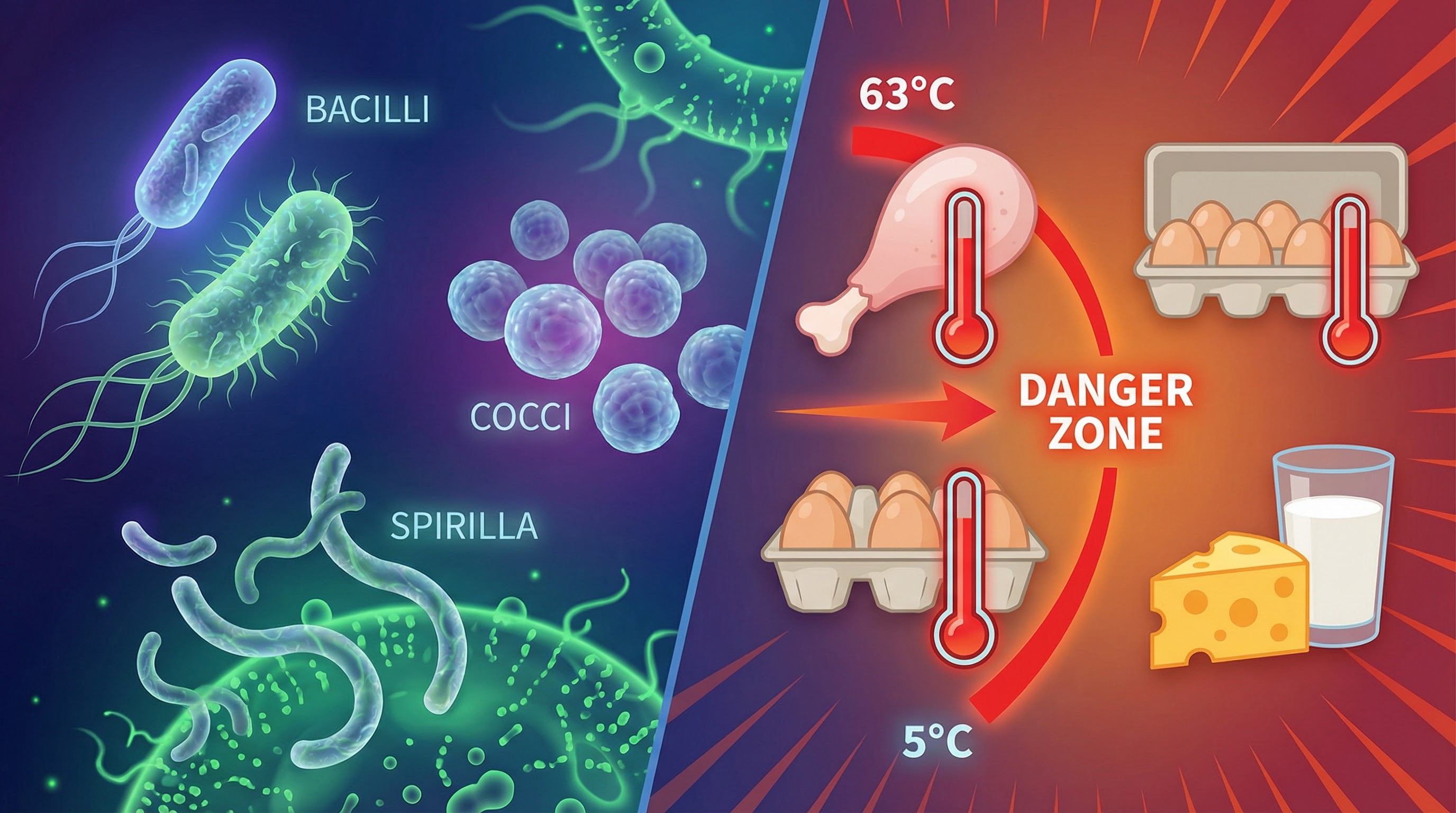
    Header image for Microorganisms in Food.

    Overview

    Microorganisms are a fundamental concept in food science, and a topic where examiners award significant marks for precision and scientific accuracy. This guide focuses on the microbiological aspects of the OCR specification, specifically the types of microorganisms, their requirements for growth, and the methods used to control them. A thorough understanding of pathogenic bacteria, the Danger Zone, and the principles of food preservation is essential for any candidate aiming for a high grade. This section will break down the core knowledge required, from the difference between spoilage and pathogenic bacteria to the specific temperature controls that ensure food safety. We will explore the mechanisms of food poisoning and how to apply this knowledge to practical, exam-style scenarios, ensuring you can write with the confidence of a senior examiner.

    Listen to the Microorganisms Study Podcast.

    Key Concepts: Understanding Microorganisms

    Types of Microorganisms

    In food, we are concerned with three main types of microorganisms: bacteria, moulds, and yeasts. For your exam, the most critical distinction is between spoilage and pathogenic bacteria.

    • Spoilage Bacteria: These alter the sensory characteristics of food, causing it to look, smell, or feel unpleasant (e.g., slime on meat, sour milk). While they ruin food quality, they are not typically the cause of illness.
    • Pathogenic Bacteria: These are the disease-causing microorganisms that lead to food poisoning. Crucially, they often do not produce any noticeable change in the food's appearance, taste, or smell. This is why a food can appear perfectly safe but still be dangerous.

    Conditions for Bacterial Growth: FATTOM

    Examiners expect you to know the six conditions that support bacterial multiplication. The acronym FATTOM is an essential memory hook.
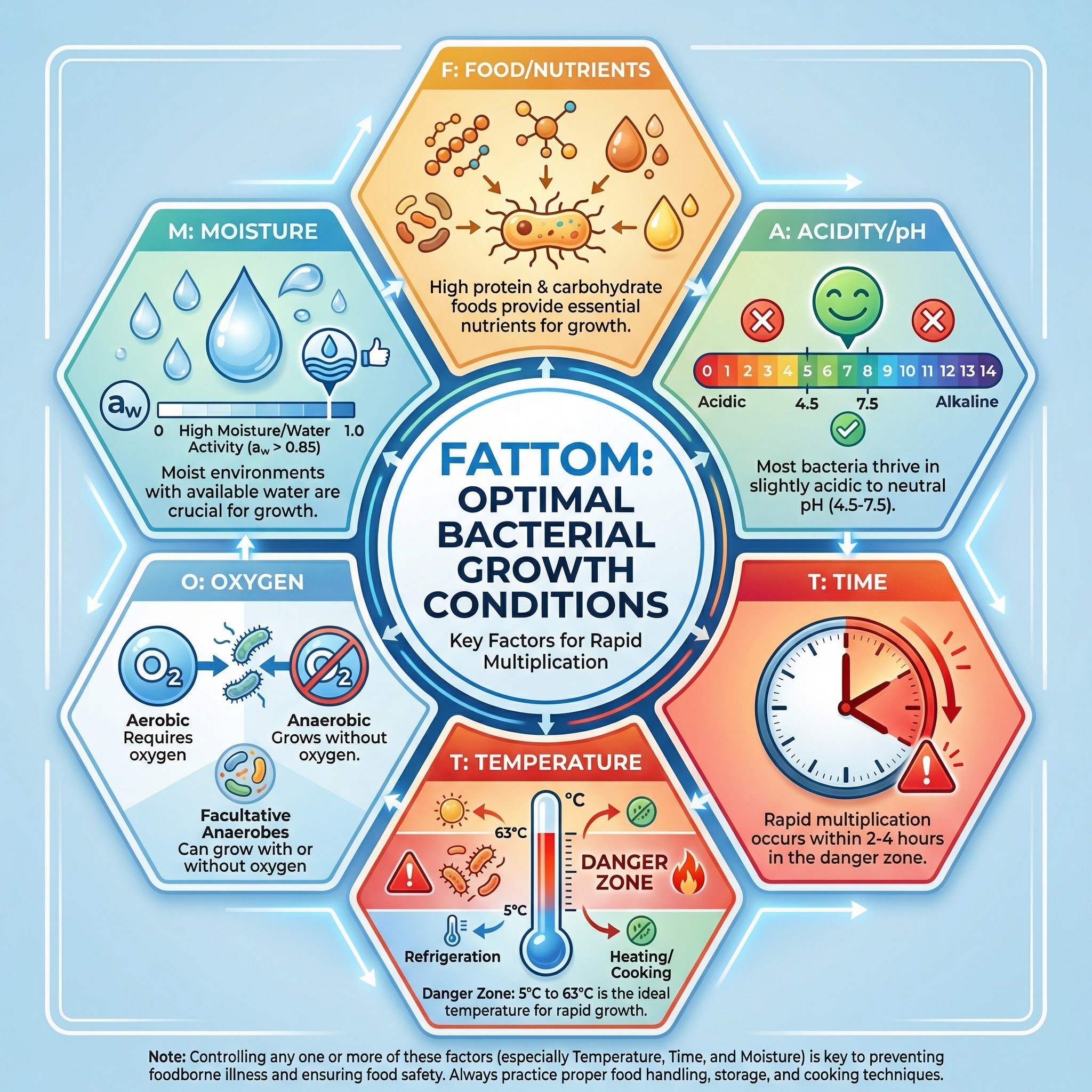
    The FATTOM conditions for bacterial growth.

    • F - Food: Bacteria thrive on high-protein and high-carbohydrate foods like meat, poultry, dairy, and cooked rice.
    • A - Acidity (pH): Most bacteria prefer a neutral to slightly acidic environment, with a pH between 4.5 and 7.5.
    • T - Time: In ideal conditions, bacteria can double in number every 10-20 minutes through a process called binary fission. Leaving food in the Danger Zone for more than 2 hours poses a significant risk.
    • T - Temperature: This is the most critical factor. Bacteria multiply rapidly within the Danger Zone (5°C to 63°C).
    • O - Oxygen: Bacterial oxygen needs vary. Aerobic bacteria require oxygen, anaerobic bacteria grow without it, and facultative anaerobes can adapt to either condition.
    • M - Moisture: Bacteria need water to grow. This is measured as Water Activity (aw), and most pathogens require an aw of 0.85 or higher.

    Temperature Control: The Golden Rule

    Temperature is the most effective tool for controlling bacterial growth. You must know these specific temperatures for the exam.
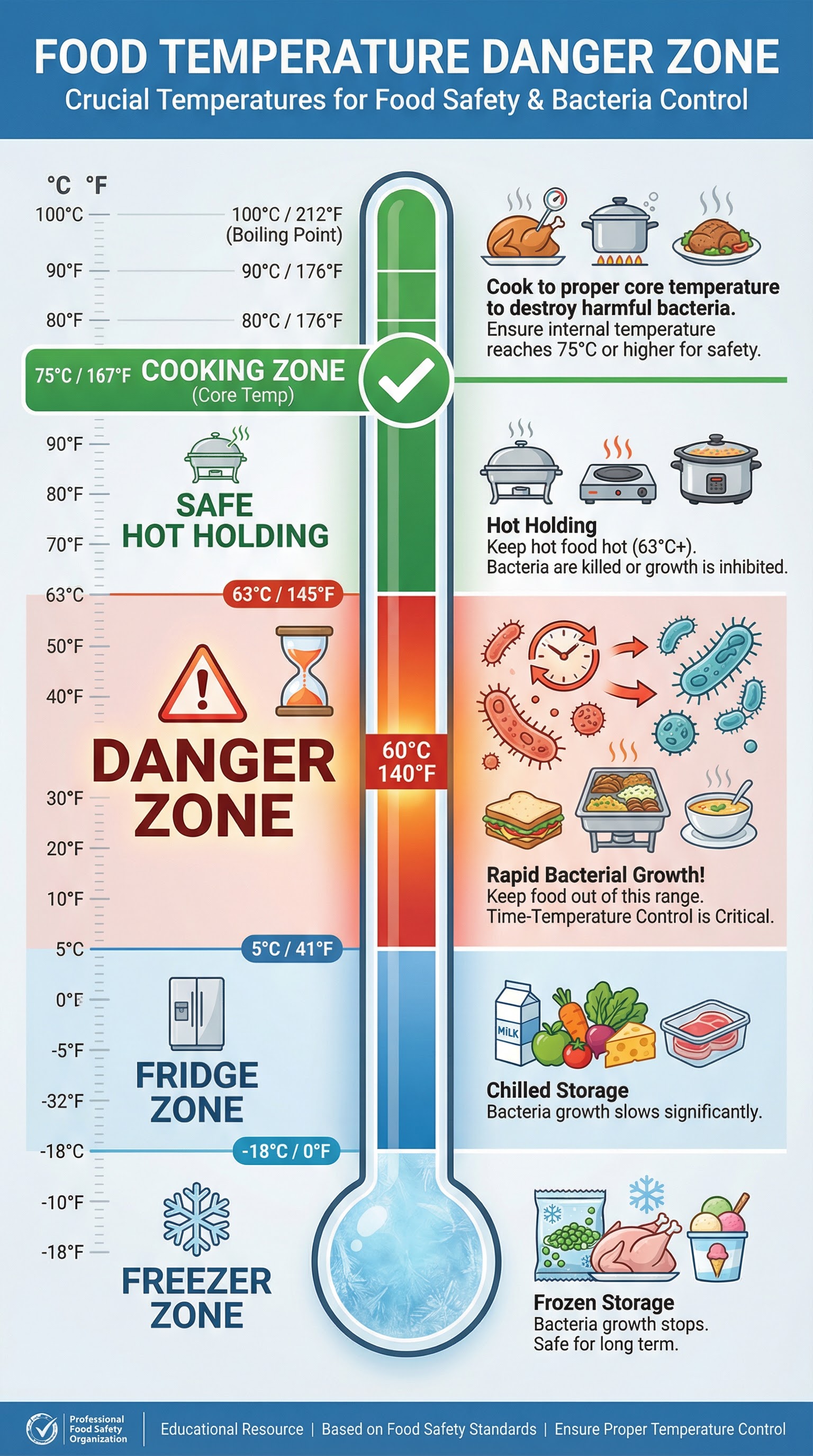
    The Food Temperature Danger Zone.

    • Freezer (-18°C): Freezing does not kill bacteria; it makes them dormant and stops them from multiplying.
    • Fridge (0°C - 5°C): Refrigeration significantly slows down bacterial multiplication.
    • Danger Zone (5°C - 63°C): The ideal temperature range for rapid bacterial growth. Food must be kept out of this zone.
    • Safe Hot Holding (63°C+): Holding food above this temperature prevents the growth of bacteria.
    • Core Cooking Temperature (75°C): Cooking food to a core temperature of 75°C for at least 2 minutes will kill most pathogenic bacteria.

    Key Pathogens You Must Know

    Candidates are awarded marks for naming specific pathogens and linking them to food sources and symptoms.
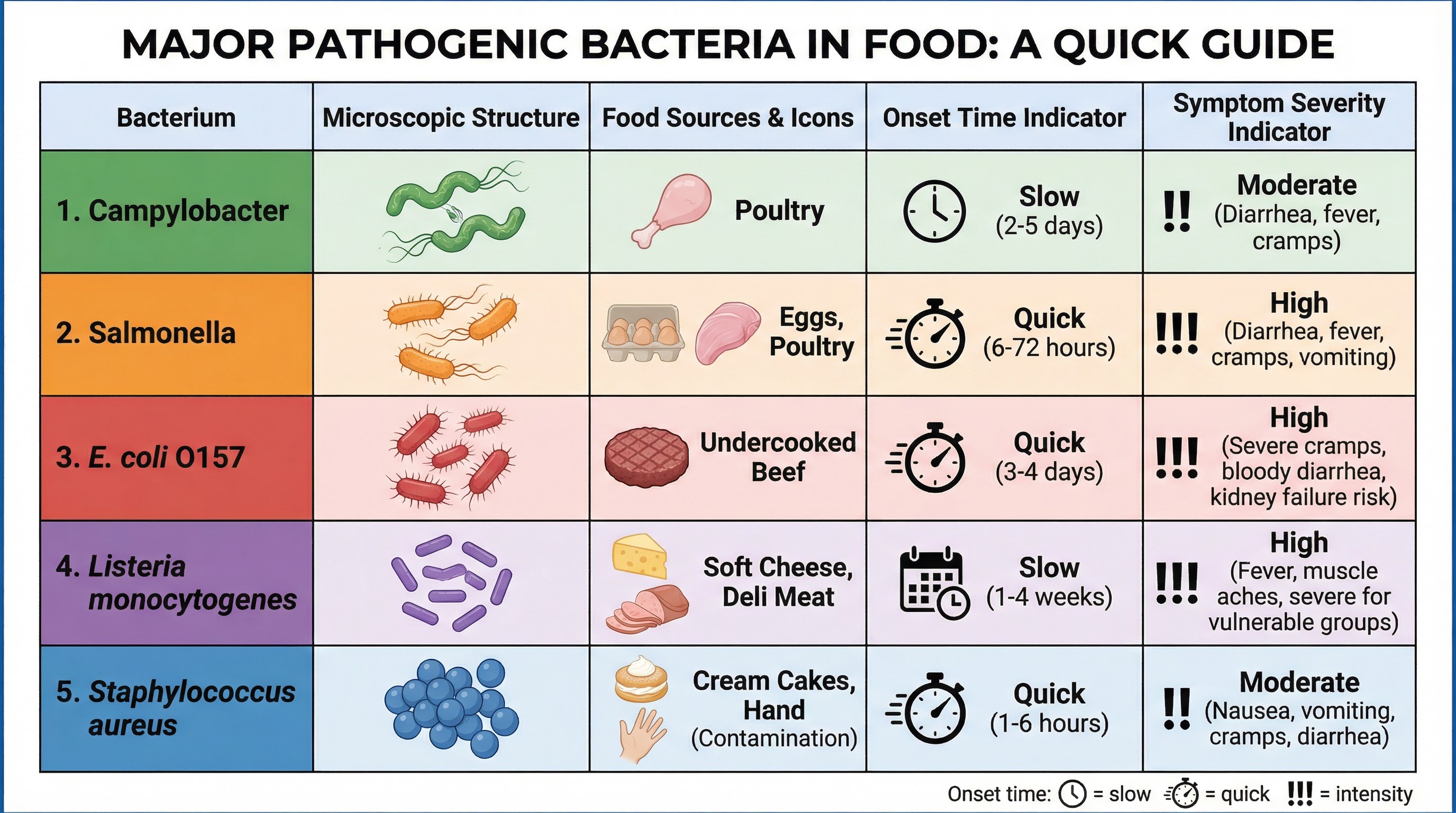
    A guide to major pathogenic bacteria.

    Visual Resources

    3 diagrams and illustrations

    The FATTOM conditions for bacterial growth.
    The FATTOM conditions for bacterial growth.
    The Food Temperature Danger Zone.
    The Food Temperature Danger Zone.
    A guide to major pathogenic bacteria.
    A guide to major pathogenic bacteria.

    Interactive Diagrams

    1 interactive diagram to visualise key concepts

    DripsDoes not wash handsUsed for raw meat then saladRaw Chicken on CounterReady-to-Eat SaladChef Handles Raw ChickenMakes a SandwichSame Chopping BoardContaminated Salad

    Flowchart showing common vectors of cross-contamination.

    Worked Examples

    3 detailed examples with solutions and examiner commentary

    Practice Questions

    Test your understanding — click to reveal model answers

    Q1

    Describe two ways in which food spoilage bacteria differ from pathogenic bacteria. (4 marks)

    4 marks
    standard

    Hint: Think about the effect on the food versus the effect on the person eating it.

    Q2

    Explain how adding a vinegar-based dressing to a salad can help to preserve it. (4 marks)

    4 marks
    standard

    Hint: Relate your answer to the FATTOM principles.

    Q3

    A chef is preparing food for a nursery. Explain why they must take extra care when preparing and cooking the food. (6 marks)

    6 marks
    high

    Hint: Consider the specific risks associated with vulnerable groups.

    Q4

    Analyse the food safety risks involved in preparing and serving a buffet at a summer party. (8 marks)

    8 marks
    high

    Hint: Think about Time and Temperature. How long will the food be out? What will the weather be like?

    Q5

    What is the key difference between food poisoning caused by Salmonella and food poisoning caused by Staphylococcus aureus? (2 marks)

    2 marks
    standard

    Hint: Think about infection vs. intoxication.

    Key Terms

    Essential vocabulary to know

    More Food Preparation and Nutrition Study Guides

    View all

    Food additives

    OCR
    GCSE

    This guide delves into the science of food additives, a critical component of the OCR GCSE Food Preparation and Nutrition exam. It explores how substances like preservatives and emulsifiers work, why they are essential for modern food production, and how to critically evaluate their use, ensuring you can secure maximum marks.

    Safe food handling practices

    OCR
    GCSE

    Mastering safe food handling is non-negotiable for a high grade in OCR GCSE Food Preparation and Nutrition. This guide moves beyond basic hygiene, delving into the microbiological principles and precise temperature controls that examiners reward. Understanding this science is the key to unlocking top-level marks and ensuring food is safe.

    Dietary Reference Values (DRVs)

    OCR
    GCSE

    Master Dietary Reference Values (DRVs) for your OCR GCSE Food Preparation and Nutrition exam. This guide breaks down the science of nutritional requirements, showing you how to apply DRV knowledge to different life stages and analyse diets like a pro to secure top marks.

    Pastry making

    OCR
    GCSE

    Pastry making is a cornerstone of the OCR GCSE Food Preparation and Nutrition specification, testing candidates' scientific understanding of ingredient functionality, chemical processes, and practical technique. Examiners award marks for precise knowledge of fat-to-flour ratios, accurate explanation of shortening and plasticity, and the ability to link functional properties to sensory outcomes. Mastering this topic demonstrates your grasp of food science principles that underpin professional culinary practice.

    Ethical considerations and Fair Trade

    OCR
    GCSE

    This study guide delves into the critical topic of ethical considerations and Fair Trade in food production, a key area of the OCR GCSE Food Preparation and Nutrition specification. It provides a detailed examination of how consumer choices impact global food supply chains, animal welfare, and the livelihoods of producers in Low Income Countries (LICs), equipping students with the analytical skills needed to excel in their exams."

    Diet-related health issues

    OCR
    GCSE

    This study guide provides a comprehensive, exam-focused overview of diet-related health issues for OCR GCSE Food Preparation and Nutrition. It decodes the science behind conditions like CHD and Type 2 Diabetes, equipping students with the precise knowledge and terminology required to achieve top marks.