
Study Notes

Overview
Differentiating between formal and informal language is one of the most critical skills assessed in Edexcel GCSE French. The Communication and Content assessment grids in both Writing and Speaking explicitly reward candidates who demonstrate the ability to adapt their language for specific purposes and audiences. This means choosing the appropriate register—whether familiar (tu) or formal (vous)—and maintaining it consistently throughout your response. Examiners penalize inconsistency heavily, as shifting between registers signals a lack of control. This topic is not merely about politeness; it directly impacts your ability to access the higher mark bands. Understanding when to use formal greetings like Bonjour Monsieur versus informal ones like Salut, when to employ the conditional mood (je voudrais) for courtesy, and when to use inversion for questions (Avez-vous?) are all skills that distinguish top-tier candidates from those in the middle bands. In this guide, you will learn the grammatical structures, vocabulary choices, and strategic approaches necessary to master register differentiation and maximize your marks.
Key Grammatical Structures
The Tu vs Vous Paradigm
When to use tu: The informal pronoun tu is used when addressing friends, family members, peers, or anyone with whom you have a familiar relationship. In exam tasks, if the rubric specifies writing to a pen pal, a friend, or a family member, you must use tu consistently.
When to use vous: The formal pronoun vous is used when addressing teachers, employers, strangers, authority figures, or anyone in a professional or unfamiliar context. In exam tasks involving letters to managers, formal complaints, job applications, or transactional role-plays (e.g., booking a hotel), vous is non-negotiable.
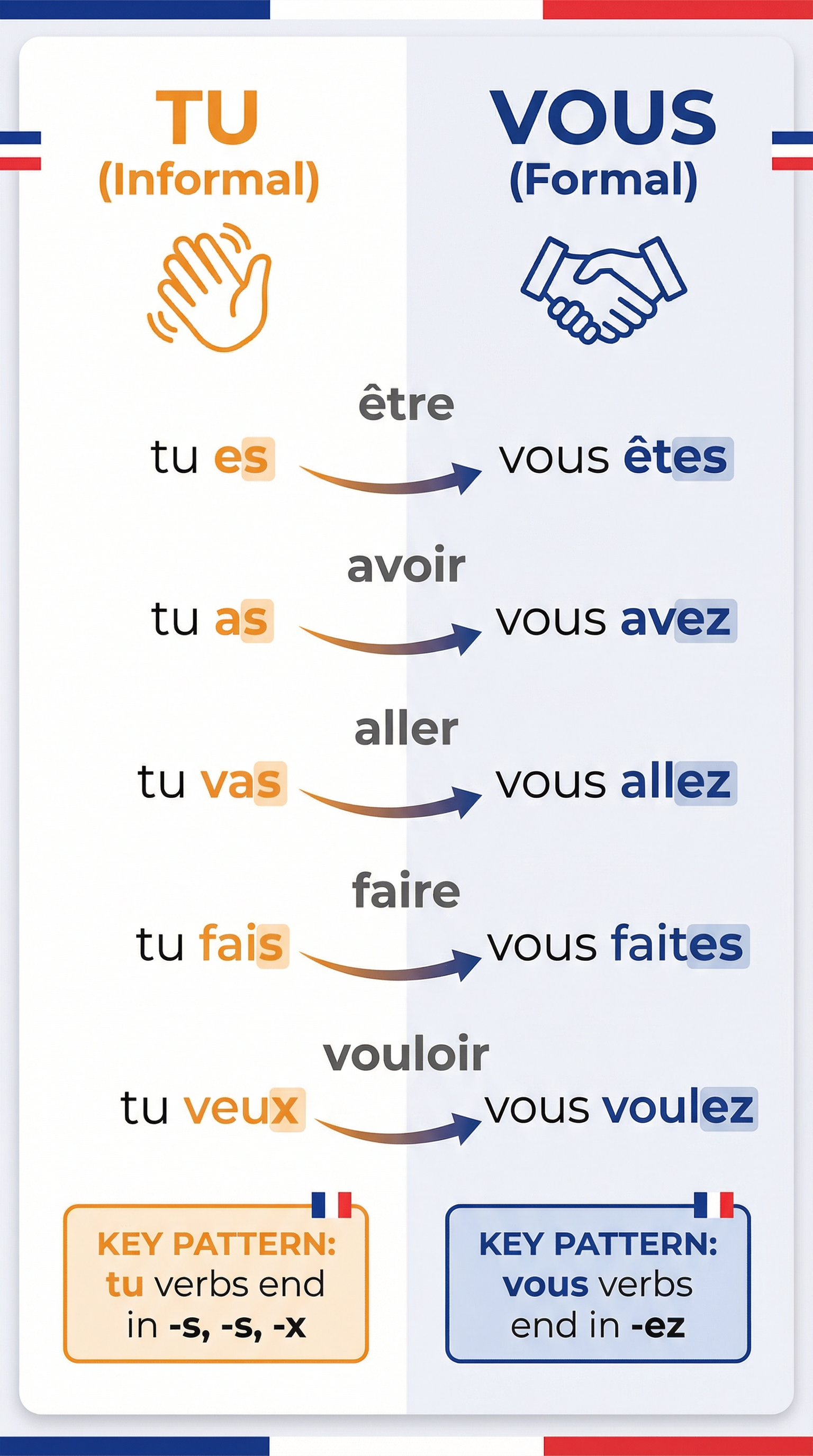
Verb conjugation patterns: The choice of pronoun fundamentally changes verb endings. For tu, most verbs end in -s or -x (e.g., tu es, tu as, tu vas, tu fais, tu veux). For vous, verbs almost universally end in -ez (e.g., vous êtes, vous avez, vous allez, vous faites, vous voulez). Candidates must internalize these patterns and apply them without error. A single slip from vous to tu within a formal letter will immediately limit Communication marks.
The Imperative Mood
The imperative mood is used for commands and instructions, and its formation differs between registers. For the tu form of -er verbs, the final -s is dropped: Parle! (Speak!), Mange! (Eat!), Écoute! (Listen!). However, for vous, the -ez ending is retained: Parlez!, Mangez!, Écoutez!. A common error is for candidates to write Parles! in the tu imperative, influenced by the present tense form. Examiners deduct marks for this grammatical inaccuracy.
For -ir and -re verbs, the tu imperative retains the -s: Finis! (Finish!), Attends! (Wait!). The vous forms are Finissez! and Attendez!.
The Conditional Mood for Politeness
In formal contexts, the conditional mood is essential for expressing polite requests. Instead of the direct present tense (je veux, I want), candidates should use je voudrais (I would like), je pourrais (I could), or j'aimerais (I would love to). This elevates the register and signals courtesy. For example, in a formal letter requesting information, write Je voudrais savoir si vous avez des chambres disponibles rather than Je veux savoir. The conditional is a hallmark of sophisticated language use and is explicitly rewarded in the mark scheme.
Question Formation
Question formation varies significantly between registers. In informal contexts, candidates can use intonation-based questions (Tu viens?, Ça va?) or est-ce que constructions (Est-ce que tu aimes le sport?). However, in formal writing, particularly at Higher Tier, inversion is stylistically superior and demonstrates linguistic range. Inversion involves reversing the subject pronoun and verb: Avez-vous des chambres libres? (Do you have free rooms?), Pouvez-vous m'envoyer des informations? (Can you send me information?). While est-ce que is grammatically acceptable in formal contexts, inversion is preferred by examiners as it shows control of complex structures.
Vocabulary and Register-Specific Choices
Greetings and Closings
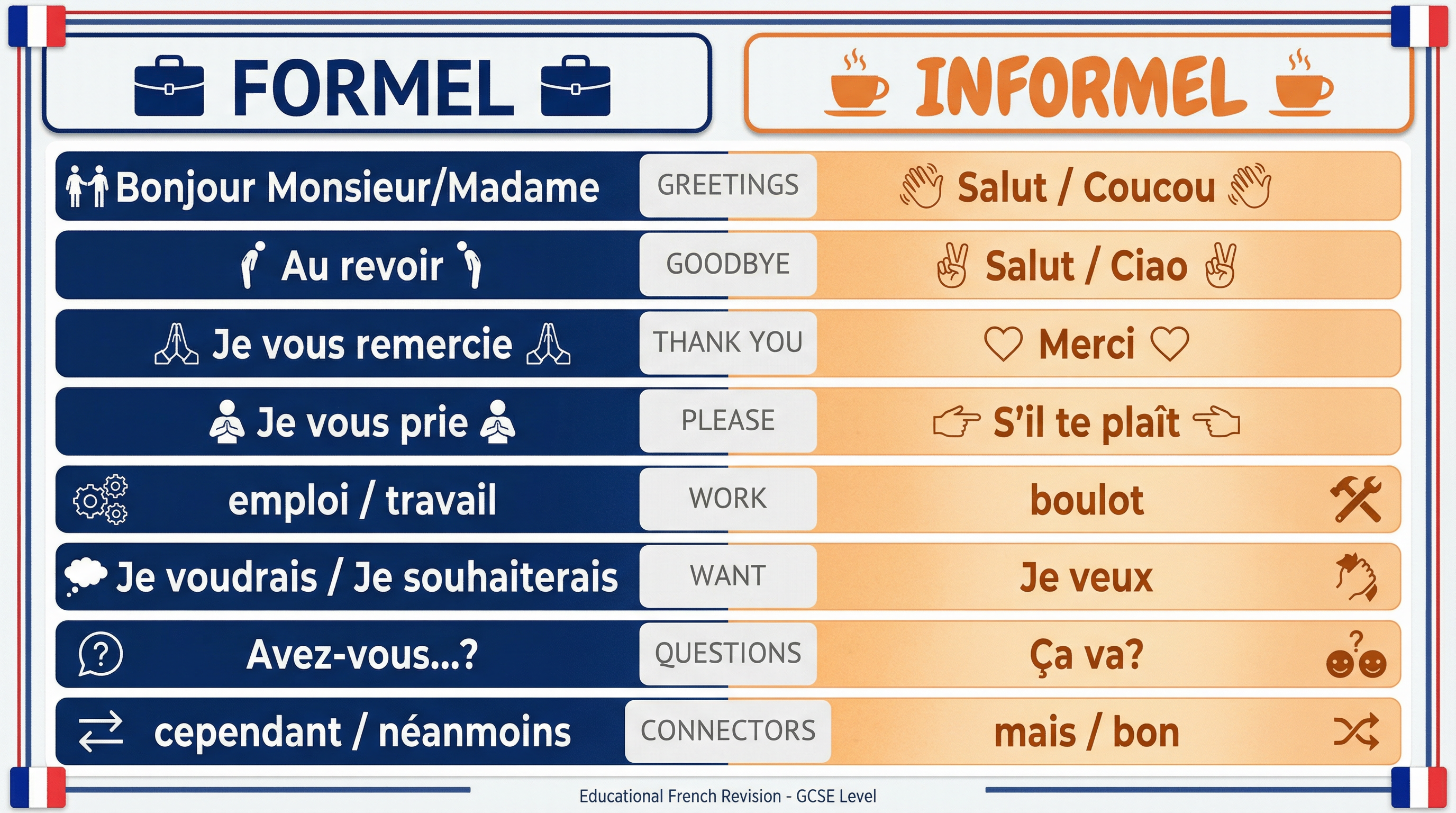
Formal greetings: In formal letters or speaking tasks, always open with Bonjour Monsieur or Bonjour Madame. If the recipient's name is known, use Bonjour Monsieur Dupont. Never use Salut, Coucou, or Bonjour alone in formal contexts, as these signal informality and will be penalized.
Informal greetings: For friends and family, Salut, Coucou, or simply Bonjour followed by the person's first name are appropriate.
Formal closings: Formal letters should conclude with Je vous prie d'agréer, Monsieur/Madame, l'expression de mes sentiments distingués (the most formal closing) or, more commonly at GCSE level, Cordialement (Yours sincerely) or Bien cordialement. Sign with your full name.
Informal closings: Letters to friends can end with Amicalement (Friendly regards), Bisous (Kisses), À bientôt (See you soon), or Grosses bises.
Register-Specific Vocabulary
Certain words are inherently formal or informal, and choosing the wrong one signals a register mismatch:
- Work: Formal = emploi, travail; Informal/slang = boulot
- Money: Formal = argent; Informal/slang = fric, thune
- Friend: Formal = ami(e); Informal/slang = pote, copain/copine
- Thing: Formal = chose; Informal/slang = truc
- Car: Formal = voiture; Informal/slang = bagnole
In a formal job application, writing Je cherche un boulot instead of Je cherche un emploi would be inappropriate and cost marks.
Connectors and Discourse Markers
Formal writing at Higher Tier benefits from sophisticated connectors:
- However: Formal = cependant, néanmoins, toutefois; Informal = mais, bon
- Therefore: Formal = par conséquent, donc, ainsi; Informal = alors, du coup
- Moreover: Formal = de plus, en outre, par ailleurs; Informal = aussi, et puis
Using formal connectors in a letter to a manager demonstrates linguistic range and elevates the tone.
Decision-Making Framework: Choosing the Right Register
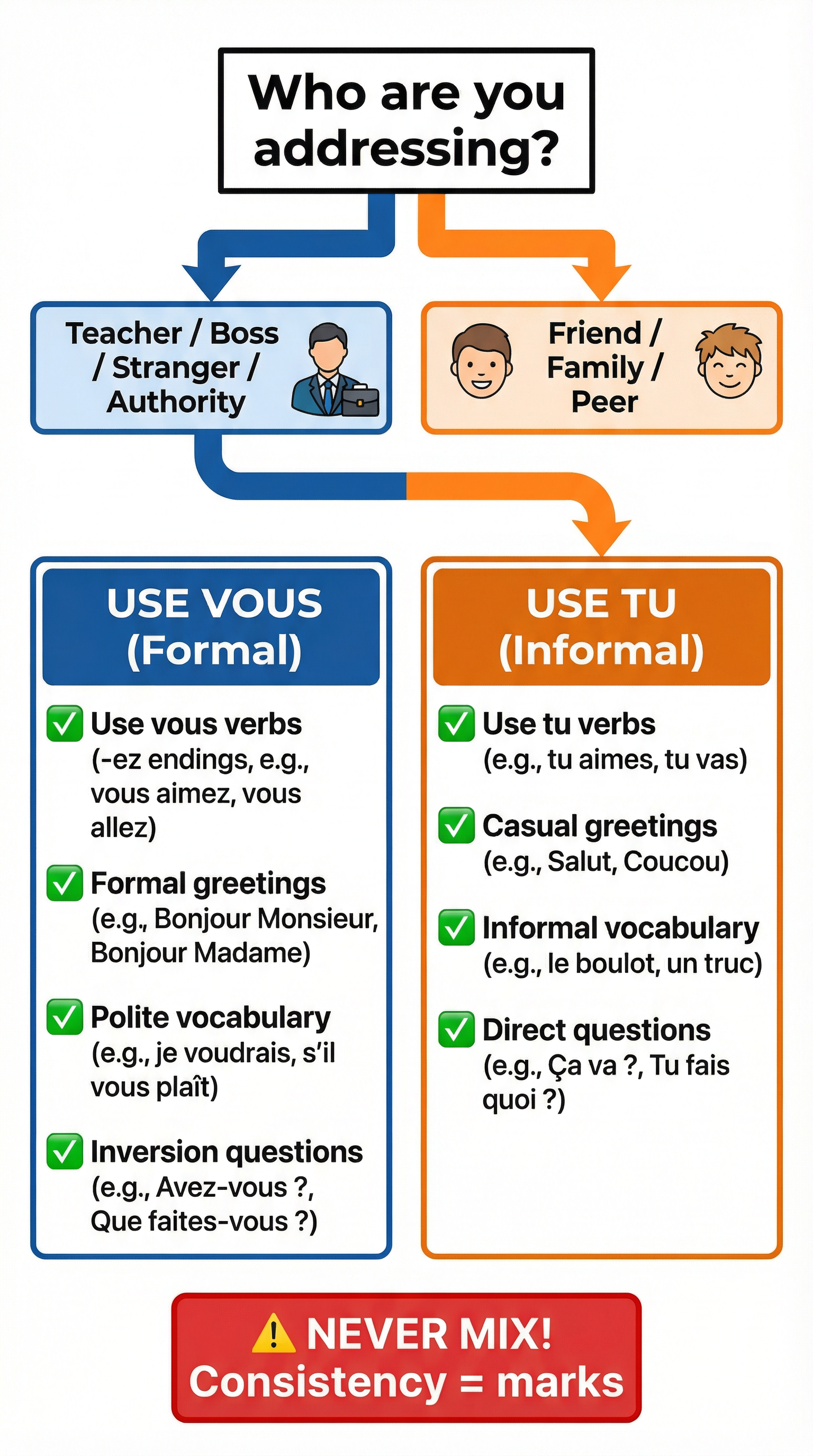
The decision tree above provides a clear framework for determining register. Before beginning any Writing or Speaking task, candidates must identify the target audience from the rubric. Ask yourself:
- Who am I addressing? If the task specifies a friend, family member, or peer, use tu. If it specifies a teacher, manager, stranger, or authority figure, use vous.
- What is the purpose? Transactional tasks (booking, complaining, applying) are almost always formal. Personal narratives to friends are informal.
- What does the examiner's greeting indicate? In Speaking role-plays, if the examiner greets you with Bonjour Monsieur/Madame, respond formally. If they use your first name or a casual tone, respond informally.
Once you have identified the register, commit to it and maintain consistency throughout. Mixing registers is the single most common error and will cap your Communication mark.
Exam Technique and Strategy
Time Management and Planning
For Writing tasks, allocate approximately 1 minute per mark for composition, plus 5 minutes for planning. During planning, note the register required and underline key verbs you will need in the correct form (tu or vous). This pre-planning reduces the risk of mid-task register shifts.
Consistency Checks
Before submitting any written work, perform a register audit:
- Have I used the correct pronoun (tu or vous) throughout?
- Are all verb endings consistent with my chosen register (-s/-x for tu, -ez for vous)?
- Do my greetings and closings match the register?
- Have I used register-appropriate vocabulary (e.g., emploi not boulot in formal contexts)?
In Speaking tasks, if you realize mid-response that you have used the wrong register, self-correct immediately. Examiners give credit for self-correction as it demonstrates linguistic awareness.
Command Word Strategies
Edexcel tasks use specific command words that signal register:
- "Write to your friend": Informal register, use tu, casual vocabulary.
- "Write a letter of application": Formal register, use vous, polite vocabulary, conditional mood.
- "You are booking a hotel room": Formal transactional context, use vous, inversion questions.
- "You are chatting with your exchange partner": Informal, use tu.
Pay close attention to these cues in the rubric.
Common Pitfalls to Avoid
- Inconsistency in address: Starting a letter with Cher Monsieur but then using tu verbs. This is the most frequent error and immediately limits marks.
- Imperative errors: Writing Parles! instead of Parle! for the tu imperative of -er verbs.
- Register mismatch in vocabulary: Using Salut or boulot in formal letters.
- Overuse of est-ce que in formal writing: While grammatically correct, inversion is stylistically superior at Higher Tier.
- Incorrect conditional forms: Writing je veux instead of je voudrais in polite requests.
Assessment Objective Alignment
Edexcel GCSE French assesses four Assessment Objectives (AOs), each weighted at 25%:
- AO1: Listening – Understanding spoken French in various contexts.
- AO2: Speaking – Communicating and interacting in French, including adapting register.
- AO3: Reading – Understanding written French.
- AO4: Writing – Communicating in writing, including register differentiation.
Register differentiation is explicitly assessed under AO2 (Speaking) and AO4 (Writing) through the Communication and Content mark grids. Candidates who demonstrate consistent, appropriate use of register access the highest mark bands (typically 13-16 marks out of 16 for Communication at Higher Tier).
Podcast: Formal vs Informal French
Listen to the podcast above for a 10-minute deep dive into formal and informal register, including worked examples, common mistakes, and a quick-fire recall quiz to test your knowledge.
Quick Summary
- Tu is for friends, family, and peers; verbs end in -s or -x.
- Vous is for teachers, bosses, strangers, and formal contexts; verbs end in -ez.
- Use conditional mood (je voudrais) for polite requests in formal contexts.
- Use inversion (Avez-vous?) for questions in formal writing.
- Never mix registers within a single task—consistency is essential for top marks.
- Formal greetings: Bonjour Monsieur/Madame; Informal greetings: Salut, Coucou.
- Formal closings: Cordialement; Informal closings: Bisous, À bientôt.
- Choose register-appropriate vocabulary: emploi (formal) vs boulot (informal).
- Perform a register audit before submitting written work.
- In Speaking, listen to the examiner's greeting to determine register.