Study Notes
Overview

Proof by Mathematical Induction is a cornerstone of A-Level Further Mathematics and a powerful tool for proving statements about all positive integers. It's a formal, logical argument that functions like a chain of dominoes: if you can prove the first one falls (the base case), and that any domino falling will knock over the next one (the inductive step), you can conclude that all the dominoes will fall. In your exam, this topic appears in the Core Pure papers and typically accounts for 5-7 marks per question. Examiners are looking for a highly structured, rigorous argument, so precision is key. This topic has strong synoptic links with Series, Matrices, and Number Theory, making it a crucial concept to master.
Key Concepts
The Four-Step Induction Framework
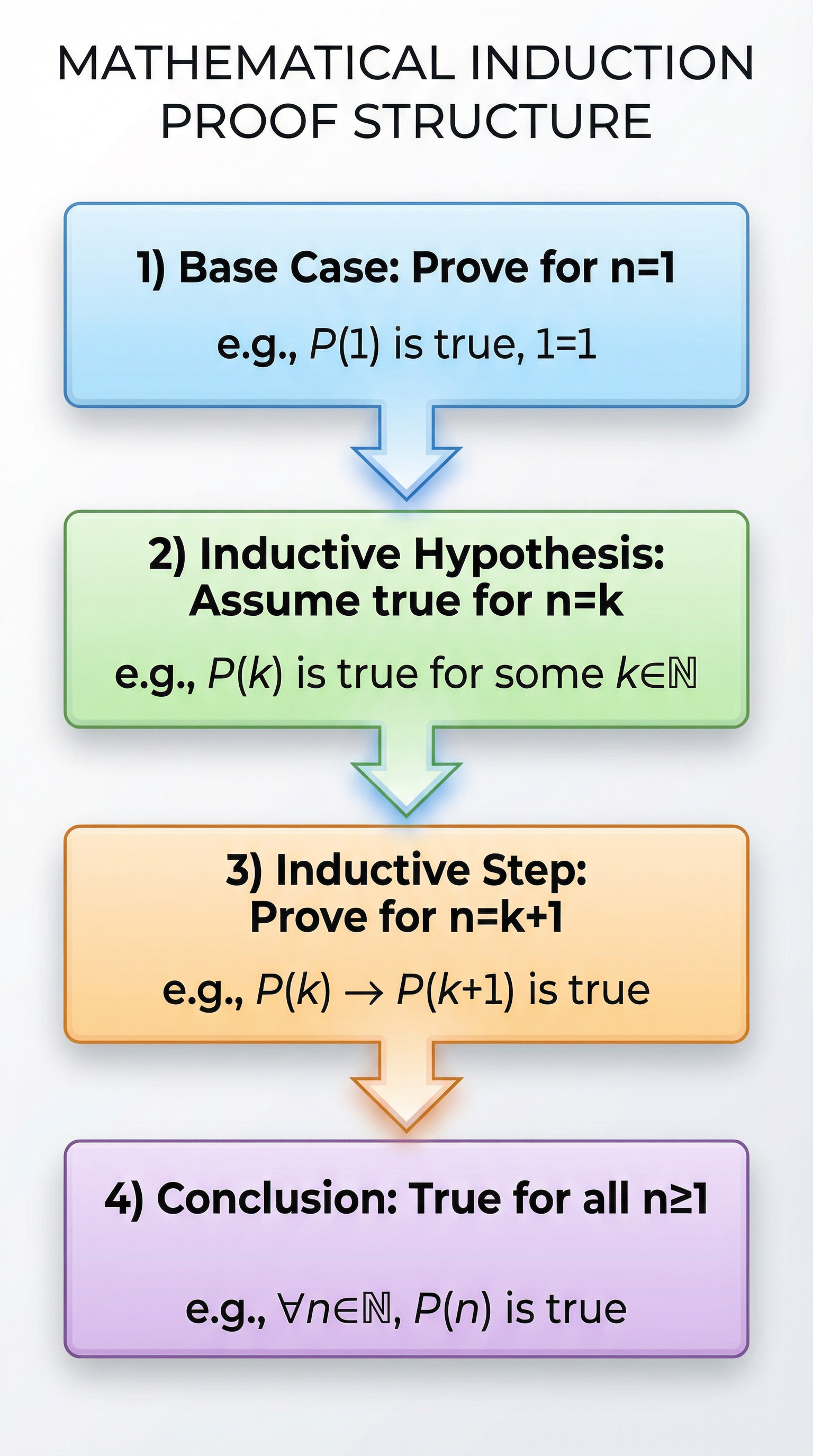
Mathematical induction follows a rigid four-step structure. Missing any of these steps will result in lost marks, particularly the final conclusion. Candidates must present their argument clearly, showing each logical stage.
-
Base Case (n=1): First, you must prove the statement is true for the smallest possible value of n, which is usually n=1. This is the 'first domino'. You must explicitly substitute n=1 into both sides of the statement and show they are equal. A B1 mark is awarded for this.
-
Inductive Hypothesis: Next, you assume the statement is true for some arbitrary positive integer, n=k. You are not proving anything here; you are simply stating the assumption that will be used in the next step. This is often written as "Assume the result is true for n=k". An M1 mark is often given for this statement.
-
Inductive Step (n=k+1): This is the core of the proof and where most algebraic manipulation occurs. You must prove that if the statement is true for n=k, then it must also be true for n=k+1. The goal is to manipulate the expression for n=k+1 until you can substitute the n=k assumption into it. This demonstrates that one domino falling causes the next to fall. This step attracts the majority of the method (M) and accuracy (A) marks.
-
Conclusion: Finally, you must write a concluding statement that ties everything together. This statement must be precise and reference the previous steps. A typical Edexcel-style conclusion is: "Since the statement is true for n=1, and if it is true for n=k then it is true for n=k+1, by the principle of mathematical induction, the statement is true for all positive integers n." This secures the final A1 cso (Correct Solution Only) mark.
Types of Induction Proofs
1. Summation of Series
This is the most common type of induction question. You will be asked to prove a formula for the sum of a series up to n terms.
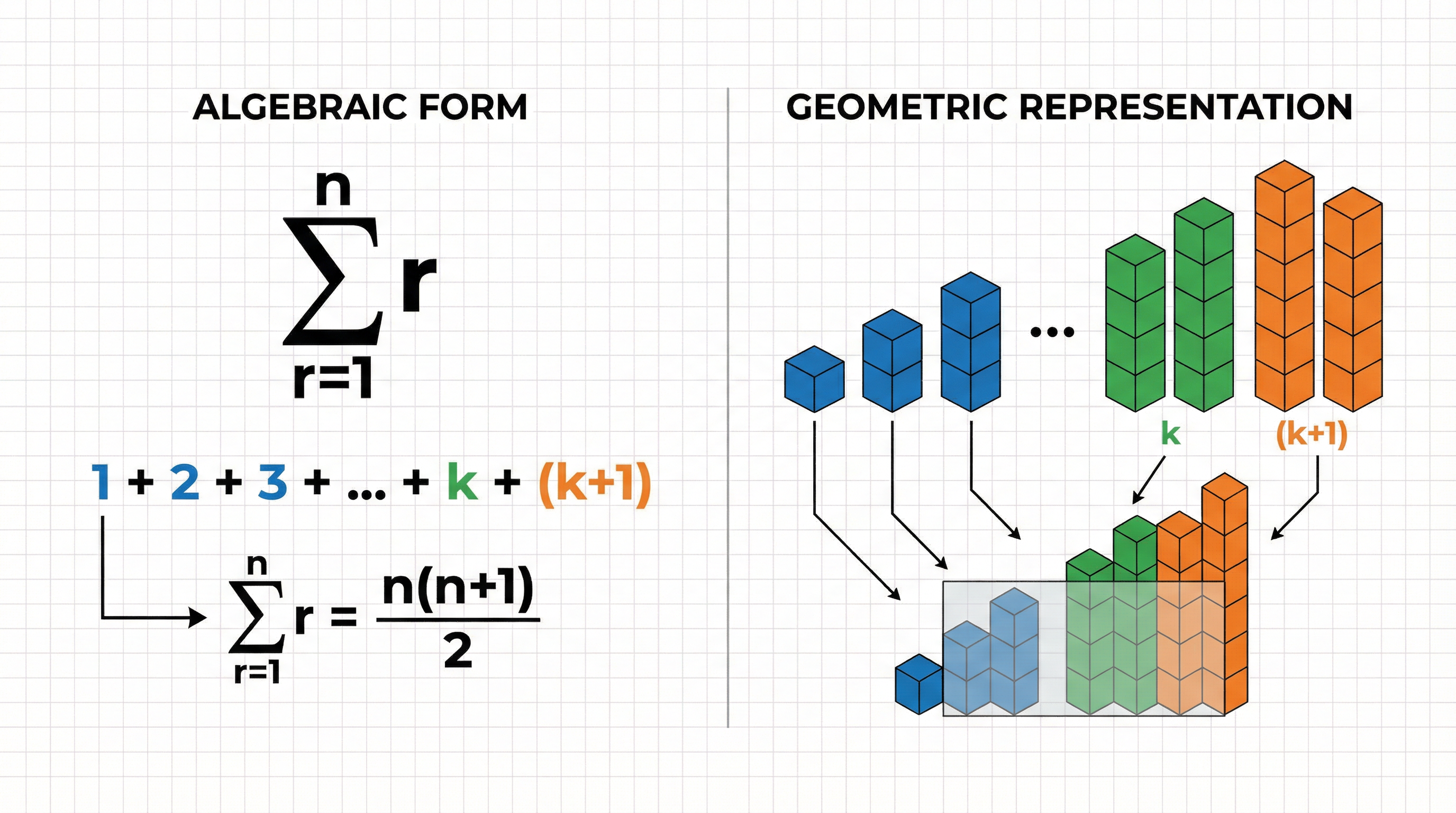
Example: Prove that for all positive integers n,
In the inductive step, you would start with the sum to k+1 terms, split it into the sum to k terms plus the (k+1)th term, and then substitute your assumption for the sum to k terms.
2. Divisibility
These proofs require you to show that a function f(n) is divisible by a certain integer for all n. The key is to relate f(k+1) to f(k).
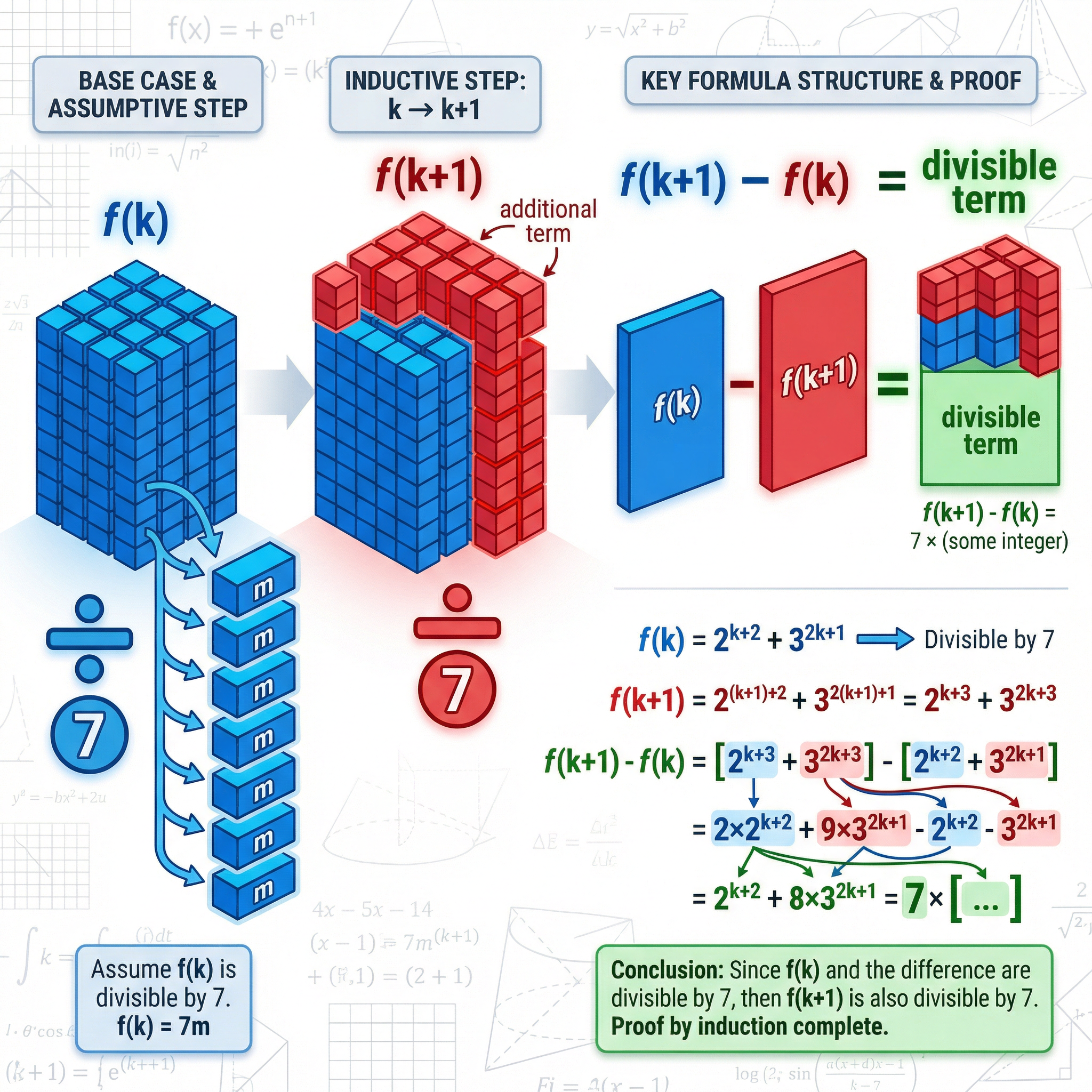
Example: Prove that
In the inductive step, you would analyse f(k+1) and try to express it in the form of f(k) plus another term that is clearly divisible by 8. A common technique is to consider f(k+1) - f(k).
3. Powers of Matrices
For these questions, you will be asked to prove a formula for the nth power of a given matrix.
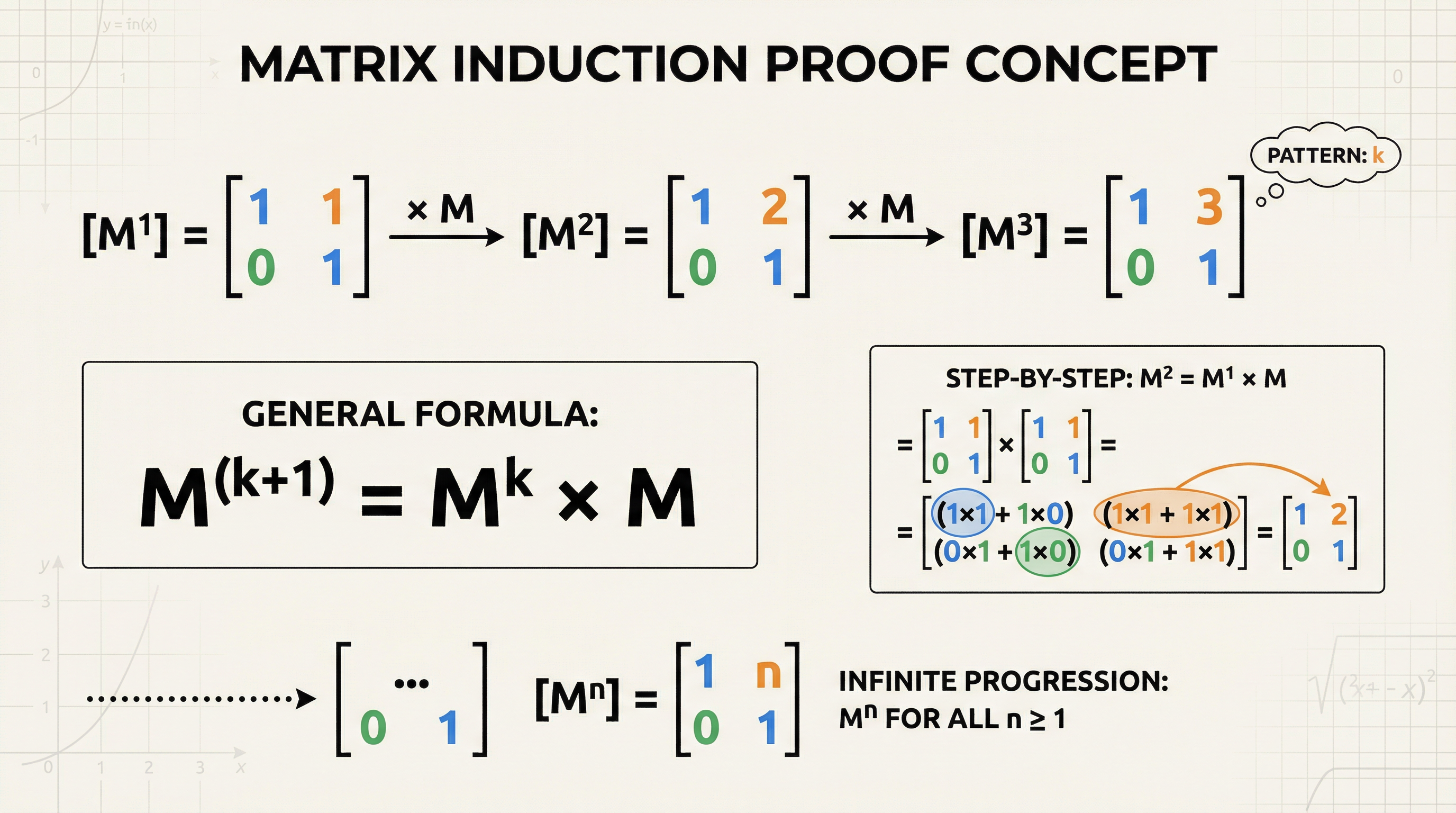
Example: Given the matrix
In the inductive step, you must show that