Study Notes
Overview
Welcome to the essential guide for topic 2.3, Inequalities, within the OCR GCSE Further Mathematics specification. This topic is a crucial extension of your work on quadratic equations and serves as a vital bridge to A-Level Mathematics. Mastery here involves moving beyond simple linear inequalities to solving quadratic inequalities, such as (x^2 - 4x + 3 > 0). Examiners frequently test this area to assess a candidate's ability to connect algebraic manipulation with graphical understanding. You will be expected to find critical values, sketch the corresponding parabola, and define the set of values that satisfy the inequality. This topic often integrates with others, particularly the discriminant, where you might be asked to find the range of values for a coefficient that results in a certain number of roots.
Key Concepts
Concept 1: Solving Quadratic Inequalities
A quadratic inequality involves a quadratic expression and an inequality symbol (<, >, ≤, ≥). The core task is to find the range or ranges of values for (x) that make the inequality true. The process is systematic and relies on a combination of algebra and graphical interpretation.
The Method:
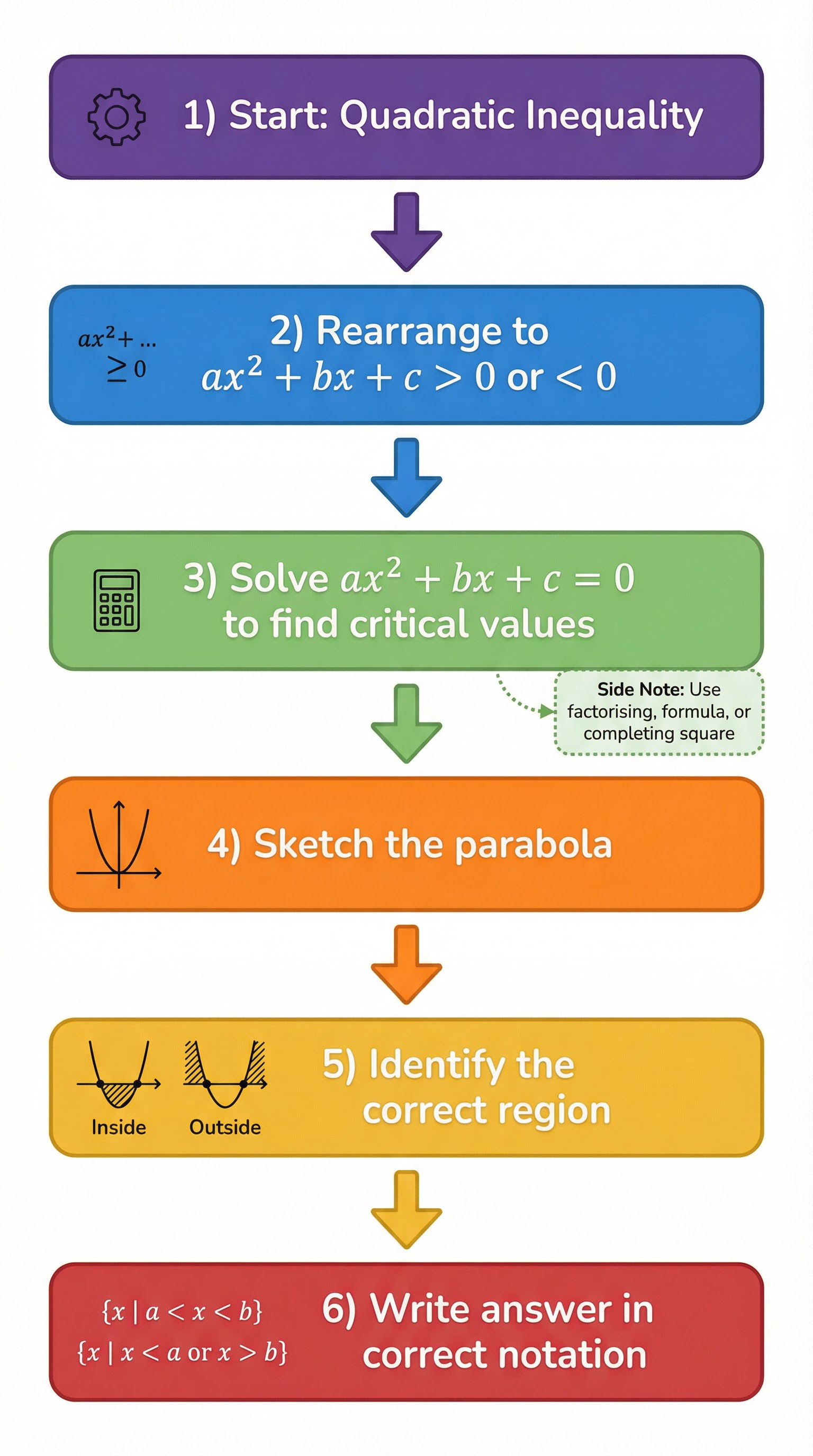
- Rearrange: Always begin by rearranging the inequality so that one side is zero, in the standard form (ax^2 + bx + c > 0) or (ax^2 + bx + c < 0). This is a non-negotiable first step to avoid sign errors.
- Find Critical Values: Temporarily replace the inequality sign with an equals sign and solve the resulting quadratic equation (ax^2 + bx + c = 0). The solutions, or roots, are your critical values. These are the points where the parabola crosses the x-axis. You can find them by factorising, using the quadratic formula, or completing the square.
- Sketch the Parabola: This is the most important step for securing full marks. You do not need a perfect, detailed graph. You only need to know two things:
- The shape: Is it a 'U-shape' (when (a > 0)) or an 'n-shape' (when (a < 0))?
- The roots: Where does it cross the x-axis (your critical values)?
- Identify the Region: Look back at your rearranged inequality.
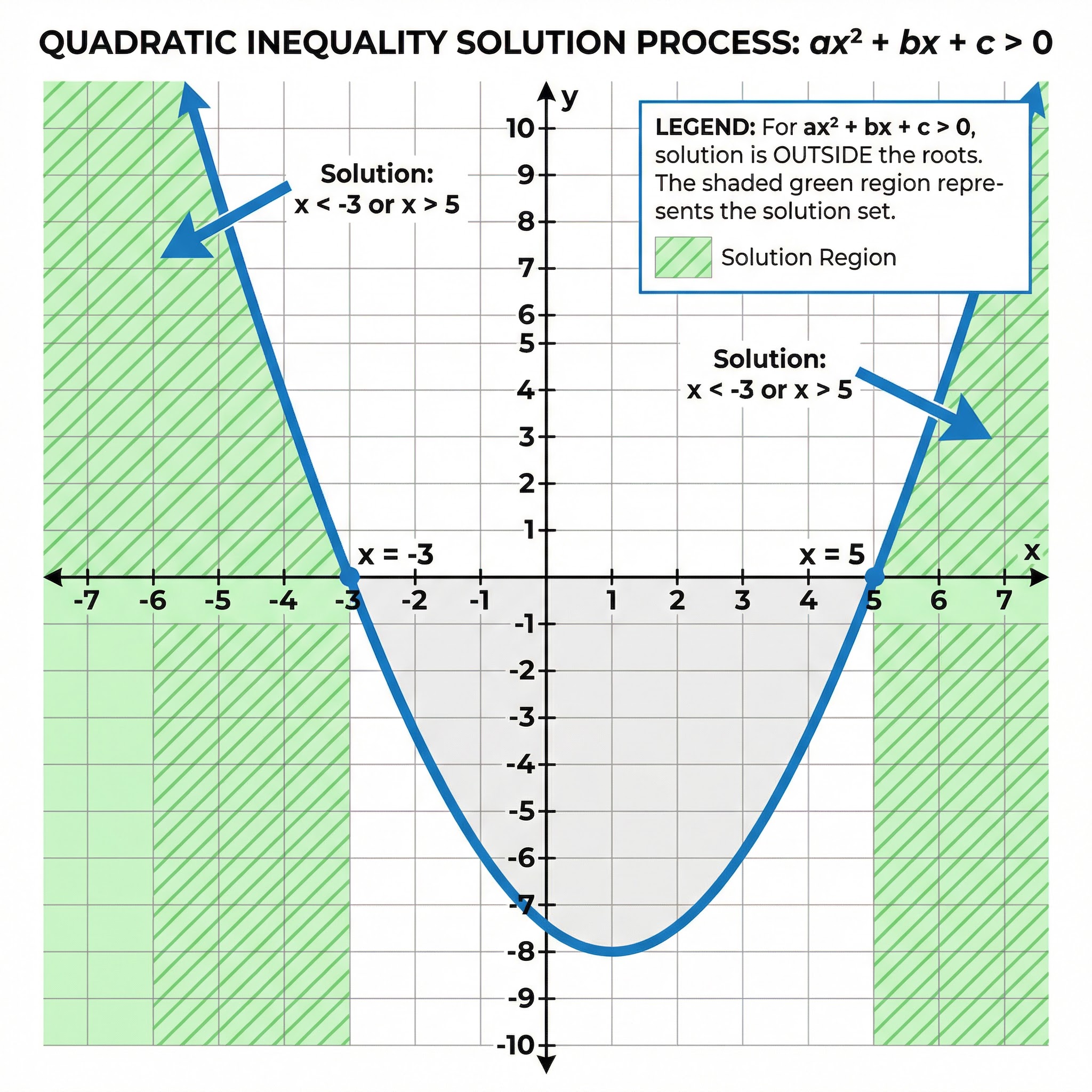
- If you have (ax^2 + bx + c > 0), you are looking for where the parabola is above the x-axis.
- If you have (ax^2 + bx + c < 0), you are looking for where the parabola is below the x-axis.
- Write the Solution: Express your final answer using correct inequality notation or set notation. For disjoint (separate) regions, you must use two separate inequalities joined by the word 'or'.
Mathematical Relationships
- Quadratic Formula: If factorising is difficult, use this to find critical values. For (ax^2 + bx + c = 0), the solutions are (x =
\frac{ -b \pm \sqrt{b ^2 - 4ac}}{2a}). (Given on formula sheet) The Discriminant ((\Delta = b^2 - 4ac)) : This is often linked to inequalities. For a quadratic to have 'real roots', the discriminant must be greater than or equal to zero ((b^2 -4ac \geq 0 )). This often creates a new quadratic inequality to solve. (Must memorise relationship)
Practical Applications
While abstract, quadratic inequalities have real-world applications in optimisation problems. For example, they can be used to determine the range of prices a company can set for a product to ensure its profit remains above a certain level. They are also used in physics to model the trajectory of a projectile, for instance, to find the time intervals during which a ball is above a certain height."