Study Notes
Overview
Vectors represent one of the most visually intuitive yet algebraically demanding topics in OCR GCSE Further Mathematics. Unlike standard GCSE, where vector work focuses primarily on addition and scalar multiplication, Further Mathematics candidates are expected to construct sophisticated vector paths through multi-point geometric figures, manipulate expressions involving multiple unknown scalars, and provide rigorous proofs of geometric properties such as collinearity and parallelism. The topic appears consistently in Paper 1, typically commanding 8-12 marks across two or three questions. Examiners favour questions that combine vector path construction with algebraic manipulation, requiring candidates to equate coefficients and solve simultaneous equations. Success in this topic hinges on three core competencies: maintaining correct directional signs when traversing vector paths, simplifying complex expressions into the standard form ka + mb, and articulating geometric conclusions with precision. The visual nature of vectors makes them accessible, yet the algebraic rigour required means that careless notation or incomplete reasoning costs marks rapidly. Master this topic, and you'll find it becomes one of the most reliable sources of marks in the entire specification.
Key Concepts
Concept 1: Vector Notation and Representation
A vector is a mathematical quantity possessing both magnitude (size) and direction, distinguishing it fundamentally from scalar quantities that have magnitude alone. In OCR examinations, vectors are represented in column notation, such as a = (3 \ 4), indicating a displacement of 3 units horizontally and 4 units vertically. The critical aspect of notation cannot be overstated: in handwritten work, you must use either an arrow over the letter (→a) or an underline (a̲) to distinguish vectors from scalar variables. Omitting this notation is treated as a fundamental error and will result in mark deductions. The examiner cannot infer your intent if 'a' appears without notation—it could represent a scalar coefficient, a variable, or a vector. This strictness reflects the mathematical precision required at Further Mathematics level.
Column vectors follow the convention (x \ y), where x represents horizontal displacement (positive rightward, negative leftward) and y represents vertical displacement (positive upward, negative downward). The magnitude of a vector a = (x \ y) is calculated using Pythagoras' theorem: |a| = √(x² + y²). However, magnitude calculations rarely appear in OCR questions; the focus is overwhelmingly on algebraic manipulation and geometric proof.
Example: If a = (2 \ 5) and b = (-3 \ 1), then a + b = (-1 \ 6), representing the resultant displacement when both vectors are applied sequentially.
Concept 2: Vector Paths and Direction
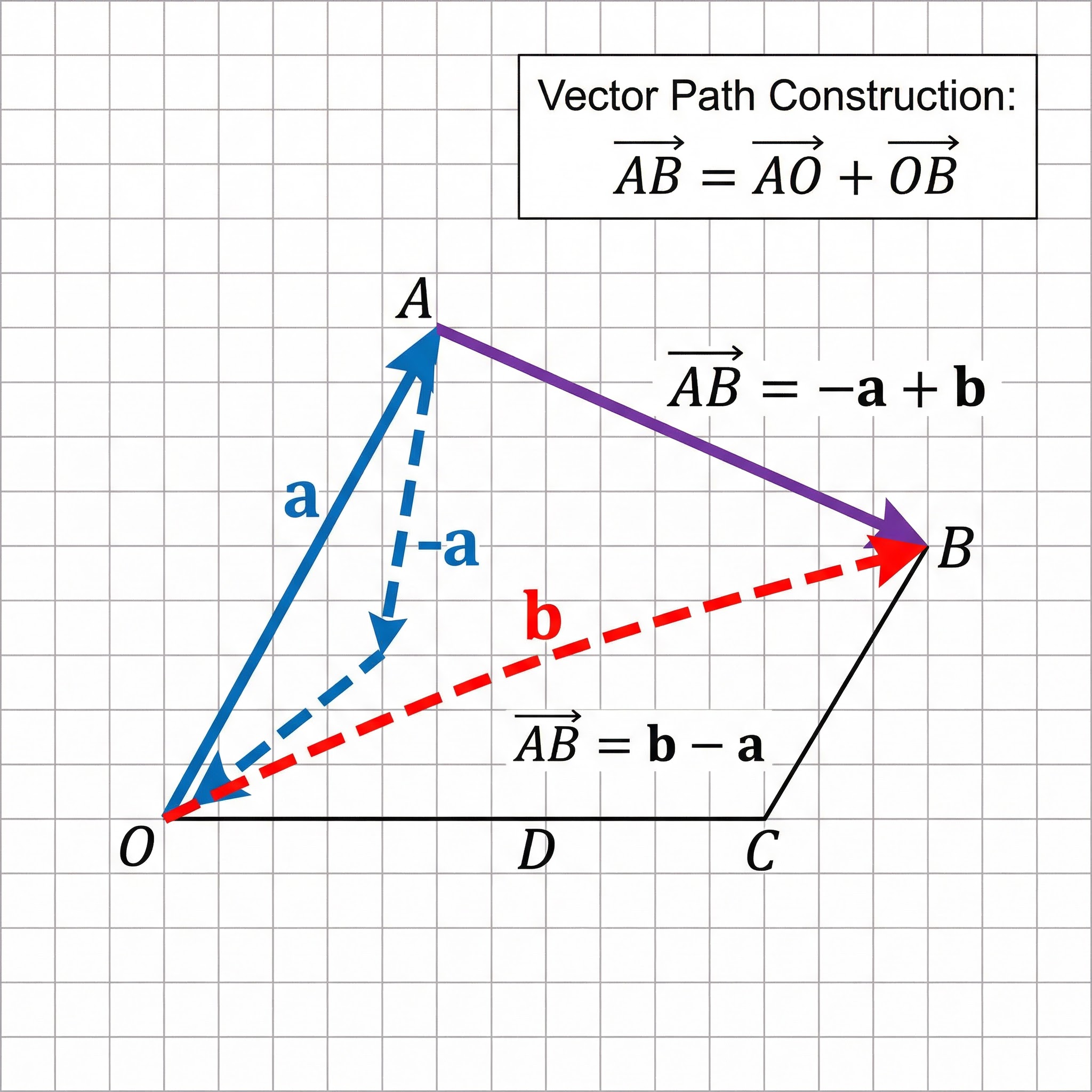
The cornerstone skill in OCR vector questions is constructing vector paths between points in geometric figures. Given a diagram with points O, A, B, C, and vectors defined from the origin O, you must express vectors between any two points using the given vectors. The fundamental rule is: to travel from point X to point Y, construct a path via intermediate points, summing vectors along the route.
For instance, to find AB when you know OA = a and OB = b, recognise that you must first travel backwards from A to O (which is -a), then forward from O to B (which is b). Therefore: AB = AO + OB = -a + b = b - a. This is where candidates most frequently lose marks: reversing direction means negating the vector. If the arrow in the diagram points from O to A, then OA = a, but AO = -a. Trace the path carefully on the diagram, noting each direction change.
When simplifying vector expressions, always collect like terms to express the result in the form ka + mb, where k and m are scalar coefficients. An unsimplified expression such as 3a - 2b + a + 4b will not earn full marks; you must simplify to 4a + 2b.
Example: In quadrilateral OABC, if OA = a, OB = b, and OC = a + b, find AC. Solution: AC = AO + OC = -a + (a + b) = b.
Concept 3: Proving Collinearity
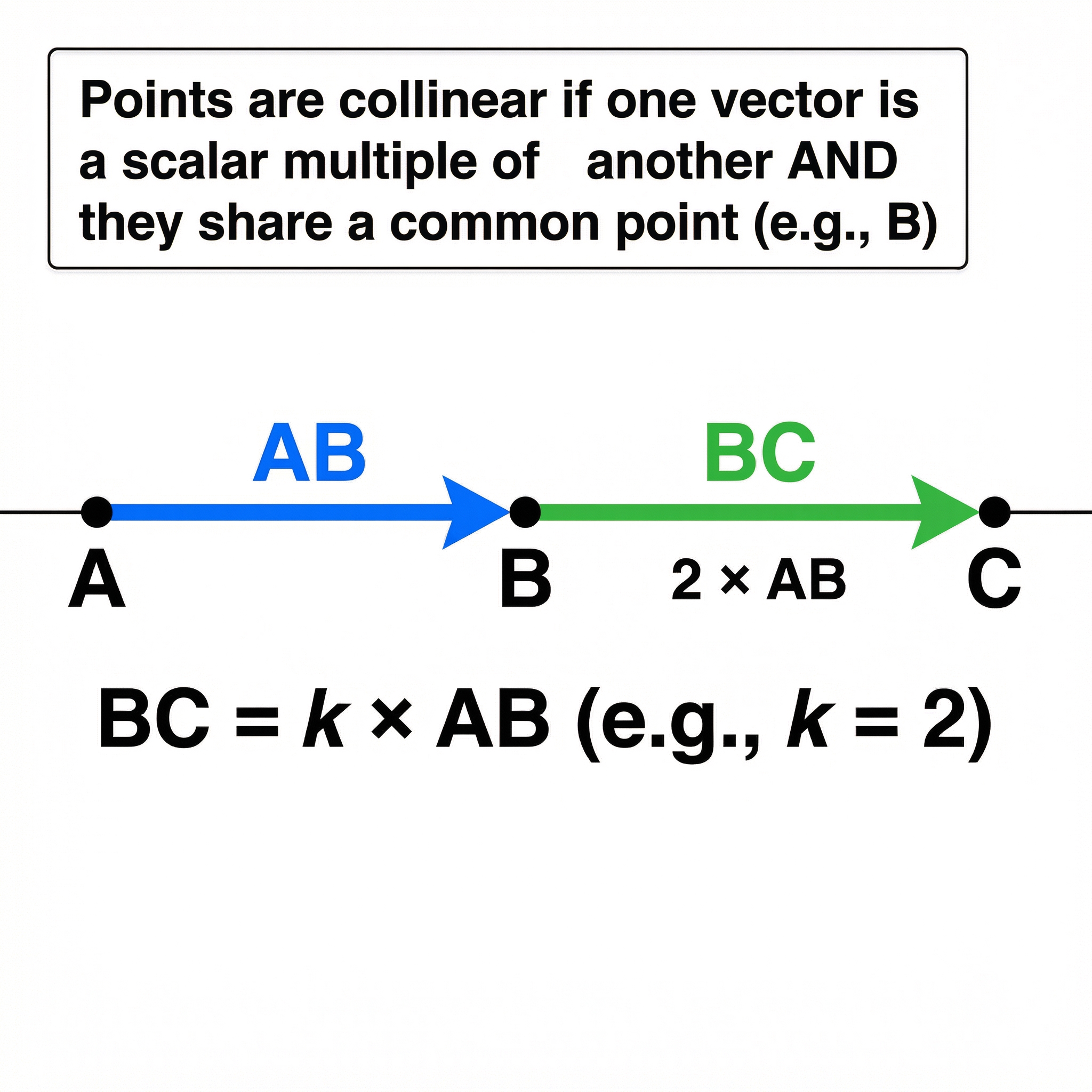
Collinearity questions are a staple of OCR Further Mathematics papers, typically worth 4-5 marks. Three points A, B, and C are collinear if they lie on the same straight line. To prove collinearity, you must demonstrate two conditions:
- One vector is a scalar multiple of another (e.g., BC = k × AB for some scalar k)
- The vectors share a common point (e.g., both pass through point B)
The algebraic process involves expressing both AB and BC in terms of the given vectors, then showing one is a multiple of the other. However, the algebra alone is insufficient. OCR mark schemes explicitly require a concluding statement: "AB and BC are parallel because BC = k × AB, and they share the common point B, therefore A, B, and C are collinear." Candidates who perform the algebra correctly but omit this conclusion lose the final mark. The examiner is testing your ability to connect algebraic results to geometric meaning.
Example: Given OA = 2a, OB = 3a + 2b, OC = 4a + 4b, prove A, B, C are collinear.
Solution:
- AB = OB - OA = (3a + 2b) - 2a = a + 2b
- BC = OC - OB = (4a + 4b) - (3a + 2b) = a + 2b
- Since BC = AB, they are parallel and share point B.
- Therefore, A, B, and C are collinear.
Concept 4: Dividing a Line in a Given Ratio
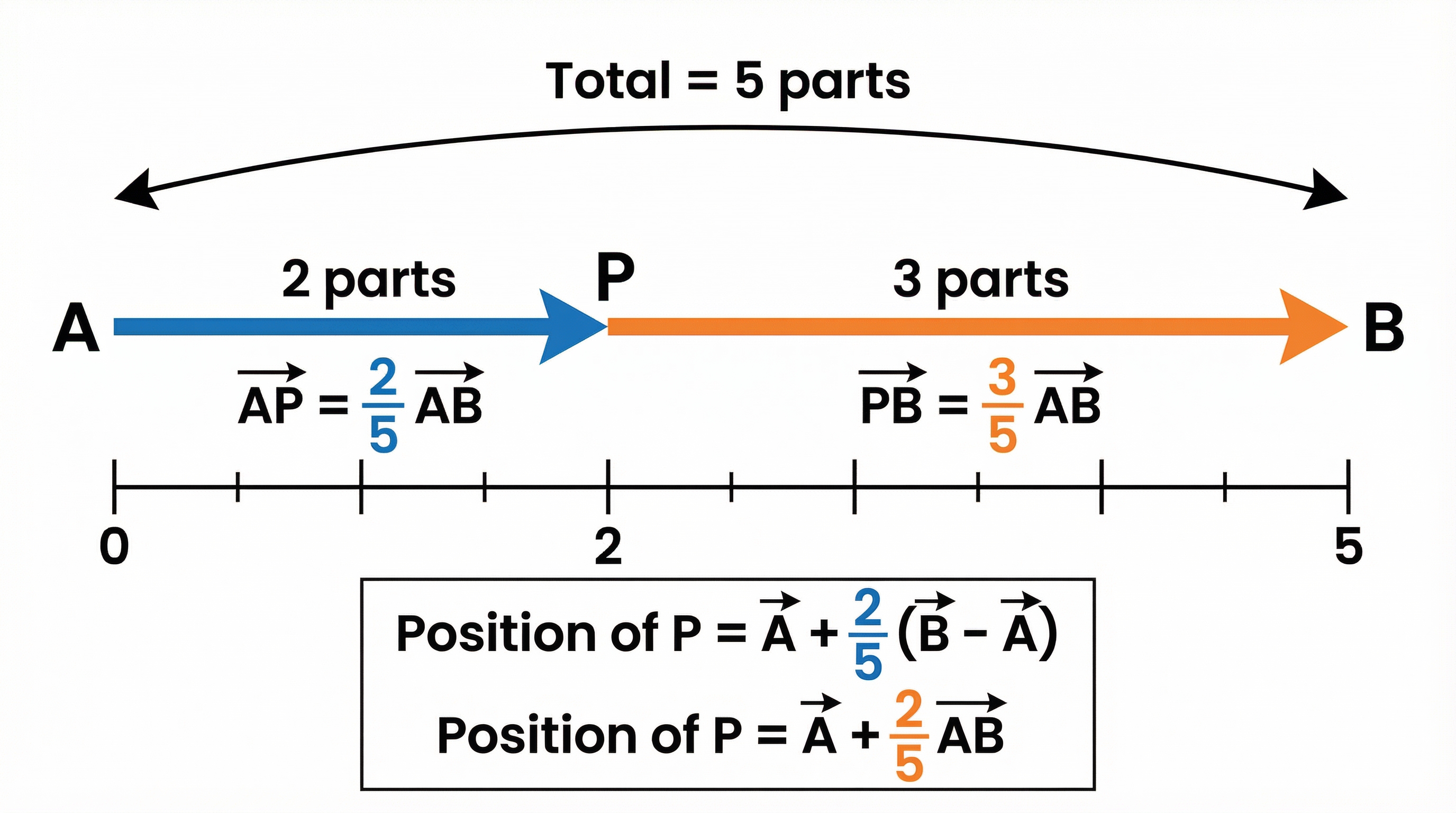
Questions asking for the position vector of a point that divides a line segment in a given ratio appear frequently and cause confusion if the method is not clearly understood. If point P divides line segment AB in the ratio m:n, then P is located such that AP:PB = m:n. The key insight is that the total number of parts is m + n, so:
- AP = (m/(m+n)) × AB
- PB = (n/(m+n)) × ABTo find the position vector OP, use: OP = OA + AP = OA + (m/(m+n)) × AB. Since AB = OB - OA, substitute and simplify.
Example: Point P divides AB in the ratio 2:3. Given OA = a and OB = b, find OP.
Solution:
- Total parts = 2 + 3 = 5
- AP = (2/5) × AB = (2/5) × (b - a)
- OP = OA + AP = a + (2/5)(b - a) = a + (2/5)b - (2/5)a = (3/5)a + (2/5)bA common error is using the ratio components directly as fractions without adding them to find the denominator. Always draw a small diagram showing the parts to avoid this mistake.
Concept 5: Solving for Unknown Scalars
Advanced OCR questions present geometric figures where some vectors are expressed as scalar multiples of base vectors, and you must solve for unknown scalars. This typically involves equating coefficients of a and b separately to form simultaneous equations. For instance, if you derive that OX = (2λ + 3)a + (4λ - 1)b and you're told that OX = 7a + 11b, then:
- Equating coefficients of a: 2λ + 3 = 7 → λ = 2
- Equating coefficients of b: 4λ - 1 = 11 → λ = 3
If these give different values, check your algebra—there's likely an error in your vector path construction. If they agree, you've found the correct scalar. This technique is fundamental when proving properties like "X is the midpoint of AB" or "lines intersect at a specific point."
Mathematical Relationships
Core Vector Operations
Vector Addition: a + b = (a₁ \ a₂) + (b₁ \ b₂) = (a₁ + b₁ \ a₂ + b₂)
Scalar Multiplication: ka = k(a₁ \ a₂) = (ka₁ \ ka₂)
Vector Subtraction: a - b = a + (-b)
Magnitude: |a| = √(a₁² + a₂²) [Rarely examined in OCR Further Maths]
Key Geometric Relationships
Parallel Vectors: a and b are parallel if a = kb for some scalar k
Collinear Points: A, B, C are collinear if AB = kBC and they share a common point
Midpoint: If M is the midpoint of AB, then OM = (OA + OB)/2
Ratio Division: If P divides AB in ratio m:n, then OP = [nOA + mOB]/(m+n)
Practical Applications
While vectors in Further Mathematics are presented in abstract geometric contexts, they have profound applications in physics and engineering. Displacement, velocity, and force are all vector quantities. In navigation, vectors describe aircraft flight paths accounting for wind velocity. In computer graphics, vectors define object positions and transformations. Structural engineers use vectors to analyse forces in bridge trusses and building frameworks. Understanding vector addition and resolution is essential for calculating resultant forces in mechanics. The algebraic skills you develop here—manipulating expressions, equating coefficients, solving simultaneous equations—are foundational for A-Level Mathematics and Physics, where vectors extend into three dimensions and incorporate dot and cross products.
Listen to the Podcast
Listen to this 10-minute podcast episode for an engaging audio walkthrough of vectors, covering core concepts, exam tips, common mistakes, and a quick-fire recall quiz. Perfect for revision on the go!