Study Notes
Overview
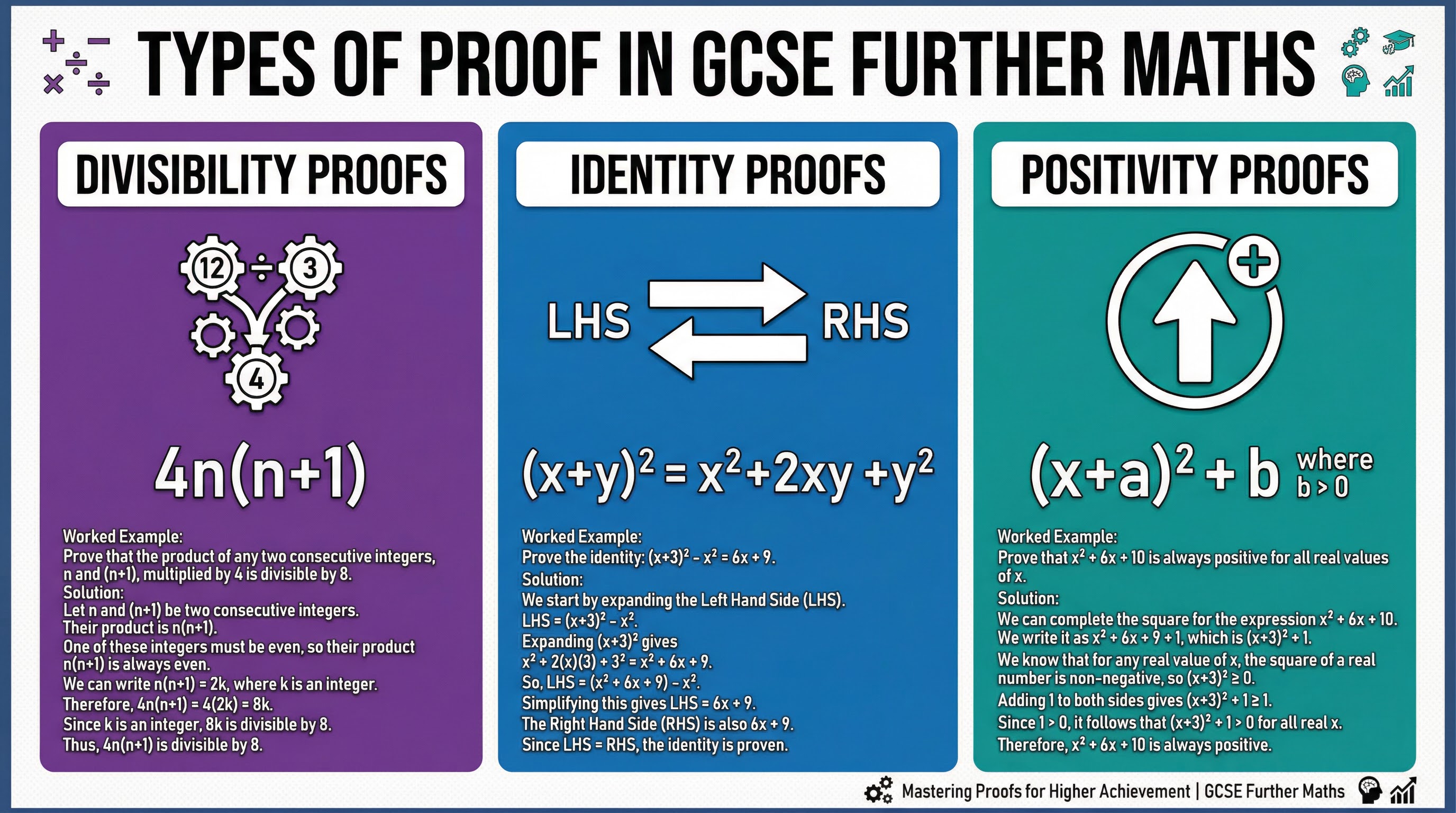
Proof represents a fundamental shift in mathematical thinking. Rather than verifying statements with numerical examples, candidates must construct general algebraic arguments that demonstrate truth for all possible values. In OCR Level 2 Further Mathematics, proof questions typically carry 4 to 6 marks and assess your ability to define terms precisely, manipulate algebra correctly, and communicate logical reasoning clearly. The specification emphasizes three core proof types: divisibility proofs (showing expressions are always divisible by specific integers), identity proofs (demonstrating two expressions are algebraically equivalent), and positivity proofs (proving expressions remain positive for all real values). These questions appear regularly on both Foundation and Higher tier papers, with Higher tier candidates expected to handle more complex algebraic manipulation and multi-step reasoning. Understanding proof not only secures marks in this topic but also strengthens your algebraic fluency across the entire specification, particularly in topics like quadratic expressions, factorization, and algebraic fractions. The assessment objective weighting reveals the emphasis: AO1 (knowledge) accounts for just 20%, while AO2 (application) dominates at 70%, with AO3 (problem-solving) contributing 10%. This distribution confirms that examiners reward your ability to apply proof techniques systematically rather than simply recalling definitions.
Key Concepts
Concept 1: Algebraic Definitions of Integer Types
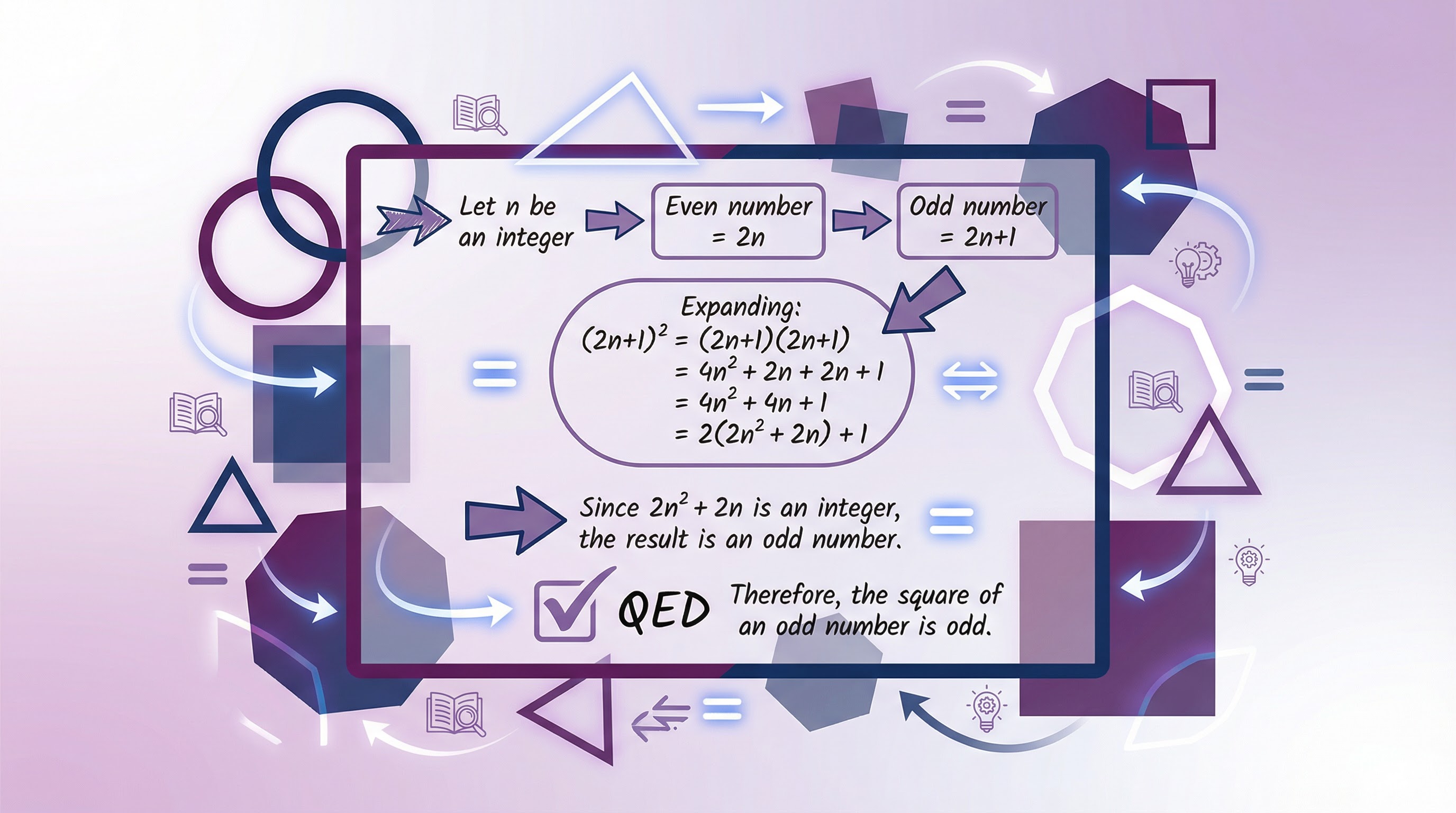
The foundation of every proof lies in defining your terms using correct algebraic notation. An even integer is always expressed as 2n, where n is an integer. This representation captures the essential property of even numbers: they are divisible by 2. Conversely, an odd integer is expressed as 2n + 1, which can never be divisible by 2 because it leaves a remainder of 1. Consecutive integers are represented as n and n + 1, ensuring they differ by exactly 1. These definitions are not arbitrary conventions; they are the algebraic language that allows you to prove statements universally. Using the wrong definition—such as representing an odd number as simply n—is a fatal error that invalidates your entire proof and earns zero marks. Examiners award a dedicated Method mark (M1) for correctly defining terms at the start of your proof, so this step is non-negotiable.
Example: If asked to prove a statement about even numbers, you must begin with "Let n be an integer, so an even number can be written as 2n." This earns the first mark and establishes the algebraic framework for your argument.
Concept 2: Divisibility Proofs
Divisibility proofs require you to demonstrate that an expression is always divisible by a specific integer, regardless of the value of the variable. The strategy involves algebraic manipulation to factorize the expression, revealing the required divisor explicitly. For instance, to prove that the product of two consecutive integers is always even, you start by defining consecutive integers as n and n + 1. Their product is n(n + 1). Since one of these consecutive integers must be even (even and odd alternate), their product contains a factor of 2, making it even. The critical final step is stating your conclusion explicitly: "Since n(n + 1) contains a factor of 2, the product of two consecutive integers is always even." Examiners look for this concluding statement to award the final accuracy mark (A1).
Example: Prove that 4n(n + 1) is always divisible by 8. Solution: Let n be an integer. Consider 4n(n + 1). Since n and n + 1 are consecutive integers, one of them must be even. Therefore, n(n + 1) is even and can be written as 2k, where k is an integer. Substituting, 4n(n + 1) = 4(2k) = 8k. Since k is an integer, 8k is divisible by 8. Therefore, 4n(n + 1) is always divisible by 8.
Concept 3: Identity Proofs
Identity proofs demonstrate that two algebraic expressions are equivalent for all values of the variable. The golden rule is: never work across the equals sign. Treating the identity as an equation to solve leads to circular reasoning and earns zero marks. Instead, you select one side (typically the more complex left-hand side, or LHS) and manipulate it step-by-step until it matches the right-hand side (RHS). Every intermediate step must be shown. If you expand brackets, write the unsimplified form before collecting like terms. This transparency allows examiners to award Method marks even if your final answer contains an error. The structure is: LHS = [expansion] = [simplification] = RHS, therefore the identity is proven.
Example: Prove the identity (x + 3)² - x² = 6x + 9. Solution: Start with the LHS: (x + 3)² - x². Expand (x + 3)²: (x + 3)(x + 3) = x² + 3x + 3x + 9 = x² + 6x + 9. Substitute back: LHS = x² + 6x + 9 - x² = 6x + 9 = RHS. Therefore, the identity is proven.
Concept 4: Positivity Proofs Using Completing the Square
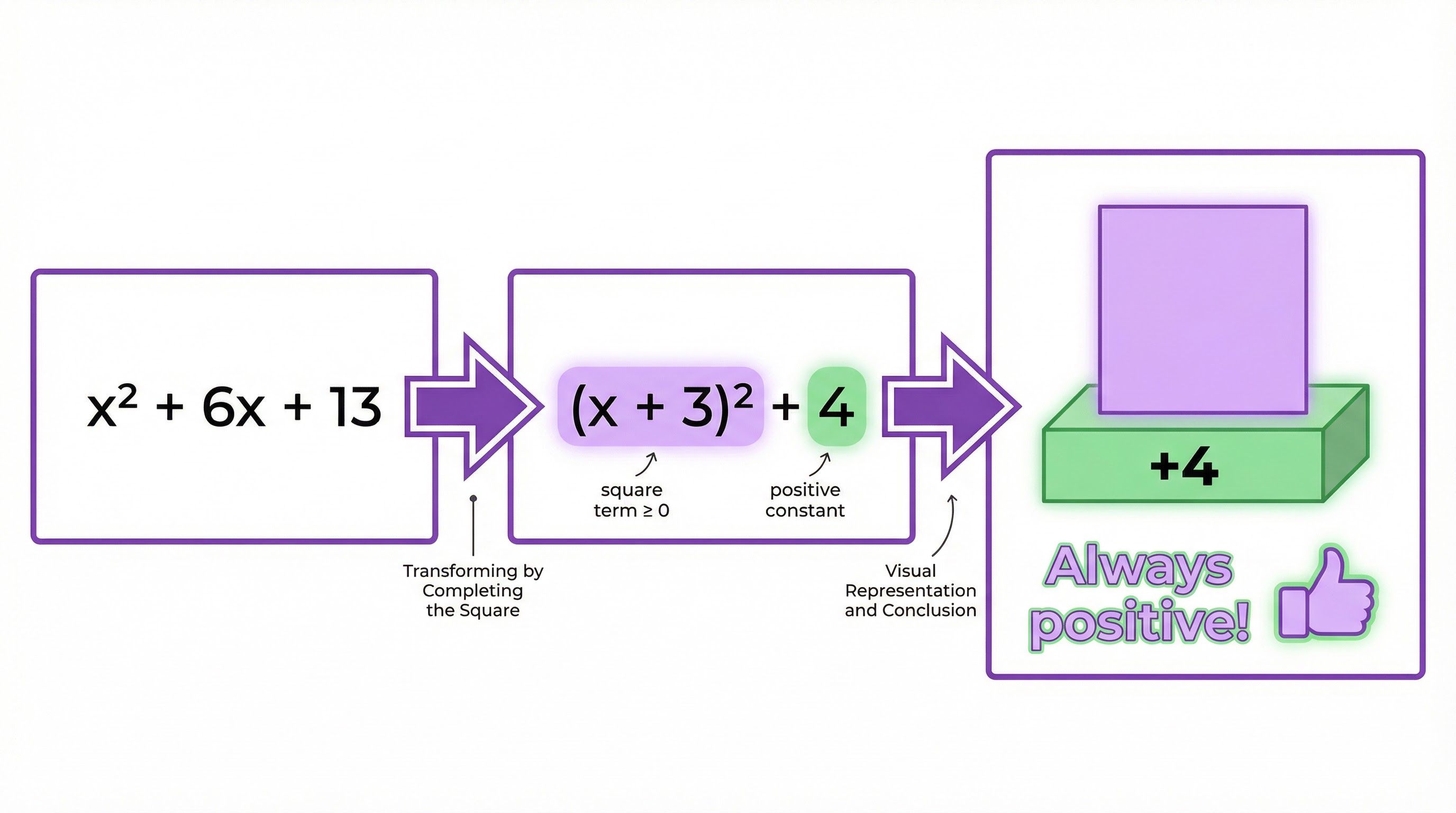
Positivity proofs require you to demonstrate that a quadratic expression is positive for all real values of the variable. The technique is completing the square, which transforms the expression into the form (x + a)² + b, where b > 0. This form is always positive because (x + a)² ≥ 0 for all real x (a squared term is never negative), and adding a positive constant b ensures the entire expression is positive. The method involves halving the coefficient of x, squaring it, and adjusting the constant term accordingly. The final step is stating: "Since (x + a)² ≥ 0 and b > 0, the expression is always positive for all real values of x."
Example: Prove that x² + 6x + 13 is always positive for all real values of x. Solution: Complete the square. x² + 6x + 13 = (x + 3)² - 9 + 13 = (x + 3)² + 4. Since (x + 3)² ≥ 0 for all real x, and 4 > 0, we have (x + 3)² + 4 ≥ 4 > 0. Therefore, x² + 6x + 13 is always positive for all real values of x.
Concept 5: The Four-Step Proof Structure
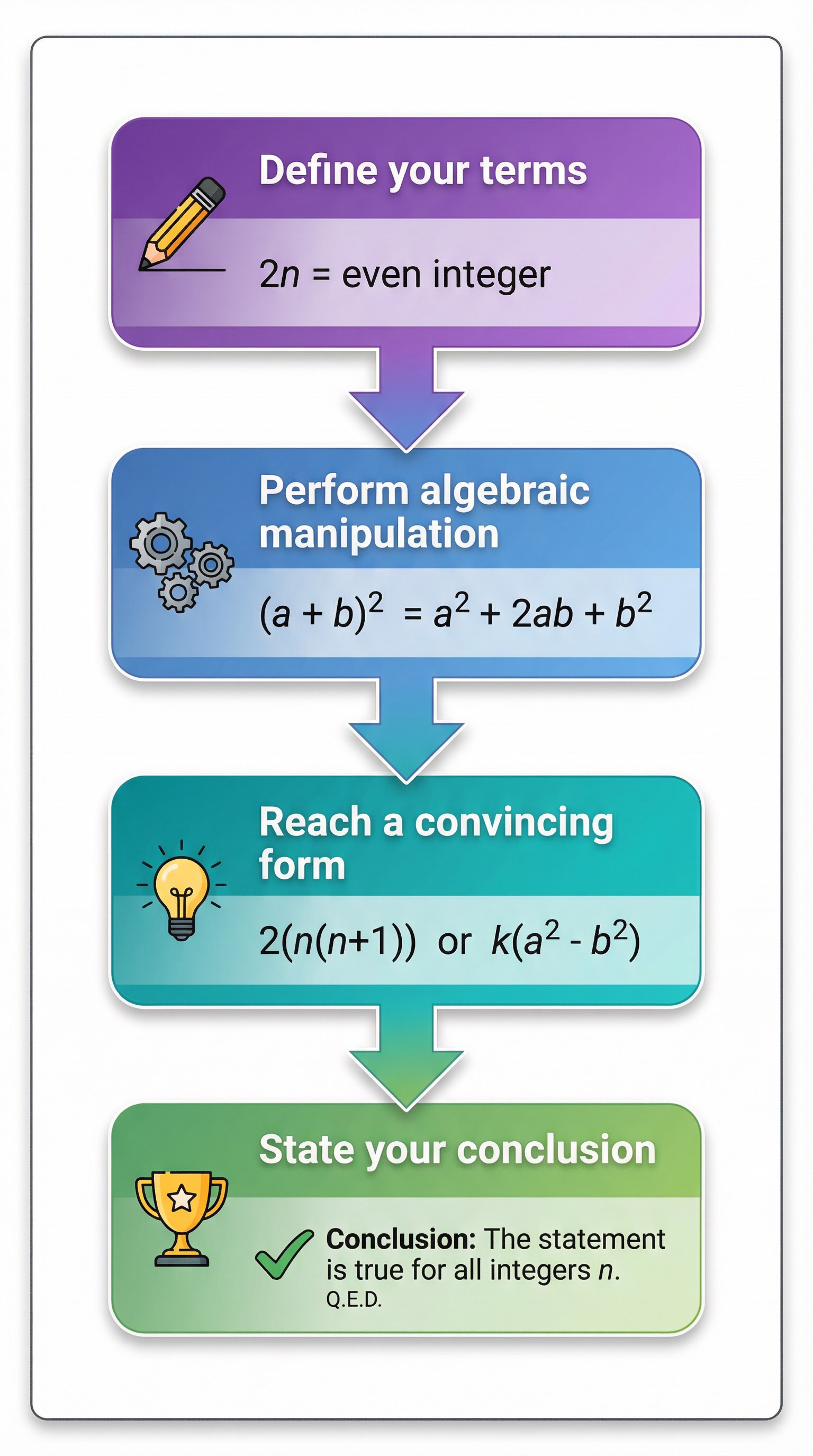
Every successful proof follows a universal four-step structure that examiners expect to see. Step 1: Define your terms. Use correct algebraic notation (2n for even, 2n + 1 for odd, n and n + 1 for consecutive). This earns M1. Step 2: Perform algebraic manipulation. Expand, factorize, or rearrange the expression using valid algebraic operations. Show all intermediate steps. This earns M1. Step 3: Reach a convincing form. Your algebra should lead to an expression that clearly demonstrates the required property (e.g., a multiple of the divisor, or a perfect square plus a positive constant). This earns A1. Step 4: State your conclusion. Write "Therefore" or "Hence" followed by a restatement of what you have proven. This earns the final A1. Omitting the conclusion is the most common error and costs you an easy mark.
Mathematical Relationships
Algebraic Identities (Must Memorise)
- (a + b)² = a² + 2ab + b² — Essential for expanding and completing the square
- (a - b)² = a² - 2ab + b² — Used in difference of squares proofs
- a² - b² = (a + b)(a - b) — Difference of two squares, critical for factorization proofs
- Completing the square: x² + bx = (x + b/2)² - (b/2)²
Integer Representations (Must Memorise)
- Even integer: 2n (where n ∈ ℤ)
- Odd integer: 2n + 1 (where n ∈ ℤ)
- Consecutive integers: n, n + 1 (where n ∈ ℤ)
- Consecutive even integers: 2n, 2n + 2 (where n ∈ ℤ)
- Consecutive odd integers: 2n + 1, 2n + 3 (where n ∈ ℤ)
Key Properties
- The product of an even integer and any integer is always even.
- The sum of two odd integers is always even.
- The sum of an even integer and an odd integer is always odd.
- For any real number x, x² ≥ 0 (a squared term is non-negative).
Practical Applications
While proof may seem abstract, it underpins critical thinking in computer science (algorithm correctness), engineering (structural integrity calculations), cryptography (security protocols), and law (logical argumentation). In pure mathematics, proof techniques extend to A-Level topics such as mathematical induction, proof by contradiction, and formal logic. Understanding proof at GCSE level builds the rigorous reasoning skills required for university-level mathematics, physics, and philosophy.
Listen to the Podcast
Listen to this 10-minute podcast episode for a comprehensive audio walkthrough of proof techniques, exam strategies, and common pitfalls. Perfect for revision on the go!