Study Notes
Overview
Sequences are a fundamental concept in Further Mathematics, extending far beyond the linear progressions studied at GCSE. This topic is crucial as it tests not only your algebraic manipulation skills but also your ability to recognise patterns, generalise rules, and understand the long-term behaviour of mathematical series. For the OCR Level 2 qualification, a mastery of sequences is non-negotiable for achieving a top grade. Examiners will expect candidates to confidently handle quadratic sequences, geometric progressions, and recurrence relations with a high degree of precision. Questions often combine these concepts and link to other areas of the specification, such as functions and graphing, making it a vital synoptic link. Expect to see questions that require you to derive and verify nth term formulae, determine if a number belongs to a sequence, and calculate the limiting value of a sequence as it tends to infinity. Success here demonstrates a deep mathematical understanding and a methodical, rigorous approach to problem-solving.
Key Concepts
Concept 1: Quadratic Sequences
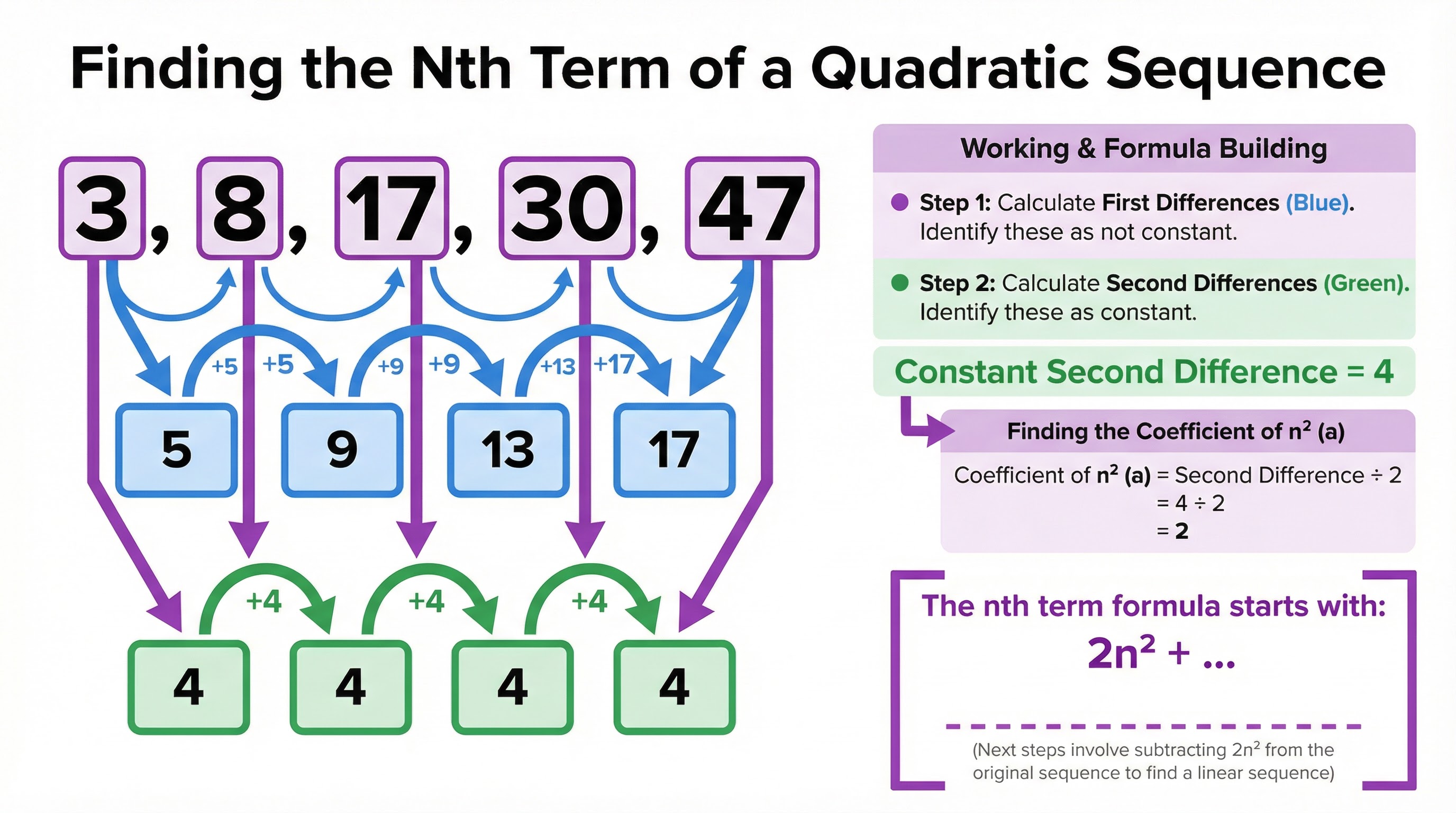
A quadratic sequence is a sequence of numbers in which the second difference between any two consecutive terms is constant. The general form of the nth term is an² + bn + c, where a, b, and c are constants. This is a significant step up from linear (arithmetic) sequences, which only have a constant first difference.
To find the nth term of a quadratic sequence, you must follow a systematic process that examiners look for. The key is that the coefficient of the n² term, 'a', is always half of the constant second difference.
Example: Consider the sequence 3, 8, 17, 30, 47...
- First differences: 5, 9, 13, 17
- Second differences: 4, 4, 4
Since the second difference is a constant 4, we know it's a quadratic sequence. The coefficient 'a' is half of this value, so a = 2. This means our formula starts with 2n². We then subtract the 2n² sequence from our original sequence to find the linear part. For n = 1, 2, 3, 4, 5, the 2n² sequence is 2, 8, 18, 32, 50. Subtracting this from the original sequence gives: 1, 0, -1, -2, -3, which has nth term -n + 2. Therefore, the complete nth term is u_n = 2n² - n + 2.
Concept 2: Geometric Sequences
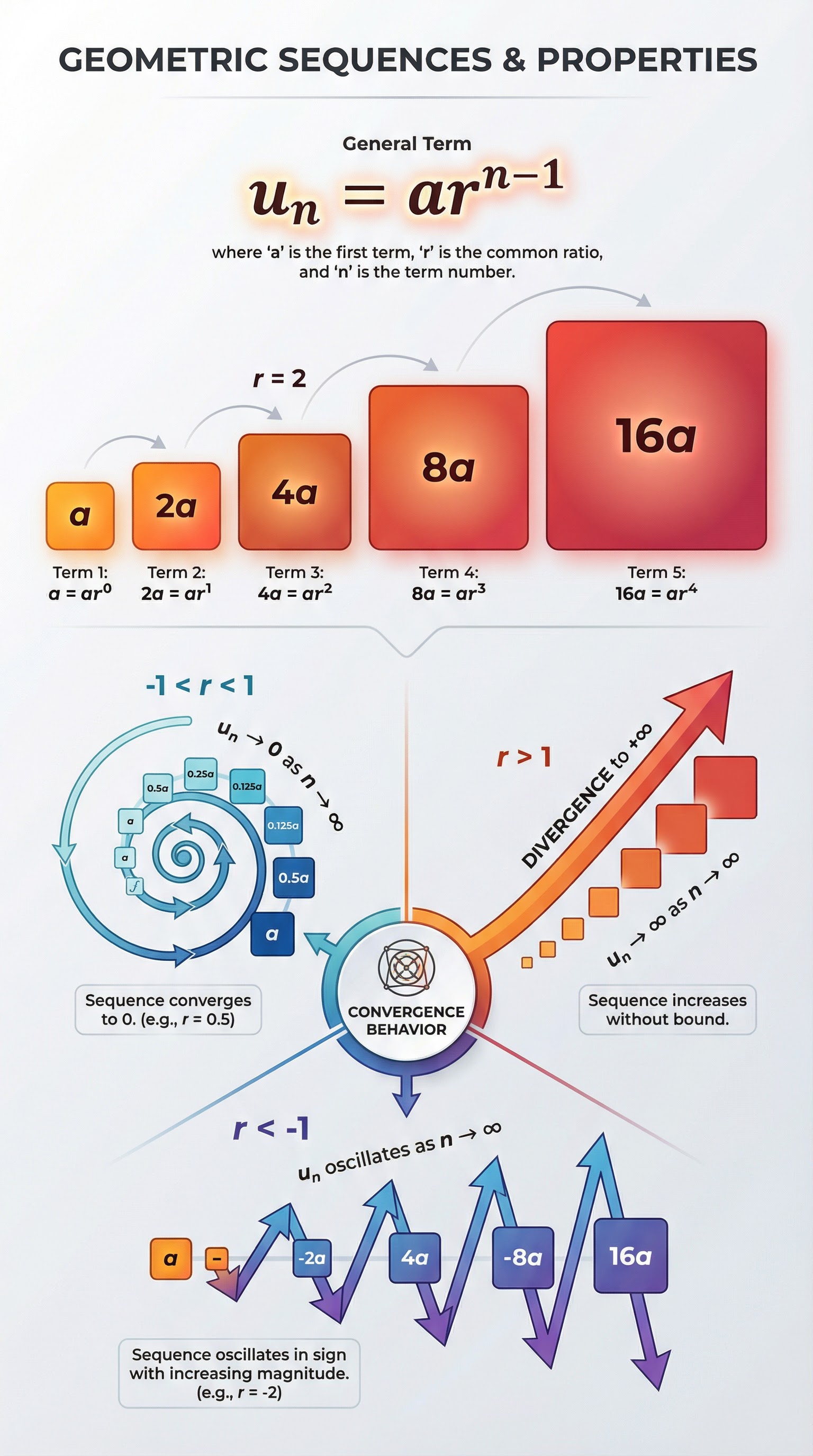
A geometric sequence (or geometric progression) is a sequence where each term after the first is found by multiplying the previous one by a fixed, non-zero number called the common ratio (r). The general form of the nth term is u_n = ar^(n-1), where 'a' is the first term.
These sequences model exponential growth or decay and are fundamental to understanding topics like compound interest or radioactive decay. A key skill is finding the common ratio, which can be done by dividing any term by its preceding term (e.g., r = u₂ / u₁). Importantly, you must verify that the ratio is consistent across all consecutive pairs of terms before concluding that a sequence is geometric.
Example: The sequence 2, 6, 18, 54... is geometric.
- The first term a = 2.
- The common ratio r = 6 / 2 = 3.
- Verify: 18/6 = 3, 54/18 = 3. The ratio is consistent.
- The nth term is therefore u_n = 2 × 3^(n-1).
Concept 3: Limiting Values (Convergence and Divergence)
This concept, primarily applied to geometric sequences, explores what happens to the terms as 'n' gets infinitely large (as n → ∞). This is a crucial concept in higher mathematics.
- Convergence: If the common ratio 'r' is between -1 and 1 (i.e., -1 < r < 1), the terms get progressively closer to zero. We say the sequence converges to a limit of 0.
- Divergence: If 'r' is greater than 1 or less than or equal to -1, the terms grow infinitely large (or oscillate with increasing magnitude). We say the sequence diverges.
Examiners require precise language here. You must state that "as n approaches infinity" or use the notation "as n → ∞" to earn full communication marks. Simply calculating a large term such as u₁₀₀ is insufficient.
Example: For the sequence u_n = 5 × (0.5)^(n-1), the common ratio r = 0.5. Since -1 < 0.5 < 1, the sequence converges to 0 as n → ∞.
Concept 4: Recurrence Relations
A recurrence relation defines each term in a sequence based on one or more previous terms, rather than providing a direct formula for the nth term. The general form is u_(n+1) = f(u_n), where f is some function.
Example: Given u₁ = 3 and u_(n+1) = 2u_n + 1, find the first five terms.
- u₁ = 3
- u₂ = 2(3) + 1 = 7
- u₃ = 2(7) + 1 = 15
- u₄ = 2(15) + 1 = 31
- u₅ = 2(31) + 1 = 63
Recurrence relations can be more complex, involving multiple previous terms or non-linear functions. The key is to work systematically, showing each step clearly.
Mathematical/Scientific Relationships
Here are the essential formulae and relationships for the Sequences topic. It is vital to know which are provided and which must be memorised.
| Formula | Description | Status |
|---|---|---|
u_n = a + (n-1)d | nth term of an arithmetic sequence. a is the first term, d is the common difference. | Must memorise |
u_n = an² + bn + c | General form of a quadratic sequence. a is half the second difference. | Must memorise |
u_n = ar^(n-1) | nth term of a geometric sequence. a is the first term, r is the common ratio. | Must memorise |
r = u_(n+1) / u_n | Formula to find the common ratio (r) in a geometric sequence. | Must memorise |
-1 < r < 1 | Condition for convergence of a geometric sequence to a limit of 0. | Must memorise |
u_(n+1) = f(u_n) | General form of a recurrence relation. The next term is a function of the previous term. | Must memorise |
Practical Applications
While sequences can seem abstract, they model numerous real-world phenomena. Understanding these applications can provide a deeper intuition for how they work.
- Finance: Geometric sequences are the foundation of compound interest calculations. If you invest £1000 with a 5% annual interest rate, the value of your investment each year forms a geometric sequence with a = 1000 and r = 1.05.
- Biology: Population growth, particularly of bacteria or viruses, can often be modelled using geometric sequences under ideal conditions. A single bacterium divides into two, those two divide into four, and so on (a=1, r=2).
- Physics: The height a bouncing ball reaches after each bounce can be modelled by a geometric sequence. If a ball is dropped from 2 metres and bounces back to 75% of its previous height each time, the sequence of maximum heights is a geometric progression with a = 2 and r = 0.75. The concept of a limiting value is clear here – the ball eventually stops bouncing.
- Computer Science: Algorithms, particularly those involving loops and recursion, are deeply connected to sequences. The complexity of an algorithm might be described by a recurrence relation, which helps computer scientists analyse its efficiency.