Study Notes
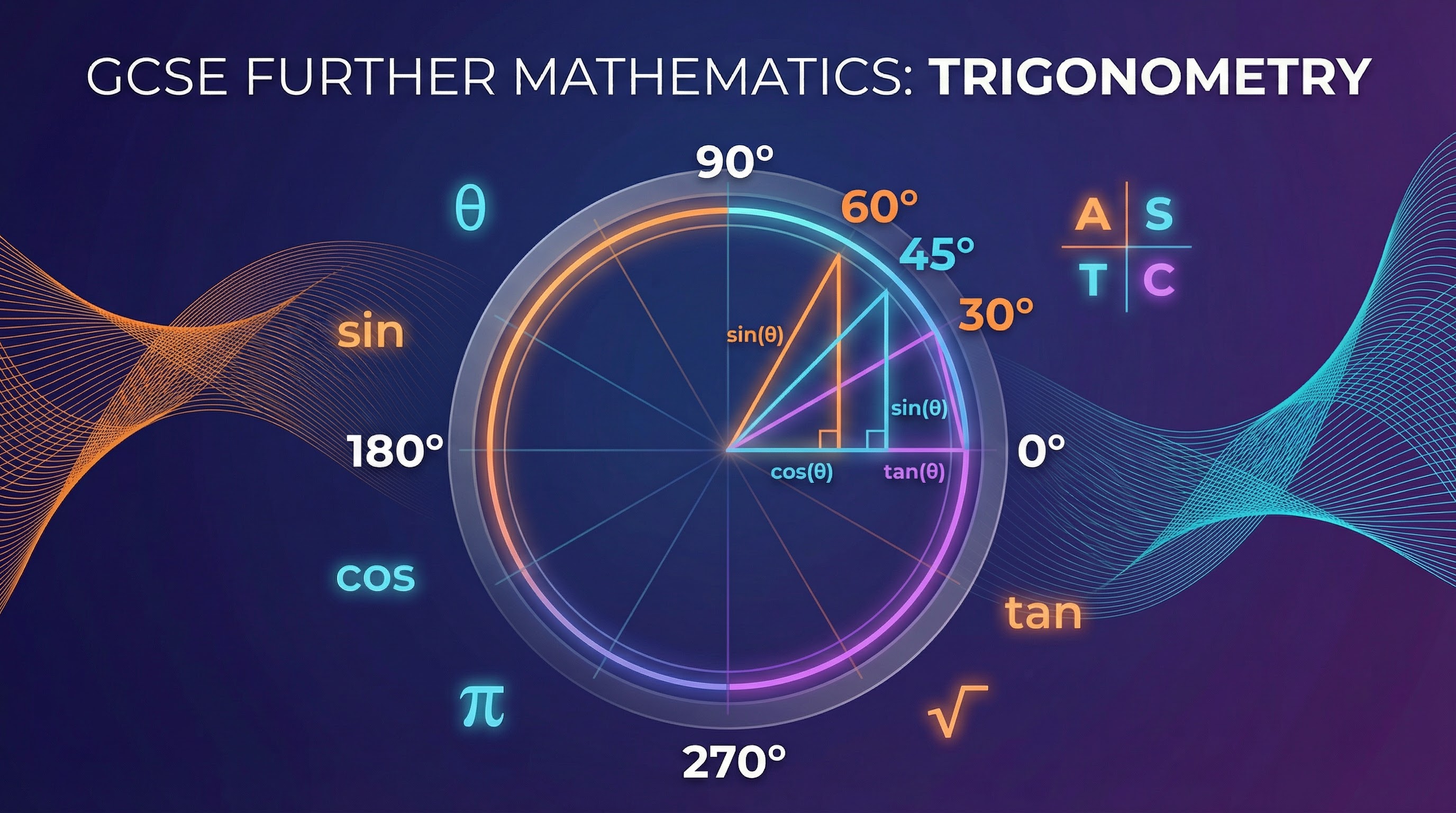
Overview
Trigonometry at GCSE Further Mathematics level represents a significant step up from the SOH CAH TOA you encountered in standard GCSE. Here, candidates are expected to work fluently with angles of any magnitude, including those beyond 360° and negative angles. The specification demands rigorous application of trigonometric identities—particularly tan θ ≡ sin θ/cos θ and sin² θ + cos² θ ≡ 1—to transform and solve equations that would otherwise appear intractable. You will also apply the Sine and Cosine Rules to non-right-angled triangles, often in three-dimensional contexts where visualisation and careful diagram work are essential. Exam questions typically combine multiple skills: you might be asked to solve an equation involving a double angle, prove an identity algebraically, and then apply the Cosine Rule to find a missing side in a 3D shape, all within a single 6-mark question. Understanding the why behind these techniques—not just the how—will enable you to adapt to unfamiliar question styles and earn those crucial A1 marks for fully correct solutions.
Key Concepts
Concept 1: The Unit Circle and Angles of Any Magnitude
The unit circle is a circle of radius 1 centred at the origin of a coordinate system. When we measure an angle θ counter-clockwise from the positive x-axis, the coordinates of the point where the terminal side of the angle intersects the circle are precisely (cos θ, sin θ). This elegant relationship allows us to define sine and cosine for any angle, not just those between 0° and 90°. Negative angles are measured clockwise, and angles greater than 360° simply represent multiple rotations around the circle. This is why sin 390° = sin 30° (because 390° = 360° + 30°), and why cos(-60°) = cos 60° (cosine is an even function). Understanding this geometric foundation is crucial because it explains why trigonometric functions are periodic and why certain angles share the same sine or cosine values.
Example: Find the exact value of sin 150°. Using the unit circle, 150° is in the second quadrant. The reference angle (the acute angle to the x-axis) is 180° - 150° = 30°. In the second quadrant, sine is positive, so sin 150° = sin 30° = 0.5 or 1/2.
Concept 2: The CAST Diagram
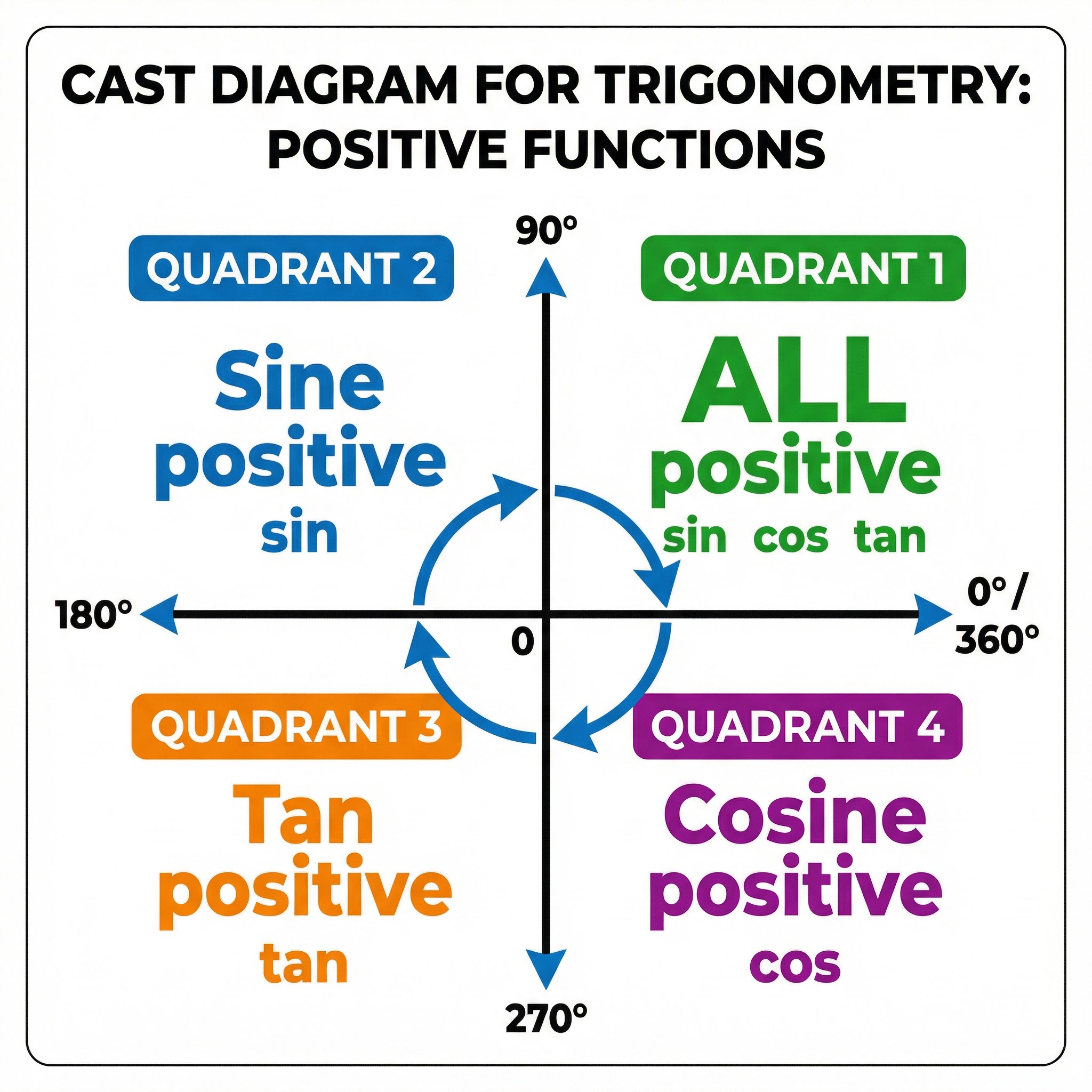
The CAST diagram is your essential tool for determining the sign of trigonometric functions in each quadrant and for finding all solutions to trigonometric equations within a given interval. The acronym CAST is read counter-clockwise starting from the fourth quadrant (bottom right). In Quadrant 1 (0° to 90°), All three functions (sin, cos, tan) are positive. In Quadrant 2 (90° to 180°), only Sine is positive. In Quadrant 3 (180° to 270°), only Tangent is positive. In Quadrant 4 (270° to 360°), only Cosine is positive. When solving an equation like cos x = -0.4, you first find the principal value (the acute angle your calculator gives for cos⁻¹(0.4), which is approximately 66.4°). Then, using CAST, you identify that cosine is negative in Quadrants 2 and 3. The solutions are therefore 180° - 66.4° = 113.6° and 180° + 66.4° = 246.4°. Examiners will award a method mark (M1) for a valid approach to finding the second solution, so always show your CAST diagram or state which quadrants you are using.
Example: Solve tan θ = 1 for 0° ≤ θ ≤ 360°. The principal value is 45°. Tangent is positive in Quadrants 1 and 3. So θ = 45° or θ = 180° + 45° = 225°.
Concept 3: Fundamental Trigonometric Identities
Two identities are absolutely fundamental and must be committed to memory:
- tan θ ≡ sin θ / cos θ for all θ where cos θ ≠ 0.
- sin² θ + cos² θ ≡ 1 for all θ.
The second identity is derived from Pythagoras' theorem applied to the unit circle. It is the key to transforming equations. If you encounter an equation mixing sin θ and cos θ, you can use this identity to express everything in terms of a single function. For instance, if you have 2sin² θ + cos θ = 2, you can substitute sin² θ = 1 - cos² θ to get 2(1 - cos² θ) + cos θ = 2, which simplifies to -2cos² θ + cos θ = 0, a quadratic in cos θ. Rearranging gives 2cos² θ - cos θ = 0, which factorises to cos θ (2cos θ - 1) = 0, yielding cos θ = 0 or cos θ = 0.5. You would then solve each of these separately using the CAST diagram. Examiners will award M1 for correctly applying the identity to form a quadratic, so always show this substitution step clearly.
Example: Prove that (sin θ / cos θ) + (cos θ / sin θ) ≡ 1 / (sin θ cos θ). Starting with the left-hand side, we combine the fractions over a common denominator: (sin² θ + cos² θ) / (sin θ cos θ). Using the identity sin² θ + cos² θ ≡ 1, this becomes 1 / (sin θ cos θ), which is the right-hand side. Hence proven.
Concept 4: Solving Trigonometric Equations
Solving trigonometric equations in Further Maths often involves multiple angles (e.g., sin 2x or cos 3x) or requires you to find solutions within a specified interval. The critical rule is: if you are solving for nx, you must adjust the interval by multiplying the range by n. For example, if the question asks you to solve sin 2x = 0.6 for 0° ≤ x ≤ 360°, you must first solve sin 2x = 0.6 for 0° ≤ 2x ≤ 720°. Find all solutions for 2x in this extended range, then divide each by 2 to find the values of x. This is one of the most common errors candidates make—forgetting to extend the range—and it will cost you marks. Always write out the adjusted interval at the start of your solution.
Another key technique is to use a sketch of the trigonometric graph. For instance, the graph of y = sin x completes one full cycle from 0° to 360°, so if sin x = k (where -1 ≤ k ≤ 1), there will typically be two solutions in this range (unless k = ±1). Sketching the horizontal line y = k on the sine curve immediately shows you where the intersections occur and helps you verify you haven't missed a solution.
Example: Solve cos x = 0.5 for 0° ≤ x ≤ 360°. The principal value (from the calculator) is cos⁻¹(0.5) = 60°. Using CAST, cosine is positive in Quadrants 1 and 4. So x = 60° (Quadrant 1) or x = 360° - 60° = 300° (Quadrant 4).
Concept 5: The Sine and Cosine Rules for Non-Right-Angled Triangles
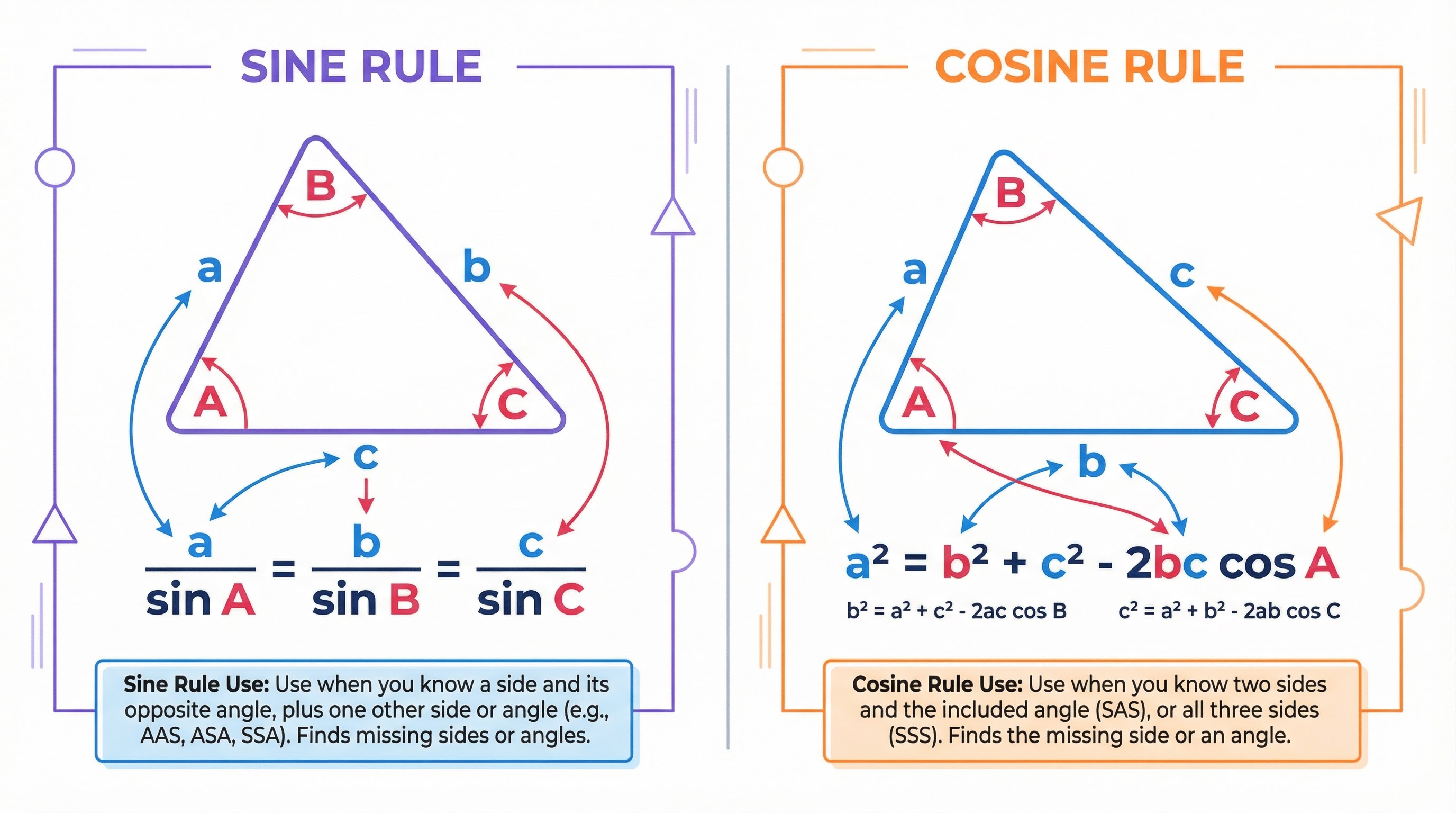
When a triangle does not contain a right angle, SOH CAH TOA cannot be used. Instead, we have two powerful rules:
The Sine Rule: a/sin A = b/sin B = c/sin C, where a, b, c are the sides of the triangle and A, B, C are the angles opposite those sides respectively. This rule is used when you know:
- Two angles and one side (AAS or ASA), or
- Two sides and a non-included angle (SSA, though this can sometimes give two possible triangles—the ambiguous case).
The Sine Rule is particularly useful for finding a missing side when you have a matching pair of side and opposite angle.
The Cosine Rule: a² = b² + c² - 2bc cos A (or rearranged to find an angle: cos A = (b² + c² - a²) / 2bc). This rule is used when you know:
- Two sides and the included angle (SAS), or
- All three sides (SSS).
The Cosine Rule is a generalisation of Pythagoras' theorem. When A = 90°, cos A = 0, and the formula reduces to a² = b² + c², which is Pythagoras. A very common algebraic error is to incorrectly rearrange the Cosine Rule when finding an angle. Candidates often subtract 2bc before dividing, or forget to divide the entire right-hand side by 2bc. Always rearrange carefully: a² = b² + c² - 2bc cos A becomes 2bc cos A = b² + c² - a², and then cos A = (b² + c² - a²) / (2bc).
In 3D problems, you will often need to identify a 2D triangle within the 3D shape, redraw it separately with all known lengths and angles clearly marked, and then apply the Sine or Cosine Rule. Examiners will award M1 for correct substitution into the formula, so always write out the formula first, then substitute your values.
Example: A triangle has sides of length 7 cm, 8 cm, and 10 cm. Find the largest angle. The largest angle is opposite the longest side (10 cm). Using the Cosine Rule: cos A = (7² + 8² - 10²) / (2 × 7 × 8) = (49 + 64 - 100) / 112 = 13 / 112 ≈ 0.116. Therefore A = cos⁻¹(0.116) ≈ 83.3°.
Concept 6: 3D Trigonometry
Many exam questions embed trigonometry within three-dimensional shapes such as cuboids, pyramids, or prisms. The key skill is to identify the relevant 2D triangle within the 3D shape, extract it, and redraw it clearly with all known information labelled. You will then apply Pythagoras' theorem (if it's a right-angled triangle) or the Sine/Cosine Rules (if it's not). Common 2D triangles to look for include: the base of the shape, a vertical cross-section, or a triangle formed by connecting a vertex to points on the base. Always mark right angles clearly, and use the 3D diagram to identify which lengths you know and which you need to find. A common error is to confuse which angle you are finding—always refer back to the question to ensure you are calculating the angle or length that has been asked for.
Example: A pyramid has a square base of side 6 cm and a vertical height of 8 cm. Find the angle between a slant edge and the base. First, find the distance from the centre of the base to a corner (half the diagonal of the square): diagonal = 6√2 cm, so half-diagonal = 3√2 cm. Now consider the right-angled triangle formed by the vertical height (8 cm), the half-diagonal (3√2 cm), and the slant edge. Using trigonometry: tan θ = opposite/adjacent = 8 / (3√2) ≈ 1.886, so θ = tan⁻¹(1.886) ≈ 62.0°.
Mathematical Relationships and Formulas
Formulas You MUST Memorise:
- tan θ ≡ sin θ / cos θ
- sin² θ + cos² θ ≡ 1
Formulas Given on the Formula Sheet:
- Sine Rule: a/sin A = b/sin B = c/sin C
- Cosine Rule: a² = b² + c² - 2bc cos A
Key Exact Values (Must Memorise):
| Angle | sin θ | cos θ | tan θ |
|---|---|---|---|
| 0° | 0 | 1 | 0 |
| 30° | 1/2 | √3/2 | 1/√3 |
| 45° | 1/√2 | 1/√2 | 1 |
| 60° | √3/2 | 1/2 | √3 |
| 90° | 1 | 0 | undefined |
Quadrant Rules (CAST):
- Quadrant 1 (0° to 90°): All positive
- Quadrant 2 (90° to 180°): Sine positive
- Quadrant 3 (180° to 270°): Tangent positive
- Quadrant 4 (270° to 360°): Cosine positive
Finding Secondary Solutions:
- If sin θ = k: solutions are θ and (180° - θ)
- If cos θ = k: solutions are θ and (360° - θ)
- If tan θ = k: solutions are θ and (180° + θ)
Practical Applications
Trigonometry has extensive real-world applications that make the content memorable and relevant. Surveyors use the Sine and Cosine Rules to calculate distances across rivers or between landmarks without direct measurement. Architects apply 3D trigonometry to determine roof angles, the height of structures, and the optimal placement of support beams. In navigation, pilots and sailors use trigonometric functions to calculate bearings and distances. Engineers designing bridges or towers must calculate forces and angles using these principles. In physics, trigonometry is essential for resolving vectors into components, analysing wave motion, and understanding oscillations. Even in computer graphics and game design, the unit circle and trigonometric functions are used to rotate objects and calculate trajectories. When revising, try to connect each abstract concept to a tangible scenario—this elaborative encoding strengthens memory and deepens understanding.
Worked Examples
Below are three authentic OCR-style exam questions with full solutions and examiner commentary to illustrate how marks are awarded.
Worked Example 1: Solving a Trigonometric Equation (4 marks)
Question: Solve the equation sin x = -0.8 for 0° ≤ x ≤ 360°. Give your answers to 1 decimal place.
Marks: 4
Solution:
Step 1: Find the principal value (the related acute angle). Using a calculator, sin⁻¹(0.8) = 53.1° (to 1 d.p.). This is our reference angle.
Step 2: Use the CAST diagram. We need sin x = -0.8, so sine is negative. Sine is negative in Quadrants 3 and 4.
Step 3: Find the solution in Quadrant 3. This is 180° + 53.1° = 233.1°.
Step 4: Find the solution in Quadrant 4. This is 360° - 53.1° = 306.9°.
Final answer: x = 233.1° or x = 306.9°
Examiner Commentary: This solution earns full marks. B1 is awarded for the correct principal value of 53.1°. M1 is awarded for a valid method to find a second solution (using CAST or equivalent). A1 is awarded for the first correct solution (233.1°), and A1 for the second correct solution (306.9°). Common errors include: only giving one solution (losing 2 marks), giving positive solutions (not reading the negative sign), or giving solutions outside the specified range. To secure full marks, always state both solutions clearly and check they lie within the given interval.
Worked Example 2: Using the Cosine Rule (5 marks)
Question: Triangle ABC has sides AB = 9 cm, BC = 7 cm, and AC = 11 cm. Calculate the size of angle ABC. Give your answer to the nearest degree.
Marks: 5
Solution:
Step 1: Identify which rule to use. We have all three sides (SSS), so we use the Cosine Rule to find an angle.
Step 2: Write out the Cosine Rule formula. We want angle ABC, which we'll call B. The side opposite angle B is AC = 11 cm. The formula is: b² = a² + c² - 2ac cos B, where b is the side opposite angle B.
Step 3: Rearrange to make cos B the subject: cos B = (a² + c² - b²) / (2ac).
Step 4: Substitute the values. Here, a = BC = 7 cm, c = AB = 9 cm, and b = AC = 11 cm.
cos B = (7² + 9² - 11²) / (2 × 7 × 9)
cos B = (49 + 81 - 121) / 126
cos B = 9 / 126
cos B = 0.0714... (to 4 d.p.)
Step 5: Find the angle. B = cos⁻¹(0.0714) = 85.9°, which rounds to 86° to the nearest degree.
Final answer: Angle ABC = 86°
Examiner Commentary: This earns full marks. M1 is awarded for selecting the Cosine Rule and writing it down. A1 is awarded for correct rearrangement to make cos B the subject (a common error is incorrect rearrangement). M1 is awarded for correct substitution of the three side lengths into the formula. A1 is awarded for the correct calculation of cos B = 9/126 or equivalent decimal. A1 is awarded for the final answer of 86°. Common errors include: using the Sine Rule (which cannot be applied here as we don't have a matching side-angle pair), incorrect algebraic rearrangement (e.g., forgetting to divide by 2ac), or using the wrong side as 'b'. Always identify which angle you are finding and which side is opposite it before substituting.
Worked Example 3: Proving a Trigonometric Identity (4 marks)
Question: Show that (1 - cos² θ) / sin θ ≡ sin θ.
Marks: 4
Solution:
Step 1: Start with the Left Hand Side (LHS): (1 - cos² θ) / sin θ.
Step 2: Use the identity sin² θ + cos² θ ≡ 1, which can be rearranged to 1 - cos² θ ≡ sin² θ.
Step 3: Substitute this into the LHS: (1 - cos² θ) / sin θ = sin² θ / sin θ.
Step 4: Simplify by cancelling: sin² θ / sin θ = sin θ (provided sin θ ≠ 0).
Step 5: This is the Right Hand Side (RHS), so the identity is proven.
Examiner Commentary: This earns full marks. M1 is awarded for a valid attempt to use the identity sin² θ + cos² θ ≡ 1. A1 is awarded for correctly substituting 1 - cos² θ = sin² θ. M1 is awarded for correct algebraic manipulation (dividing sin² θ by sin θ). A1 is awarded for reaching the RHS and stating the identity is proven. Common errors include: trying to work from both sides simultaneously (which is not a valid proof method), making algebraic errors when simplifying, or not stating which identity is being used. For 'Show that' or 'Prove' questions, always work from one side to the other, state the identities you are using, and show every step of your working. Do not assume the result you are trying to prove.
Podcast Episode
Listen to the full 10-minute podcast episode below, where an experienced educator walks you through the core concepts, exam tips, and common mistakes, followed by a quick-fire recall quiz to test your understanding.
Podcast: