Box Plots

    Master the art of constructing and interpreting box plots for your OCR GCSE Further Mathematics exam. This guide breaks down how to earn full marks on questions about quartiles, skewness, and comparing distributions, turning a tricky topic into guaranteed marks.

    6
    Min Read
    3
    Examples
    5
    Questions
    6
    Key Terms
    🎙 Podcast Episode
    Box Plots
    9:42
    0:00-9:42

    Study Notes

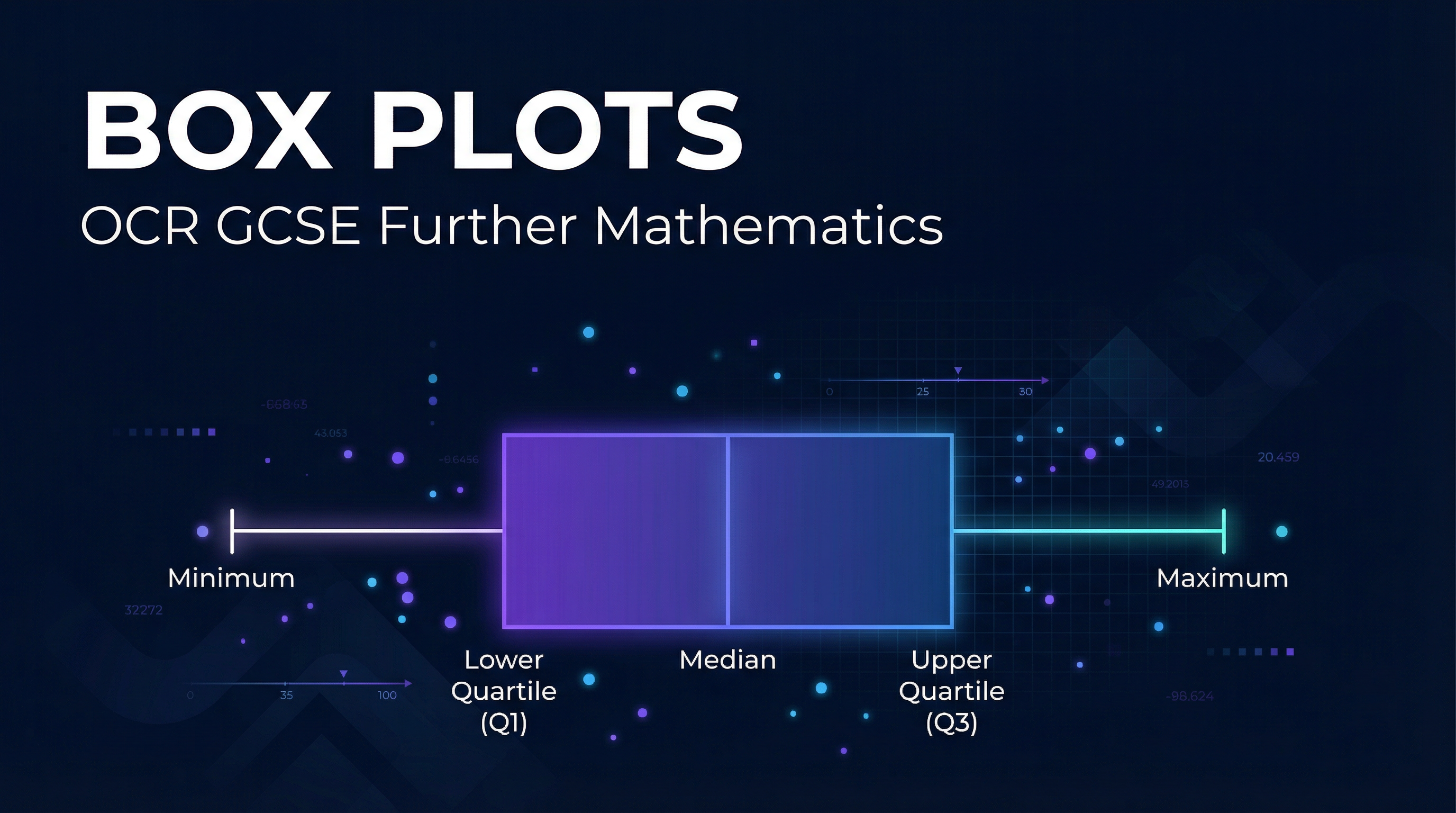
    Header image for OCR GCSE Further Mathematics: Box Plots

    Overview

    Welcome to your deep dive into Box Plots (Specification reference 5.3), a key data representation topic in OCR Level 2 Further Mathematics. Box plots, or box-and-whisker diagrams, are a powerful tool for visualising the spread and central tendency of a dataset. They provide a concise five-number summary that allows for rapid comparison between different groups. In your exam, you won't just be asked to draw them; you'll be expected to interpret them with a high degree of sophistication. This includes calculating and comparing medians and interquartile ranges (IQRs), and identifying skewness. Examiners use this topic to test your ability to move beyond simple calculations and make reasoned, contextual judgements about data. A typical question might present you with two box plots and ask you to 'Compare the distributions', a command word that requires a specific, two-part answer to secure all the marks. Mastering this topic provides a strong foundation for understanding statistical analysis and its connection to real-world data interpretation.

    Listen to the 10-minute audio guide on Box Plots.

    Key Concepts

    Concept 1: The Five-Number Summary

    A box plot is built from just five key values that summarise the entire dataset. To find them, your first step is always to arrange the data in ascending order. Failure to do so is a critical error from which you cannot recover in a question.

    1. Minimum: The smallest value in the dataset.
    2. Lower Quartile (Q1): The median of the lower half of the data. It marks the 25th percentile.
    3. Median (Q2): The middle value of the entire dataset. It marks the 50th percentile.
    4. Upper Quartile (Q3): The median of the upper half of the data. It marks the 75th percentile.
    5. Maximum: The largest value in the dataset.

    Example: Find the five-number summary for the data: 1, 8, 5, 3, 9, 8, 2, 10, 7

    • Step 1: Order the data.
      1, 2, 3, 5, 7, 8, 8, 9, 10 (There are 9 values, so n=9)
    • **Step 2: Find the Median (Q2).**The middle value is the (n+1)/2 term. (9+1)/2 = 5. The 5th value is 7. So, Median = 7.
    • **Step 3: Find the Lower Quartile (Q1).**This is the median of the data to the left of the median: 1, 2, 3, 5. As there are an even number of values, we find the mean of the middle two: (2+3)/2 = 2.5. So, Q1 = 2.5.
    • **Step 4: Find the Upper Quartile (Q3).**This is the median of the data to the right of the median: 8, 8, 9, 10. The mean of the middle two is (8+9)/2 = 8.5. So, Q3 = 8.5.
    • Step 5: Identify Minimum and Maximum.
      Minimum = 1, Maximum = 10.

    Concept 2: The Interquartile Range (IQR)

    The IQR is a crucial measure of statistical spread or dispersion. It represents the range in which the middle 50% of the data lies. A smaller IQR indicates that the data points are clustered closely around the median, suggesting greater consistency. A larger IQR indicates the data is more spread out.

    Formula: IQR = Upper Quartile (Q3) - Lower Quartile (Q1)

    From our example above, the IQR would be 8.5 - 2.5 = 6.

    In an exam, when comparing IQRs, you must use comparative language and link it to context. For instance, 'Group A has a smaller IQR than Group B, which means their performance was more consistent.' The word consistent is highly valued by examiners.

    Concept 3: Identifying Skewness

    Skewness describes the asymmetry of a distribution. A box plot gives clear visual clues about the skew.
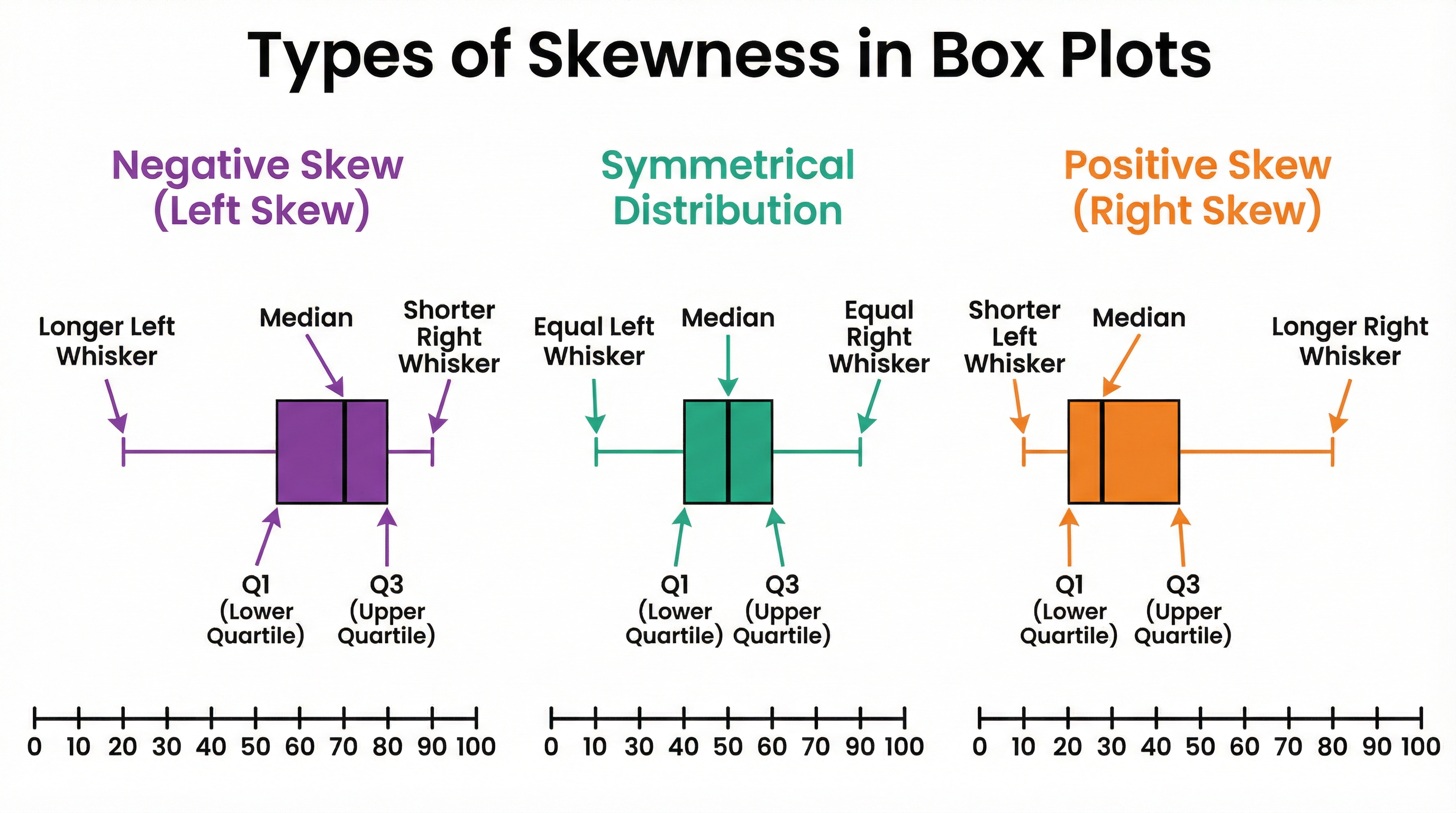
    Visual guide to identifying skewness in box plots.

    • Symmetrical Distribution: The median is located exactly in the middle of the box (Q1 to Q3), and the whiskers are of roughly equal length. This indicates the data is evenly spread around the centre.
    • Positive Skew (or Right-Skewed): The median is closer to the lower quartile (Q1). This often results in the right-hand side of the box and the right whisker being longer than the left. It suggests a larger number of lower values and a tail of higher values.
    • Negative Skew (or Left-Skewed): The median is closer to the upper quartile (Q3). This often results in the left-hand side of the box and the left whisker being longer than the left. It suggests a larger number of higher values and a tail of lower values.

    Examiners may ask you to 'Describe the skewness'. A good answer would be: 'The distribution is positively skewed, as the median is positioned closer to the lower quartile.'

    Mathematical Relationships

    • Median Position (from raw data): (n+1)/2 where n is the number of data points.
    • Interquartile Range (IQR): Q3 - Q1 (Must memorise)
    • Range: Maximum - Minimum (Must memorise)

    Practical Applications

    Box plots are used extensively in the real world to compare data sets quickly. For example:

    • Business: A company might use box plots to compare the monthly sales figures of two different stores to see which is more successful and which is more consistent.
    • Science: Biologists could compare the heights of plants grown with two different types of fertiliser.
    • Finance: An analyst might compare the daily price fluctuations of two different stocks to assess volatility (consistency).

    In all these cases, the goal is the same: use the median to compare the average and the IQR to compare the spread or consistency.
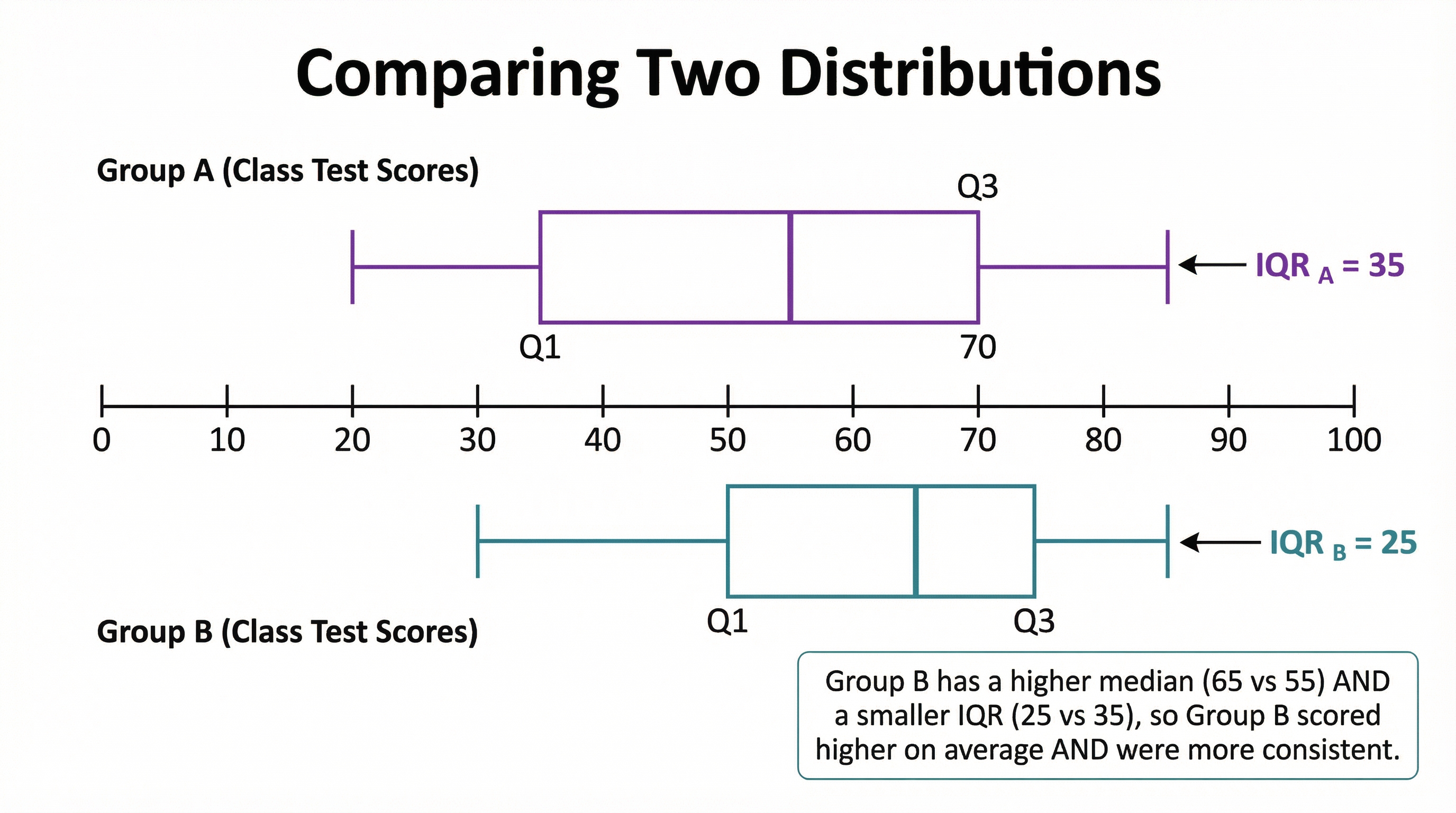
    Example of how to compare two box plot distributions.

    Visual Resources

    2 diagrams and illustrations

    Visual guide to identifying skewness in box plots.
    Visual guide to identifying skewness in box plots.
    Example of how to compare two box plot distributions.
    Example of how to compare two box plot distributions.

    Interactive Diagrams

    2 interactive diagrams to visualise key concepts

    Start: Get raw dataOrder data from smallest to largestFind Median (Q2)Find Lower Quartile (Q1) - median of lower halfFind Upper Quartile (Q3) - median of upper halfIdentify Minimum & MaximumDraw scale and plot the 5 valuesDraw box from Q1 to Q3 with median lineDraw whiskers to Min and MaxEnd: Box Plot Complete

    Flowchart showing the step-by-step process for constructing a box plot from a list of data.

    Compare DistributionsCompare MediansCompare IQRsHigher median = higher averageSmaller IQR = more consistentWrite two separate sentences in context

    Concept map for answering a 'Compare distributions' exam question.

    Worked Examples

    3 detailed examples with solutions and examiner commentary

    Practice Questions

    Test your understanding — click to reveal model answers

    Q1

    The following data represents the scores of 10 students in a quiz: 12, 15, 9, 18, 25, 15, 21, 13, 15, 19. Calculate the interquartile range.

    3 marks
    foundation

    Hint: Remember the very first step before you can find any quartiles. Then find the median of the lower and upper halves of the data.

    Q2

    A box plot summarises the reaction times of a group of people. The box plot has Q1 at 0.4s, a median at 0.5s, and Q3 at 0.8s. Describe the skewness of the distribution and explain what it means in this context.

    2 marks
    standard

    Hint: Look at where the median (0.5s) is positioned between the two quartiles (0.4s and 0.8s). Is it closer to one than the other?

    Q3

    The times taken for two groups of runners, Group X and Group Y, to complete a race are shown in the parallel box plots below. Compare the distributions of the race times for the two groups.
    [Box Plot X: Min=50, Q1=55, Med=60, Q3=62, Max=65]
    [Box Plot Y: Min=45, Q1=52, Med=58, Q3=64, Max=75]

    2 marks
    standard

    Hint: You need to make two points. One about the average (median) and one about the consistency (IQR). Use the MIC mnemonic: Median, IQR, Context.

    Q4

    For a dataset of 20 numbers, the quartiles are Q1=10 and Q3=22. The numbers 2 and 45 are added to the dataset. What is the largest possible value of the new interquartile range?

    4 marks
    challenging

    Hint: The original dataset had 20 numbers. The new one has 22. Think about how adding a very low and a very high number will affect the positions of the new Q1 and Q3.

    Q5

    Draw a box plot for the following data, and mark any outliers (values > 1.5xIQR from the box) with an 'x' and draw the whisker to the next highest/lowest value.
    Data: 10, 50, 52, 53, 55, 58, 60, 62, 90

    5 marks
    challenging

    Hint: First, find the five-number summary. Then calculate the outlier boundaries. If any values are outside these boundaries, they are outliers.

    Key Terms

    Essential vocabulary to know

    More Further Mathematics Study Guides

    View all

    Trigonometry

    OCR
    GCSE

    This topic extends your trigonometry knowledge beyond right-angled triangles into the realm of any angle, trigonometric identities, and complex equation solving. You'll master the CAST diagram, apply the Sine and Cosine Rules to non-right-angled triangles in 2D and 3D contexts, and prove identities using fundamental relationships. This is a high-value topic in Further Maths exams, frequently appearing in multi-step problem-solving questions worth 4-6 marks.

    Proof

    OCR
    GCSE

    Proof is the art of constructing watertight algebraic arguments that demonstrate mathematical statements are true for ALL cases, not just specific examples. This topic is a cornerstone of OCR GCSE Further Mathematics, demanding rigorous logic, precise algebraic notation, and clear communication. Mastering proof unlocks high-value marks and develops critical thinking skills that extend far beyond mathematics.

    Vectors

    OCR
    GCSE

    Vectors in OCR GCSE Further Mathematics goes far beyond basic GCSE column vector arithmetic. You'll master constructing complex vector paths through geometric figures, proving collinearity using scalar multiples, and finding positions of points that divide lines in given ratios. This topic demands algebraic precision, rigorous notation, and explicit geometric reasoning—skills that examiners reward generously when demonstrated correctly.

    Inequalities

    OCR
    GCSE

    Master OCR GCSE Further Maths Inequalities (2.3) by learning to solve quadratic inequalities algebraically and graphically. This guide breaks down the critical steps, from finding roots to sketching parabolas and selecting the correct regions, ensuring you can secure every mark."

    Sequences

    OCR
    GCSE

    Sequences in OCR GCSE Further Mathematics extend beyond standard GCSE, requiring mastery of quadratic sequences, geometric progressions, limiting values, and recurrence relations. This topic is essential for top grades, testing algebraic rigour, pattern recognition, and the ability to determine long-term behaviour of mathematical series.

    Standard Form

    OCR
    GCSE

    This guide provides a comprehensive, exam-focused breakdown of Standard Form for OCR GCSE Further Mathematics. It covers everything from the core principles of writing numbers in the form A × 10ⁿ to performing complex calculations, ensuring you can secure every mark available on this crucial topic.