Gradients and Parallel/Perpendicular Lines

    Master OCR GCSE Further Maths Topic 3.3 on Gradients and Lines. This guide breaks down how to calculate gradients, understand parallel and perpendicular relationships (m1*m2=-1), and tackle complex exam questions like finding perpendicular bisectors to secure top marks.

    4
    Min Read
    3
    Examples
    5
    Questions
    6
    Key Terms
    🎙 Podcast Episode
    Gradients and Parallel/Perpendicular Lines
    7:50
    0:00-7:50

    Study Notes

    Overview
    Header image for Gradients and Perpendicular Lines

    Welcome to the essential guide for mastering Gradients and Parallel/Perpendicular Lines, a cornerstone of OCR's Level 2 Further Mathematics specification. This topic is a gateway to higher-level coordinate geometry and is frequently tested. It demands not just procedural knowledge but deep algebraic fluency. Candidates are expected to confidently handle linear equations, moving between y=mx+c and ax+by+c=0 forms, and apply these skills to solve multi-step geometric problems. Examiners often create questions that link gradients to other areas like coordinate geometry, such as finding the equation of a perpendicular bisector or determining the nature of a quadrilateral. Mastering the content in this guide will equip you to tackle these challenges with confidence and precision, turning a potentially tricky topic into a reliable source of marks.

    Podcast: Mastering Gradients & Perpendicular Lines

    Key Concepts

    Concept 1: Calculating the Gradient

    The gradient of a line is a measure of its steepness. It's defined as the ratio of the change in the y-coordinate (the 'rise') to the change in the x-coordinate (the 'run'). The formula, which must be memorised, is:

    **m = (y₂ - y₁) / (x₂ - x₁) **It is crucial to subtract the coordinates in the same order in both the numerator and the denominator. A common mistake is to calculate (y₂ - y₁) / (x₁ - x₂), which gives the negative of the correct gradient.
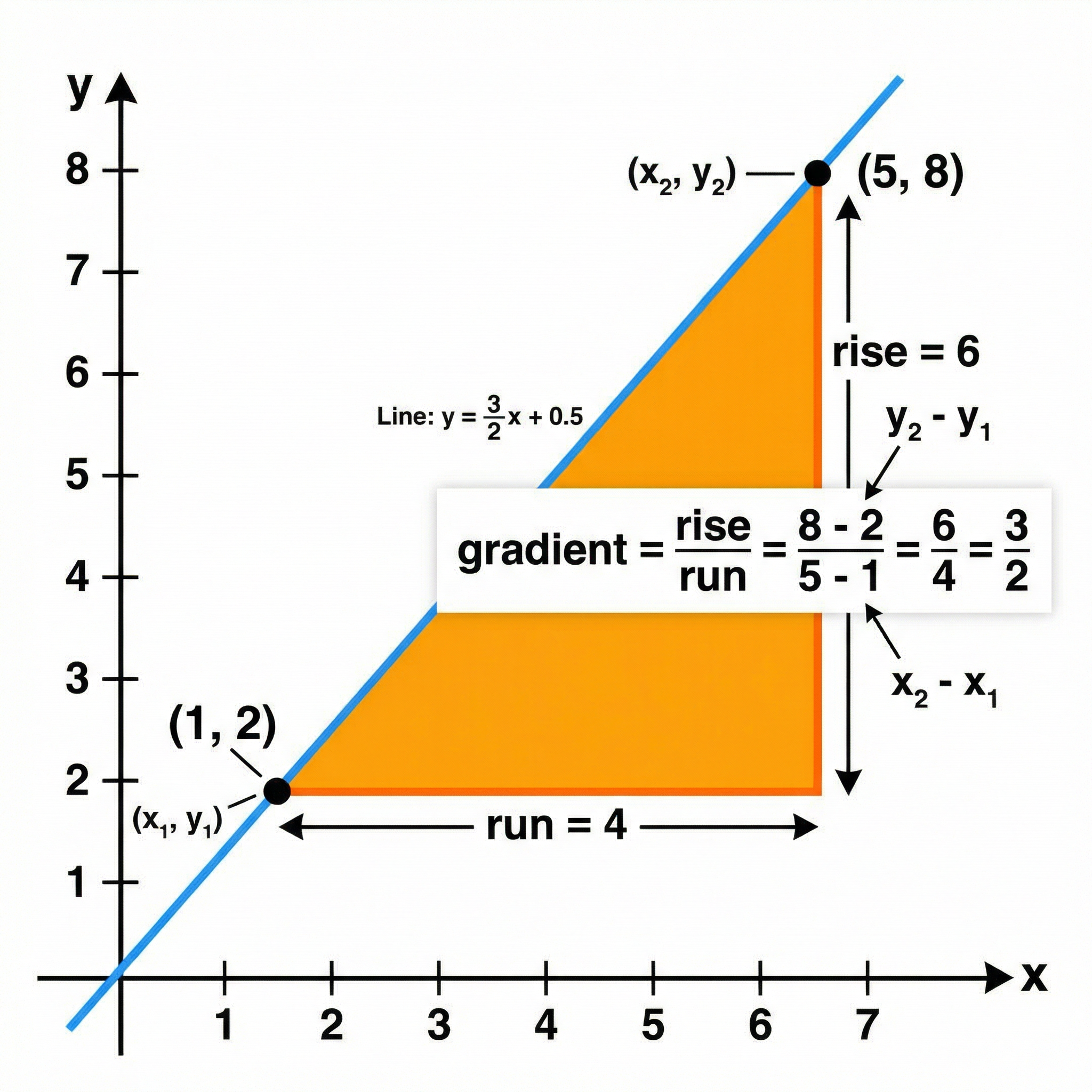
    Calculating the gradient (rise/run)

    Example: Find the gradient of the line joining points A(3, -2) and B(5, 4).

    • m = (4 - (-2)) / (5 - 3) = (4 + 2) / 2 = 6 / 2 = 3. A positive gradient indicates the line slopes upwards from left to right.

    Concept 2: Parallel Lines

    This is the most straightforward relationship. Two or more lines are parallel if and only if they have the same gradient. If line L1 has gradient m1 and line L2 has gradient m2, then L1 is parallel to L2 if m1 = m2.

    Example: The line y = 4x - 7 has a gradient of 4. Any line parallel to it, such as y = 4x + 100, will also have a gradient of 4.

    Concept 3: Perpendicular Lines

    Two lines are perpendicular if they intersect at a right angle (90°). The relationship between their gradients is fundamental and must be memorised. If line L1 has gradient m1 and line L2 has gradient m2, then L1 is perpendicular to L2 if m1 * m2 = -1.

    This means the gradient of a perpendicular line is the negative reciprocal of the original gradient. To find it, you flip the fraction and change the sign.
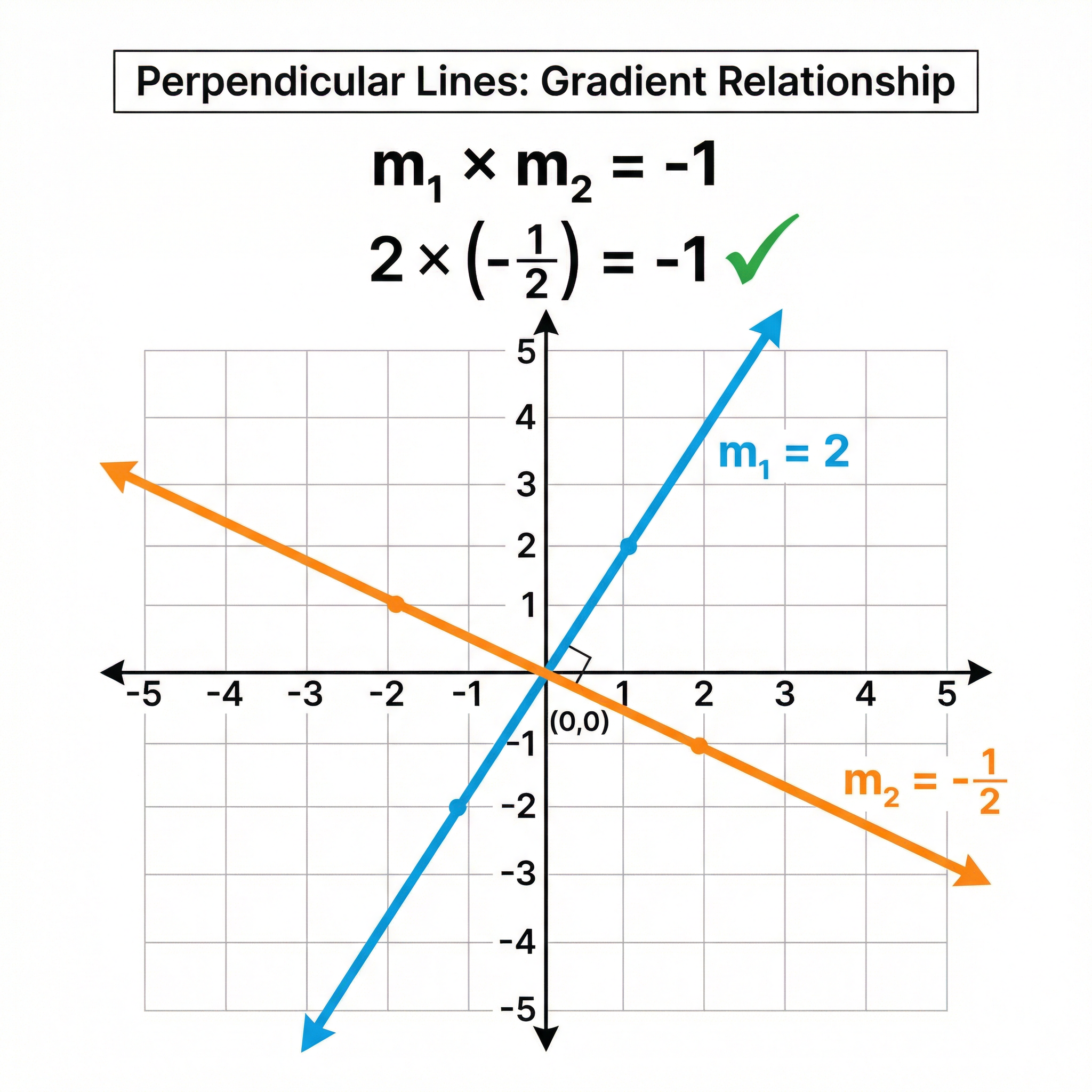
    The gradient relationship for perpendicular lines

    Example: If a line has a gradient of m1 = 2, the gradient of a perpendicular line is m2 = -1/2. Check: 2 * (-1/2) = -1. If a line has a gradient of m1 = -3/4, the perpendicular gradient is m2 = 4/3.

    Mathematical/Scientific Relationships

    • Gradient Formula: m = (y₂ - y₁) / (x₂ - x₁) (Must memorise)
    • Equation of a Line (Slope-Intercept Form): y = mx + c (Given on formula sheet)
    • Equation of a Line (Point-Slope Form): y - y₁ = m(x - x₁) (Must memorise)
    • Parallel Lines Condition: m₁ = m₂ (Must memorise)
    • Perpendicular Lines Condition: m₁ * m₂ = -1 (Must memorise)
    • Midpoint Formula: ((x₁ + x₂)/2, (y₁ + y₂)/2) (Must memorise)

    Practical Applications

    While this topic is primarily abstract algebra, the principles of gradients and perpendicularity are foundational in many real-world fields:

    • Engineering & Architecture: Ensuring walls are perpendicular to floors, calculating roof pitches, and designing stable structures.
    • Computer Graphics: Used in algorithms for rendering 2D and 3D shapes, calculating lighting angles, and creating realistic object interactions.
    • Navigation & Surveying: Used in mapping and GPS to calculate paths, bearings, and relative positions.
    Visual Resources

    3 diagrams and illustrations

    Calculating the gradient (rise/run)
    Calculating the gradient (rise/run)
    The gradient relationship for perpendicular lines
    The gradient relationship for perpendicular lines
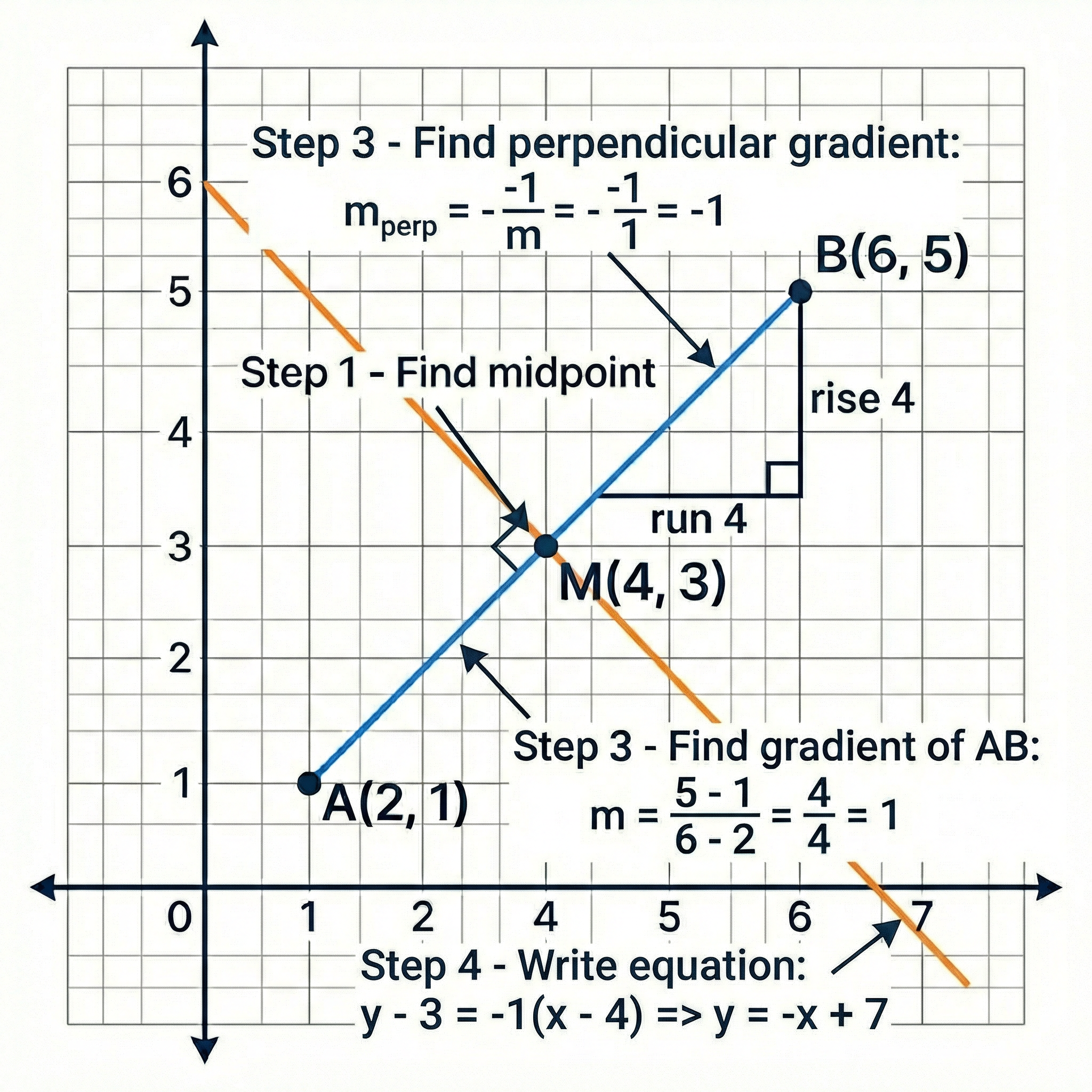
    Steps to find a perpendicular bisector
    Steps to find a perpendicular bisector

    Interactive Diagrams

    2 interactive diagrams to visualise key concepts

    Start: Given line segment ABFind Midpoint M of ABFind Gradient of ABCalculate Perpendicular GradientUse Midpoint M and Perpendicular Gradient to find EquationEnd: Equation of Perpendicular Bisector

    Flowchart showing the step-by-step process for finding the equation of a perpendicular bisector.

    Diagram could not be rendered

    Decision-making flowchart for finding the equation of a parallel or perpendicular line.

    Worked Examples

    3 detailed examples with solutions and examiner commentary

    Practice Questions

    Test your understanding — click to reveal model answers

    Q1

    A line passes through the points (0, 5) and (3, 14). Find the equation of the line.

    3 marks
    foundation

    Hint: First, calculate the gradient. Then notice that one of the given points is the y-intercept.

    Q2

    The line L has equation y = 2x + 5. The line M is parallel to L and passes through the point (3, 1). Find the equation of line M.

    2 marks
    foundation

    Hint: Parallel lines have the same gradient.

    Q3

    Find the equation of the line that is perpendicular to y = 5x - 1 and passes through the point (10, -1).

    3 marks
    standard

    Hint: First find the negative reciprocal of the gradient of the given line.

    Q4

    Line A passes through (1, 2) and (5, 10). Line B passes through (-1, 8) and (1, 4). Are lines A and B parallel, perpendicular, or neither?

    4 marks
    standard

    Hint: Calculate the gradient of each line separately and then compare them.

    Q5

    A triangle has vertices P(2,7), Q(5,1) and R(8,4). By calculating the gradients of the sides, show that the triangle is a right-angled triangle.

    5 marks
    challenging

    Hint: Find the gradient of all three sides. If two of the gradients multiply to give -1, then those two sides are perpendicular.

    Key Terms

    Essential vocabulary to know

    More Further Mathematics Study Guides

    View all

    Trigonometry

    OCR
    GCSE

    This topic extends your trigonometry knowledge beyond right-angled triangles into the realm of any angle, trigonometric identities, and complex equation solving. You'll master the CAST diagram, apply the Sine and Cosine Rules to non-right-angled triangles in 2D and 3D contexts, and prove identities using fundamental relationships. This is a high-value topic in Further Maths exams, frequently appearing in multi-step problem-solving questions worth 4-6 marks.

    Proof

    OCR
    GCSE

    Proof is the art of constructing watertight algebraic arguments that demonstrate mathematical statements are true for ALL cases, not just specific examples. This topic is a cornerstone of OCR GCSE Further Mathematics, demanding rigorous logic, precise algebraic notation, and clear communication. Mastering proof unlocks high-value marks and develops critical thinking skills that extend far beyond mathematics.

    Vectors

    OCR
    GCSE

    Vectors in OCR GCSE Further Mathematics goes far beyond basic GCSE column vector arithmetic. You'll master constructing complex vector paths through geometric figures, proving collinearity using scalar multiples, and finding positions of points that divide lines in given ratios. This topic demands algebraic precision, rigorous notation, and explicit geometric reasoning—skills that examiners reward generously when demonstrated correctly.

    Inequalities

    OCR
    GCSE

    Master OCR GCSE Further Maths Inequalities (2.3) by learning to solve quadratic inequalities algebraically and graphically. This guide breaks down the critical steps, from finding roots to sketching parabolas and selecting the correct regions, ensuring you can secure every mark."

    Sequences

    OCR
    GCSE

    Sequences in OCR GCSE Further Mathematics extend beyond standard GCSE, requiring mastery of quadratic sequences, geometric progressions, limiting values, and recurrence relations. This topic is essential for top grades, testing algebraic rigour, pattern recognition, and the ability to determine long-term behaviour of mathematical series.

    Standard Form

    OCR
    GCSE

    This guide provides a comprehensive, exam-focused breakdown of Standard Form for OCR GCSE Further Mathematics. It covers everything from the core principles of writing numbers in the form A × 10ⁿ to performing complex calculations, ensuring you can secure every mark available on this crucial topic.

    Syntax error in textmermaid version 11.12.2