Histograms

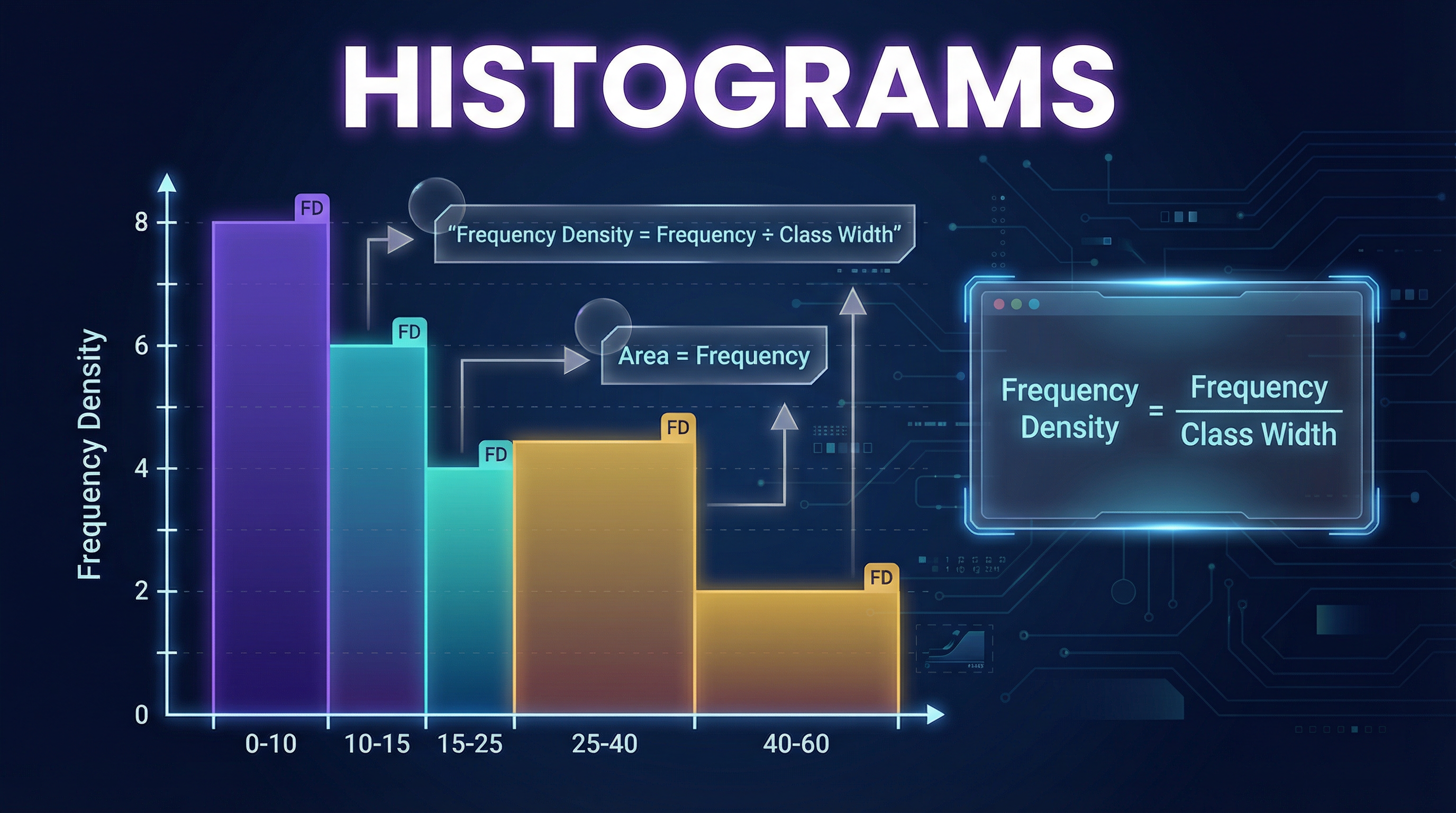
    Master OCR GCSE Further Maths Histograms by understanding the crucial link between area and frequency. This guide breaks down how to calculate frequency density, construct accurate diagrams, and tackle tricky reverse problems to secure top marks."

    4
    Min Read
    3
    Examples
    5
    Questions
    0
    Key Terms
    🎙 Podcast Episode
    Histograms
    0:00-0:00

    Study Notes

    header_image.png

    Overview

    Histograms are a fundamental tool in statistics for representing grouped continuous data, but they are a significant step up from simple bar charts. For the OCR GCSE Further Mathematics exam, a solid understanding of histograms is essential, as questions frequently test the core principle that area is proportional to frequency. Unlike bar charts where the height of the bar is the key measure, in histograms, it is the area that tells the story. This topic is not just about drawing graphs; it is about interpreting them, solving problems where information is missing, and linking the visual representation of data to statistical calculations like the mean. Candidates who confuse histograms with bar charts invariably lose marks, so mastering the concept of frequency density is non-negotiable. Typical exam questions will involve constructing a histogram from a table, calculating frequencies from a given histogram (often without a scale on the vertical axis), and estimating the mean from the diagram.

    histograms_podcast.mp3

    Key Concepts

    Concept 1: Frequency Density is Key

    The single most important concept is Frequency Density (FD). Because the class intervals in a histogram can have unequal widths, plotting frequency directly on the vertical axis would create a misleading picture. A wide bar with a low frequency could look more significant than a narrow bar with a high frequency. To correct for this, we calculate the frequency density, which standardises the frequency per unit of width.

    Example: Imagine two classes. Class A has a width of 10 and a frequency of 20. Class B has a width of 5 and a frequency of 20. If we just plotted frequency, the bars would be the same height, which is misleading because the data in Class B is twice as concentrated. By calculating frequency density (FD = F/CW), Class A has an FD of 2, while Class B has an FD of 4. The histogram bar for Class B will be twice as high, accurately reflecting the denser data.

    Concept 2: Area = Frequency

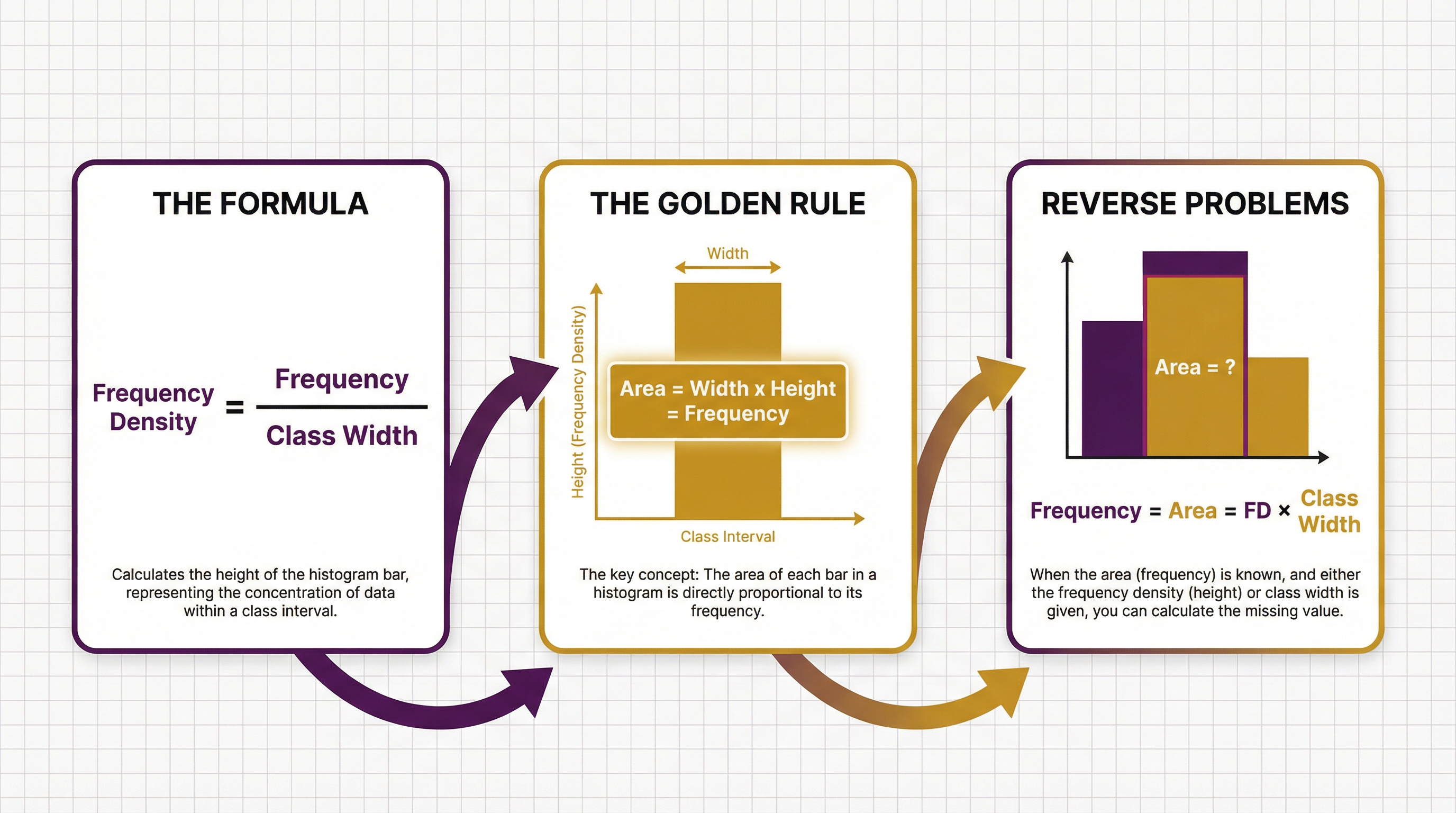
    This is the golden rule that underpins all histogram calculations. The area of each bar is directly proportional to the frequency of that class. In the simplest case, the area is the frequency.

    • Area = Class Width × Frequency Density
    • Since Frequency Density = Frequency / Class Width
    • Area = Class Width × (Frequency / Class Width) = FrequencyThis relationship is your tool for solving all types of histogram problems. If you are given a histogram and need to find the frequency of a certain bar, you simply calculate its area.
    frequency_density_diagram.png

    Mathematical/Scientific Relationships

    The core formulas for histograms are:

    1. Frequency Density = Frequency ÷ Class Width (Must memorise)

      • FD = F / CW
      • Use this when you have a frequency table and need to find the heights of the bars to draw the histogram.
    2. Frequency = Frequency Density × Class Width (Must memorise)

      • F = FD × CW
      • Use this when you are given a histogram and need to find the frequency of a specific bar by calculating its area.
    3. Estimate of the Mean = Σ(f × x) / Σf (Given on formula sheet)

      • Σ means 'sum of'.
      • f is the frequency of each class (the area of the bar).
      • x is the midpoint of each class interval.
      • Use this to calculate the estimated mean from a completed frequency table derived from a histogram.

    Practical Applications

    Histograms are used everywhere to analyse the distribution of data. For example:

    • Manufacturing: A factory might use a histogram to analyse the distribution of lengths of bolts produced by a machine. Bars clustered tightly around the target length indicate high precision, while a wide spread indicates a problem.
    • Finance: Analysts use histograms to understand the distribution of daily stock returns. This helps in assessing the risk and volatility of an investment.
    • Population Studies: Demographers use histograms to show the age distribution of a population, which is crucial for planning social services like schools and pensions."

    Worked Examples

    3 detailed examples with solutions and examiner commentary

    Practice Questions

    Test your understanding — click to reveal model answers

    Q1

    A histogram is drawn. The bar for the interval 5 < t ≤ 10 has a height of 3.6 cm and represents a frequency of 18. The bar for the interval 10 < t ≤ 20 has a height of 2.1 cm. Find the frequency for the 10 < t ≤ 20 interval.

    3 marks
    standard

    Hint: First, use the known bar to find out what 1 unit of area represents in terms of frequency.

    Q2

    The table shows the weights of 80 parcels.

    Weight (w kg)Frequency
    0 < w ≤ 212
    2 < w ≤ 420
    4 < w ≤ 727
    7 < w ≤ 1221

    Draw a histogram for this data.

    4 marks
    foundation

    Hint: You must calculate the frequency density before you can draw the bars. Remember to label your axes correctly.

    Q3

    A histogram is drawn for a set of data. The total frequency is 240. The bar for the interval 30-40 has an area that is 1/4 of the total area of the histogram. Find the frequency density for this bar.

    3 marks
    challenging

    Hint: Remember the golden rule: Area = Frequency. What is the frequency of this bar?

    Q4

    Explain why a histogram is used for the heights of students in a school, but a bar chart would be used for their favourite subjects.

    2 marks
    foundation

    Hint: Think about the type of data involved in each case.

    Q5

    From the histogram created in the first practice question (weights of 80 parcels), estimate the mean weight.

    4 marks
    standard

    Hint: You will need to find the midpoint of each class interval.

    More Further Mathematics Study Guides

    View all

    Trigonometry

    OCR
    GCSE

    This topic extends your trigonometry knowledge beyond right-angled triangles into the realm of any angle, trigonometric identities, and complex equation solving. You'll master the CAST diagram, apply the Sine and Cosine Rules to non-right-angled triangles in 2D and 3D contexts, and prove identities using fundamental relationships. This is a high-value topic in Further Maths exams, frequently appearing in multi-step problem-solving questions worth 4-6 marks.

    Proof

    OCR
    GCSE

    Proof is the art of constructing watertight algebraic arguments that demonstrate mathematical statements are true for ALL cases, not just specific examples. This topic is a cornerstone of OCR GCSE Further Mathematics, demanding rigorous logic, precise algebraic notation, and clear communication. Mastering proof unlocks high-value marks and develops critical thinking skills that extend far beyond mathematics.

    Vectors

    OCR
    GCSE

    Vectors in OCR GCSE Further Mathematics goes far beyond basic GCSE column vector arithmetic. You'll master constructing complex vector paths through geometric figures, proving collinearity using scalar multiples, and finding positions of points that divide lines in given ratios. This topic demands algebraic precision, rigorous notation, and explicit geometric reasoning—skills that examiners reward generously when demonstrated correctly.

    Inequalities

    OCR
    GCSE

    Master OCR GCSE Further Maths Inequalities (2.3) by learning to solve quadratic inequalities algebraically and graphically. This guide breaks down the critical steps, from finding roots to sketching parabolas and selecting the correct regions, ensuring you can secure every mark."

    Sequences

    OCR
    GCSE

    Sequences in OCR GCSE Further Mathematics extend beyond standard GCSE, requiring mastery of quadratic sequences, geometric progressions, limiting values, and recurrence relations. This topic is essential for top grades, testing algebraic rigour, pattern recognition, and the ability to determine long-term behaviour of mathematical series.

    Standard Form

    OCR
    GCSE

    This guide provides a comprehensive, exam-focused breakdown of Standard Form for OCR GCSE Further Mathematics. It covers everything from the core principles of writing numbers in the form A × 10ⁿ to performing complex calculations, ensuring you can secure every mark available on this crucial topic.