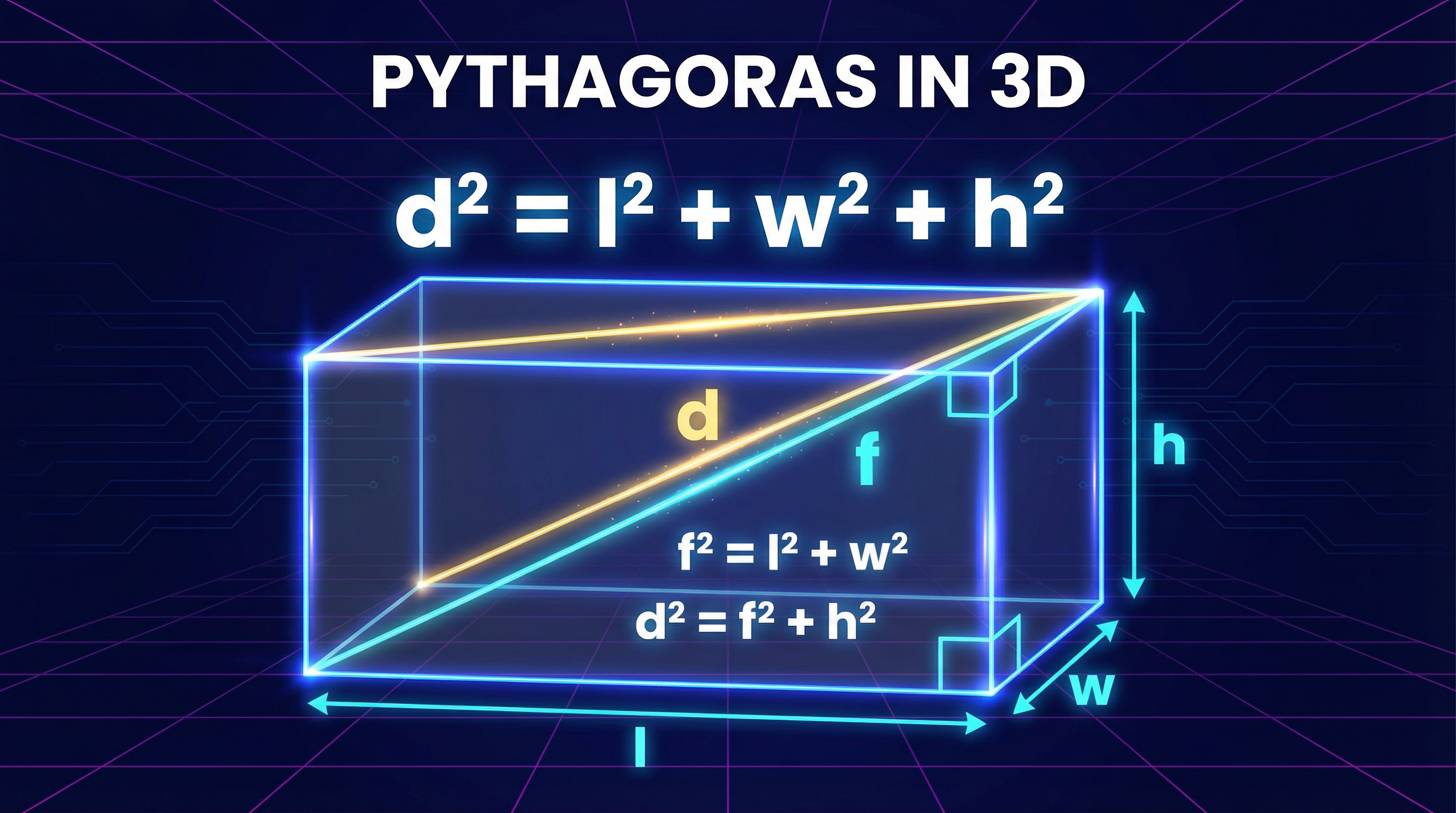
Pythagoras' Theorem in 3D

    Master Pythagoras in 3D for your OCR GCSE Further Maths exam. This guide breaks down how to find space diagonals and pyramid heights, showing you how to secure top marks by applying 2D concepts to 3D shapes and avoiding common examiner traps.

    4
    Min Read
    3
    Examples
    5
    Questions
    6
    Key Terms
    🎙 Podcast Episode
    Pythagoras' Theorem in 3D
    9:00
    0:00-9:00

    Study Notes

    Header image for Pythagoras in 3D

    Overview

    Pythagoras' Theorem in 3D (OCR specification reference 4.5) is a crucial topic in Further Mathematics that tests your ability to visualise and solve problems in three-dimensional space. While you are already familiar with the classic a² + b² = c² formula, this topic requires you to extend that knowledge to more complex shapes like cuboids, pyramids, and other solids. Success here is not just about memorising a new formula, but about developing the skill to dissect a 3D problem into a series of manageable 2D right-angled triangles. Examiners frequently use this topic to differentiate candidates, rewarding those who can show clear, logical working and handle exact surd forms with precision. Typical exam questions involve finding the length of a space diagonal, the vertical height of a pyramid, or the shortest distance between two points on the surface of a 3D object.

    Pythagoras in 3D Revision Podcast

    Key Concepts

    Concept 1: The Space Diagonal of a Cuboid

    The longest straight line that can be drawn inside a cuboid, connecting two opposite corners, is called the space diagonal. Finding its length is the most common application of Pythagoras in 3D. The key is to see it as a two-step process.

    1. Find the Face Diagonal (f): First, we must find the diagonal of one of the cuboid's faces, usually the base. For a cuboid with length l and width w, the face diagonal f is the hypotenuse of the right-angled triangle on the base. So, f² = l² + w².
    2. Find the Space Diagonal (d): Now, imagine a new right-angled triangle standing up inside the cuboid. Its base is the face diagonal f, its height is the cuboid's height h, and its hypotenuse is the space diagonal d. Therefore, d² = f² + h².

    By substituting the first equation into the second, we get the master formula for the space diagonal.
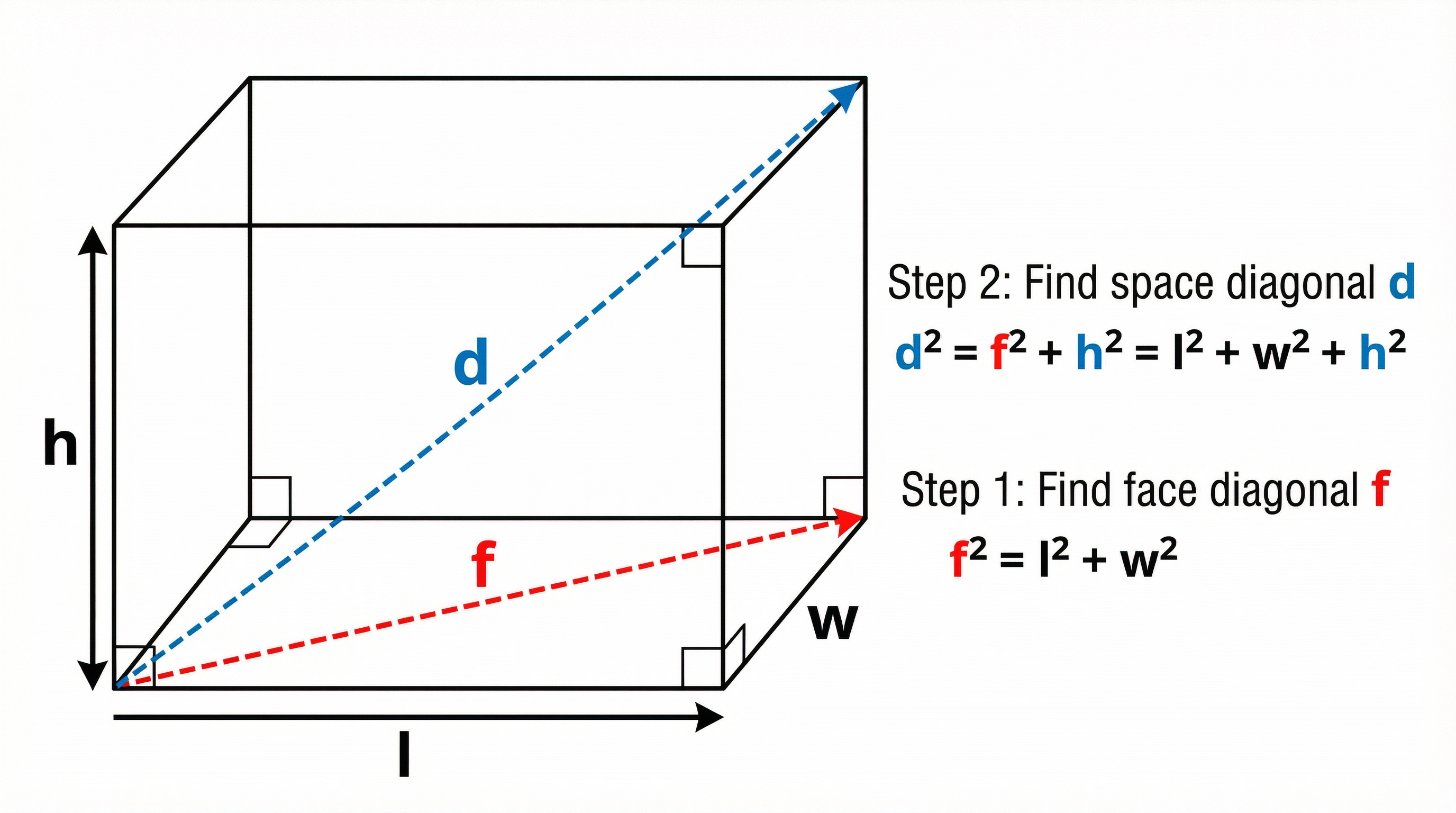
    Key diagonals in a cuboid

    Concept 2: Hidden Triangles in Pyramids

    Pyramids present a more complex challenge because the right-angled triangles are often 'hidden'. The two most important triangles to be able to identify are:

    1. The Slant Height Triangle: This is formed by the vertical height (h) of the pyramid, the apothem (the line from the centre of the base to the midpoint of a base edge), and the slant height (l). The right angle is at the centre of the base. For a square-based pyramid with side length a, the apothem is a/2. The relationship is l² = h² + (a/2)².
    2. The Slant Edge Triangle: This is formed by the vertical height (h), the line from the centre of the base to a corner, and the slant edge (e). The right angle is again at the centre of the base. Finding the distance from the centre to a corner requires using Pythagoras on the base itself.

    Candidates frequently lose marks by confusing the slant height with the vertical height. The vertical height is always the perpendicular distance from the apex to the base.
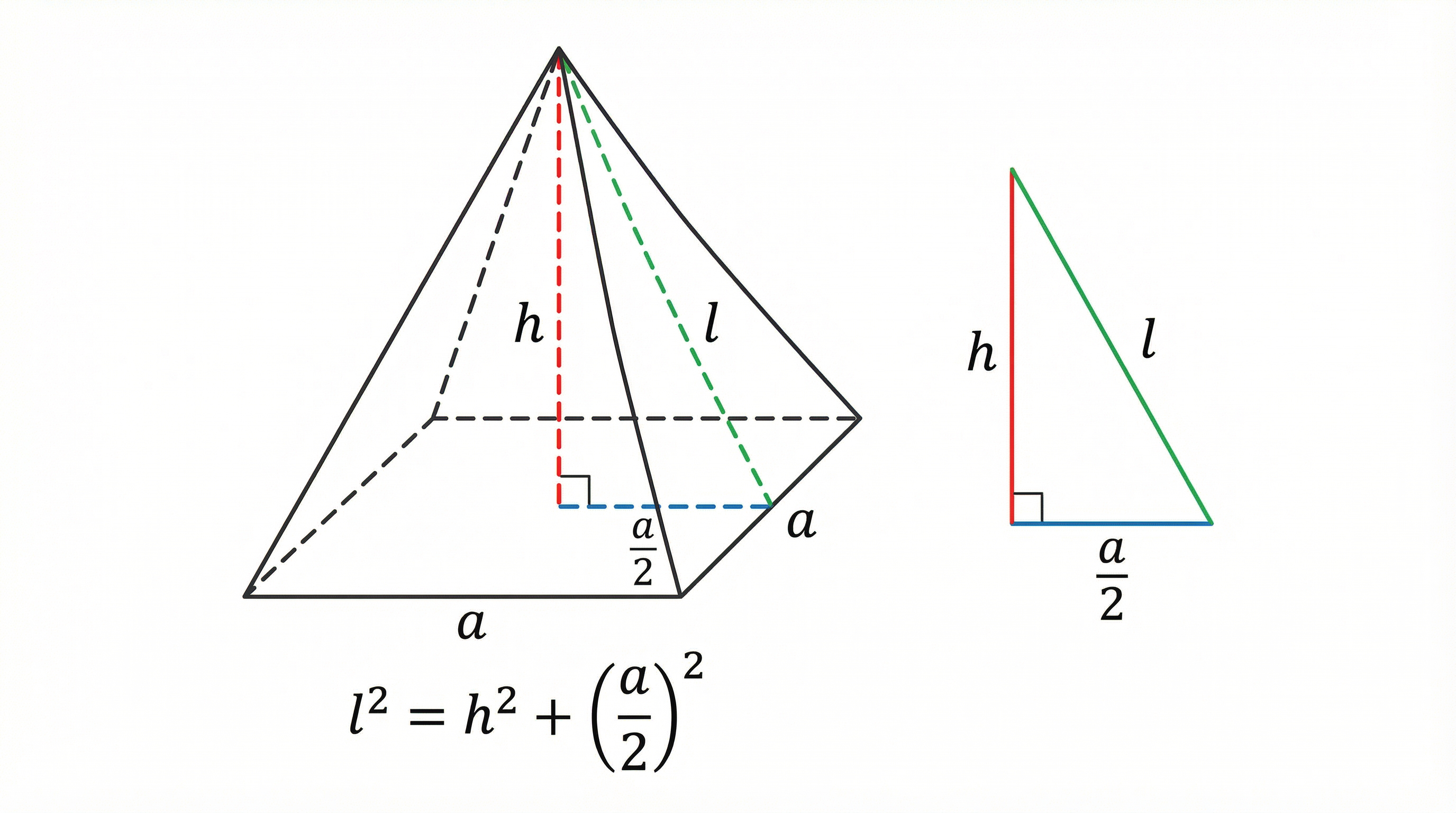
    Key relationships in a square-based pyramid

    Mathematical/Scientific Relationships

    • Pythagoras' Theorem in 2D: a² + b² = c² (Must memorise)
    • Space Diagonal of a Cuboid: d² = l² + w² + h² (Must memorise - this is a direct extension of the 2D theorem)
    • Slant Height of a Square Pyramid: l² = h² + (a/2)² (Derived from Pythagoras - understand, don't just memorise)

    It is critical to leave answers in exact surd form (e.g., 5√2) unless the question specifies a number of decimal places. Converting to a decimal prematurely will result in losing accuracy marks.

    Practical Applications

    While abstract, these principles have real-world applications in fields like architecture (calculating the length of support beams), engineering (designing components that fit within a certain space), and even video game design (calculating collision detection paths in a 3D environment).

    Visual Resources

    2 diagrams and illustrations

    Key diagonals in a cuboid
    Key diagonals in a cuboid
    Key relationships in a square-based pyramid
    Key relationships in a square-based pyramid

    Interactive Diagrams

    2 interactive diagrams to visualise key concepts

    YesNoYesNoStart: 3D Shape ProblemIdentify Target LengthIs it a Space Diagonal?Calculate Face Diagonal f = sqrt(l²+w²)Calculate Space Diagonal d = sqrt(f²+h²)Is it in a Pyramid?Identify Hidden Triangle (h, l, apothem?)Apply Pythagoras a²+b²=c²Unfold Surface (Net)Apply 2D PythagorasFinal Answer

    A flowchart showing the decision-making process for solving 3D Pythagoras problems.

    Diagram could not be rendered

    A concept map showing the relationships between the dimensions and the formulas for cuboids and pyramids.

    Worked Examples

    3 detailed examples with solutions and examiner commentary

    Practice Questions

    Test your understanding — click to reveal model answers

    Q1

    A cuboid measures 2 cm by 3 cm by 4 cm. What is the exact length of its space diagonal?

    3 marks
    foundation

    Hint: Use the formula d² = l² + w² + h².

    Q2

    A square-based pyramid has a base of side 6 cm and a vertical height of 4 cm. Calculate the slant height of the pyramid.

    3 marks
    standard

    Hint: The slant height, vertical height, and apothem (half the base side) form a right-angled triangle.

    Q3

    A cone has a radius of 5 cm and a slant height of 13 cm. Calculate the vertical height of the cone.

    3 marks
    standard

    Hint: A cone is just a pyramid with a circular base. The radius, vertical height, and slant height form a right-angled triangle.

    Q4

    The points A(1, 2, 3), B(4, 6, 3) and C(4, 2, 9) are three vertices of a cuboid. Find the length of the space diagonal AC.

    4 marks
    challenging

    Hint: Find the change in x, change in y, and change in z between the two points. These are the length, width, and height.

    Q5

    A spider is at corner A of a cuboid with length 6 cm, width 5 cm, and height 3 cm. It wants to crawl to the opposite corner G. What is the shortest possible distance it can crawl?

    4 marks
    challenging

    Hint: This is a surface distance problem. Unfold the faces to create a 2D net and find the straight-line distance.

    Key Terms

    Essential vocabulary to know

    More Further Mathematics Study Guides

    View all

    Trigonometry

    OCR
    GCSE

    This topic extends your trigonometry knowledge beyond right-angled triangles into the realm of any angle, trigonometric identities, and complex equation solving. You'll master the CAST diagram, apply the Sine and Cosine Rules to non-right-angled triangles in 2D and 3D contexts, and prove identities using fundamental relationships. This is a high-value topic in Further Maths exams, frequently appearing in multi-step problem-solving questions worth 4-6 marks.

    Proof

    OCR
    GCSE

    Proof is the art of constructing watertight algebraic arguments that demonstrate mathematical statements are true for ALL cases, not just specific examples. This topic is a cornerstone of OCR GCSE Further Mathematics, demanding rigorous logic, precise algebraic notation, and clear communication. Mastering proof unlocks high-value marks and develops critical thinking skills that extend far beyond mathematics.

    Vectors

    OCR
    GCSE

    Vectors in OCR GCSE Further Mathematics goes far beyond basic GCSE column vector arithmetic. You'll master constructing complex vector paths through geometric figures, proving collinearity using scalar multiples, and finding positions of points that divide lines in given ratios. This topic demands algebraic precision, rigorous notation, and explicit geometric reasoning—skills that examiners reward generously when demonstrated correctly.

    Inequalities

    OCR
    GCSE

    Master OCR GCSE Further Maths Inequalities (2.3) by learning to solve quadratic inequalities algebraically and graphically. This guide breaks down the critical steps, from finding roots to sketching parabolas and selecting the correct regions, ensuring you can secure every mark."

    Sequences

    OCR
    GCSE

    Sequences in OCR GCSE Further Mathematics extend beyond standard GCSE, requiring mastery of quadratic sequences, geometric progressions, limiting values, and recurrence relations. This topic is essential for top grades, testing algebraic rigour, pattern recognition, and the ability to determine long-term behaviour of mathematical series.

    Standard Form

    OCR
    GCSE

    This guide provides a comprehensive, exam-focused breakdown of Standard Form for OCR GCSE Further Mathematics. It covers everything from the core principles of writing numbers in the form A × 10ⁿ to performing complex calculations, ensuring you can secure every mark available on this crucial topic.