Surds

    Surds are irrational roots like √2 that cannot be written as fractions. Mastering surds is essential for exact arithmetic in GCSE Further Maths, as examiners demand rigorous working without decimal approximations. This guide covers simplification, operations, rationalising denominators, and applying surds in geometric contexts to secure full marks.

    6
    Min Read
    4
    Examples
    6
    Questions
    7
    Key Terms
    🎙 Podcast Episode
    Surds
    0:00-0:00

    Study Notes

    Header image for OCR GCSE Further Mathematics: Surds

    Overview

    Surds are the language of mathematical precision. They are expressions involving irrational roots, like √2 or √75, which cannot be written as a simple fraction. In OCR GCSE Further Mathematics, your ability to work with surds is a direct test of your algebraic fluency and your understanding of the number system. Examiners use surds to ensure you can manipulate and solve problems without resorting to a calculator's decimal approximations, thereby preserving exact values. This topic is fundamental, forming the bedrock for more advanced algebraic and geometric problems, including exact trigonometric values and Pythagoras' theorem in 2D and 3D space. A typical exam question will require you to simplify expressions, rationalise denominators, or solve equations, often within a geometric context, demanding complete and rigorous working to secure full marks.

    Surds Study Guide Podcast: Core concepts, exam technique, and practice quiz

    Key Concepts

    Concept 1: Simplifying Surds

    A surd is in its simplest form when the number inside the square root has no square number factors (other than 1). For example, √12 is not in its simplest form because 12 has a factor of 4, which is a perfect square. The entire process hinges on one key rule: √(ab) = √a × √b.

    To simplify a surd, you must find the largest square number that divides the number inside the root. You then split the surd into two, one of which can be simplified to an integer. This integer then becomes the coefficient of the remaining surd.

    Example: Simplify √48.

    1. Identify square factors of 48. The square numbers are 4, 9, 16, 25... We can see that 4 is a factor (48 = 4 × 12) and 16 is a factor (48 = 16 × 3).
    2. Choose the largest square factor, which is 16.
    3. Rewrite the surd: √48 = √(16 × 3).
    4. Split the surd: √(16 × 3) = √16 × √3.
    5. Simplify the square root part: √16 = 4.
    6. The final answer is 4√3.

    Credit is often given (typically a B1 mark) for correctly identifying the largest square factor and splitting the surd, even if the final simplification is incorrect.
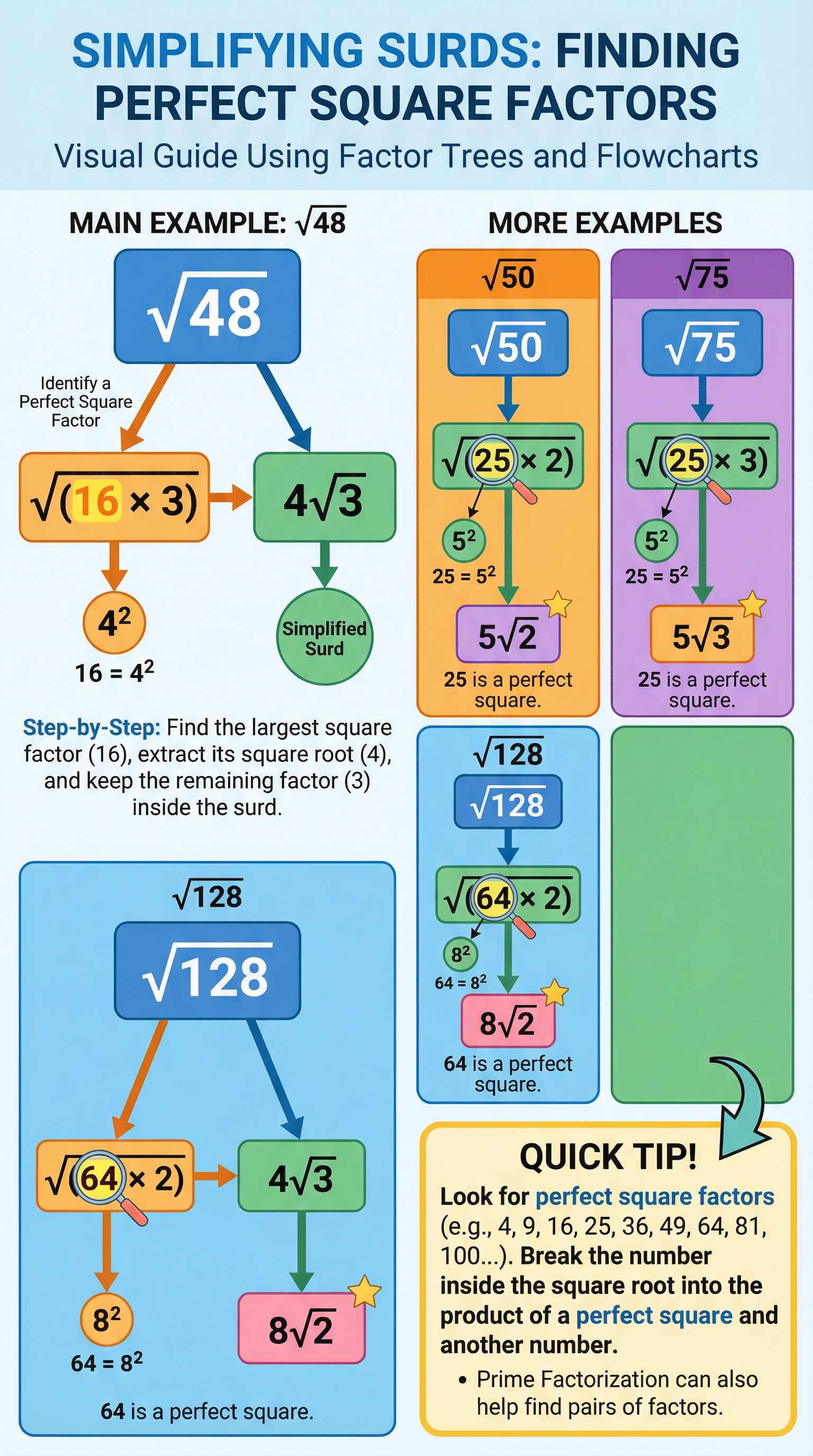
    Visual guide to simplifying surds using factor trees and square number identification

    Concept 2: Operations with Surds

    Addition and Subtraction: You can only add or subtract 'like' surds – those with the same number inside the root. This is identical to collecting like terms in algebra. For example, 5x + 2x = 7x, and similarly, 5√3 + 2√3 = 7√3. You cannot simplify 5√3 + 2√5.

    Multiplication: To multiply surds, you multiply the numbers outside the roots together, and the numbers inside the roots together. For example, (2√3) × (4√5) = (2×4)√(3×5) = 8√15. A critical rule is that √a × √a = a.

    Expansion of Brackets: When expanding brackets containing surds, you must use the standard rules of algebra, such as the FOIL method (First, Outer, Inner, Last). For 'Show that' questions, examiners expect to see all four terms of the expansion written out explicitly before simplification.
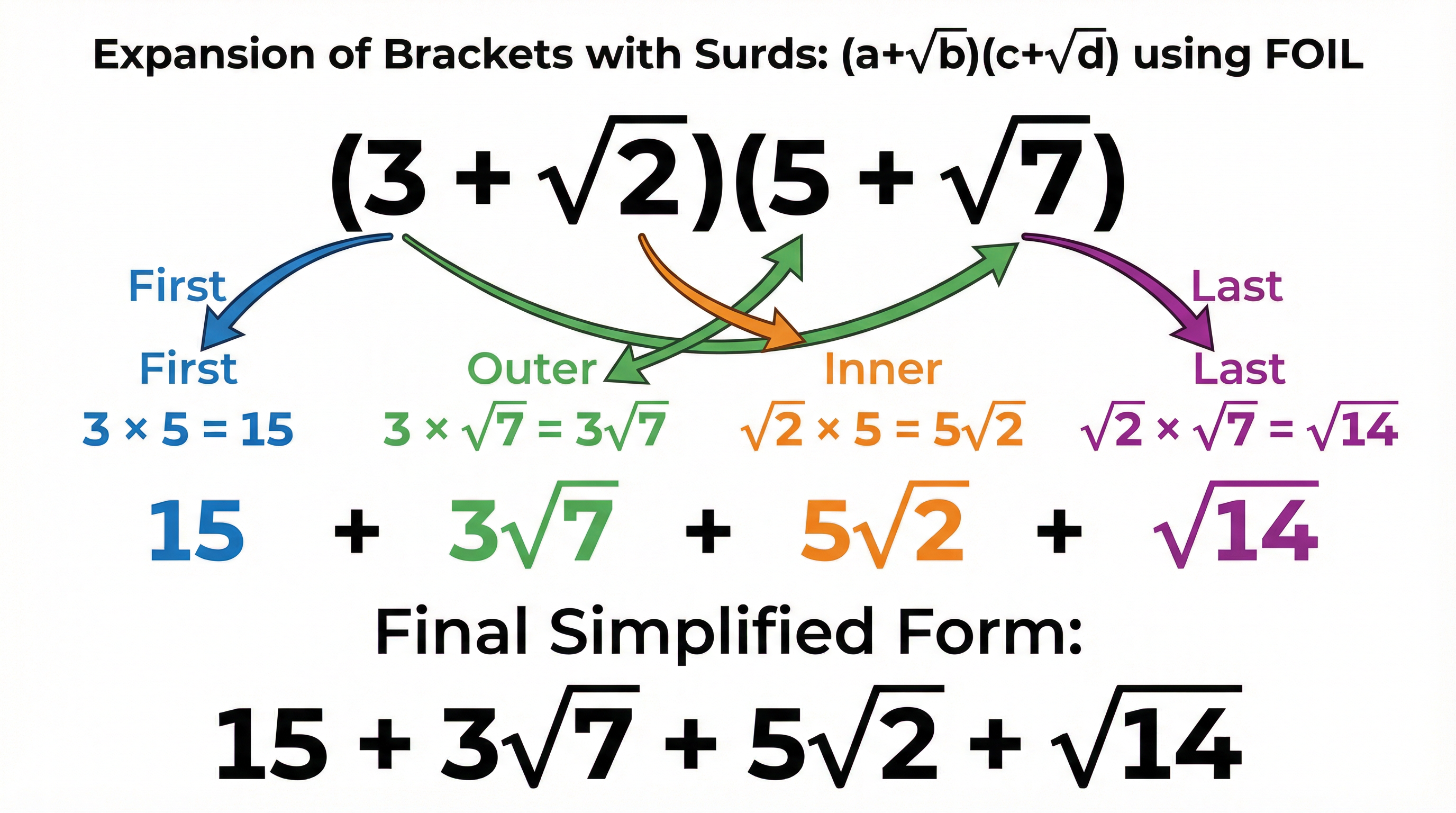
    Expanding brackets with surds using the FOIL method

    Concept 3: Rationalising the Denominator

    It is a mathematical convention not to have a surd in the denominator of a fraction. The process of removing it is called rationalising. There are two cases:

    **Case 1: Denominator is a single surd (e.g., k/√a)**To rationalise, you multiply the numerator and denominator by the surd. For example, to rationalise 12/√3, you calculate (12/√3) × (√3/√3) = 12√3/3 = 4√3.

    **Case 2: Denominator is a compound expression (e.g., k/(a+√b))**To rationalise this form, you must multiply the numerator and denominator by the conjugate of the denominator. The conjugate is formed by changing the sign in the middle of the expression. The conjugate of (a + √b) is (a - √b). When you multiply an expression by its conjugate, you create a difference of two squares, (a+√b)(a-√b) = a² - (√b)² = a² - b, which is always a rational number.

    Example: Rationalise the denominator of 4 / (3 + √2).

    1. Identify the conjugate of the denominator: 3 - √2.
    2. Multiply the numerator and denominator by the conjugate: 4/(3+√2) × (3-√2)/(3-√2).
    3. This gives (4(3-√2)) / ((3+√2)(3-√2)).
    4. The denominator becomes 3² - (√2)² = 9 - 2 = 7.
    5. The final answer is (12 - 4√2) / 7.

    An M1 mark is awarded for the correct method of multiplying by the conjugate.
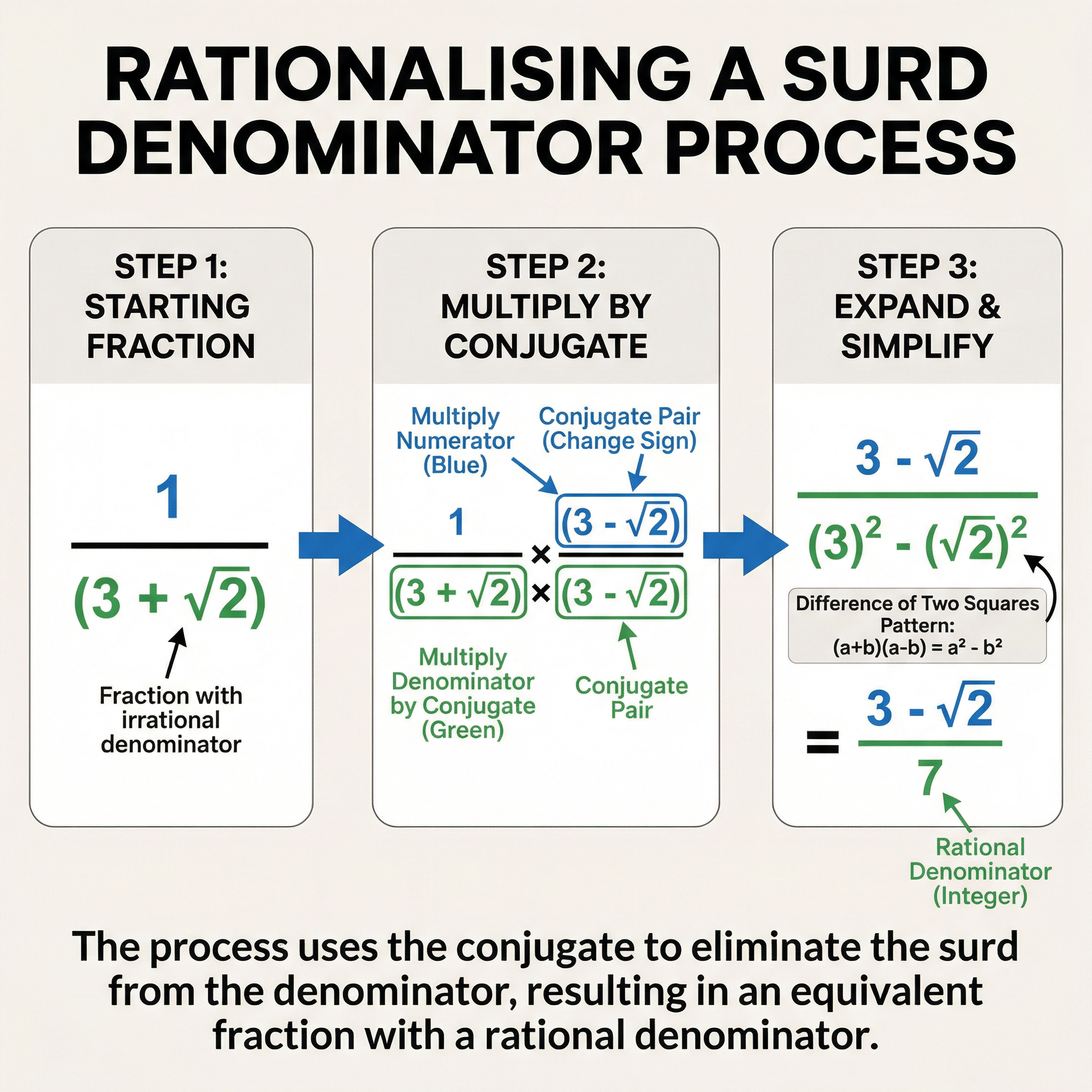
    Rationalising the denominator: using the conjugate to eliminate surds from the denominator

    Mathematical Relationships

    • Simplification Law: √(ab) = √a × √b (Must memorise)
    • Division Law: √(a/b) = √a / √b (Must memorise)
    • Squaring a Surd: (√a)² = a (Must memorise)
    • Difference of Two Squares: (a+√b)(a-√b) = a² - b (Must memorise)
    • Perfect Square Expansion: (a+√b)² = a² + 2a√b + b (Must memorise)

    Practical Applications

    While surds may seem abstract, they are essential in fields requiring exact measurements. In architecture and engineering, calculations for diagonal lengths in structures must be exact to ensure stability. For example, the diagonal of a 1m x 1m square is exactly √2 metres. Using a rounded decimal could lead to significant errors on a large scale. Similarly, in computer graphics and game design, surds are used in calculations for distances, angles, and creating precise geometric models. In advanced physics, particularly in quantum mechanics and special relativity, equations often involve surds to represent exact values in the fabric of spacetime.

    Visual Resources

    3 diagrams and illustrations

    Visual guide to simplifying surds using factor trees and square number identification
    Visual guide to simplifying surds using factor trees and square number identification
    Rationalising the denominator: using the conjugate to eliminate surds from the denominator
    Rationalising the denominator: using the conjugate to eliminate surds from the denominator
    Expanding brackets with surds using the FOIL method
    Expanding brackets with surds using the FOIL method

    Interactive Diagrams

    2 interactive diagrams to visualise key concepts

    Failed to render diagram
    graph TD
        A[Start: Unsimplified Surd √n] --> B{Does n have a square factor?}
        B -->|Yes| C[Find largest square factor k²]
        B -->|No| D[Surd is already in simplest form]
        C --> E[Rewrite as √(k² × m)]
        E --> F[Split: √k² × √m]
        F --> G[Simplify: k√m]
        G --> H[Final Answer: k√m]

    Flowchart for simplifying a surd by identifying and extracting the largest square factor.

    Failed to render diagram
    graph LR
        A[Fraction with surd denominator] --> B{Type of denominator?}
        B -->|Single surd: k/√a| C[Multiply by √a/√a]
        B -->|Compound: k/(a+√b)| D[Multiply by conjugate (a-√b)/(a-√b)]
        C --> E[Numerator: k√a]
        C --> F[Denominator: a]
        E --> G[Simplify: k√a/a]
        D --> H[Numerator: k(a-√b)]
        D --> I[Denominator: a²-b using difference of squares]
        H --> J[Final Answer: k(a-√b)/(a²-b)]
        I --> J

    Decision tree for rationalising the denominator, showing the two main cases and the appropriate method for each.

    Worked Examples

    4 detailed examples with solutions and examiner commentary

    Practice Questions

    Test your understanding — click to reveal model answers

    Q1

    Simplify √32.

    2 marks
    foundation

    Hint: Find the largest square number that divides 32. Think of 4, 9, 16, 25...

    Q2

    Calculate (√7)² + (√3)².

    2 marks
    foundation

    Hint: Remember that (√a)² = a.

    Q3

    Expand and simplify (2 + √3)².

    3 marks
    standard

    Hint: Expand as (2 + √3)(2 + √3) using FOIL, not as 2² + (√3)².

    Q4

    Rationalise the denominator of 10/√5. Give your answer in its simplest form.

    2 marks
    standard

    Hint: Multiply the numerator and denominator by √5.

    Q5

    Express 8/(3-√2) in the form a + b√2, where a and b are rational numbers.

    4 marks
    challenging

    Hint: Multiply the numerator and denominator by the conjugate of 3-√2.

    Q6

    Solve the equation (x-1)² = 18, giving your answer in the form a ± b√c, where a, b, and c are integers.

    4 marks
    challenging

    Hint: Take the square root of both sides, remembering the ± sign, then simplify √18.

    Key Terms

    Essential vocabulary to know

    More Further Mathematics Study Guides

    View all

    Trigonometry

    OCR
    GCSE

    This topic extends your trigonometry knowledge beyond right-angled triangles into the realm of any angle, trigonometric identities, and complex equation solving. You'll master the CAST diagram, apply the Sine and Cosine Rules to non-right-angled triangles in 2D and 3D contexts, and prove identities using fundamental relationships. This is a high-value topic in Further Maths exams, frequently appearing in multi-step problem-solving questions worth 4-6 marks.

    Proof

    OCR
    GCSE

    Proof is the art of constructing watertight algebraic arguments that demonstrate mathematical statements are true for ALL cases, not just specific examples. This topic is a cornerstone of OCR GCSE Further Mathematics, demanding rigorous logic, precise algebraic notation, and clear communication. Mastering proof unlocks high-value marks and develops critical thinking skills that extend far beyond mathematics.

    Vectors

    OCR
    GCSE

    Vectors in OCR GCSE Further Mathematics goes far beyond basic GCSE column vector arithmetic. You'll master constructing complex vector paths through geometric figures, proving collinearity using scalar multiples, and finding positions of points that divide lines in given ratios. This topic demands algebraic precision, rigorous notation, and explicit geometric reasoning—skills that examiners reward generously when demonstrated correctly.

    Inequalities

    OCR
    GCSE

    Master OCR GCSE Further Maths Inequalities (2.3) by learning to solve quadratic inequalities algebraically and graphically. This guide breaks down the critical steps, from finding roots to sketching parabolas and selecting the correct regions, ensuring you can secure every mark."

    Sequences

    OCR
    GCSE

    Sequences in OCR GCSE Further Mathematics extend beyond standard GCSE, requiring mastery of quadratic sequences, geometric progressions, limiting values, and recurrence relations. This topic is essential for top grades, testing algebraic rigour, pattern recognition, and the ability to determine long-term behaviour of mathematical series.

    Standard Form

    OCR
    GCSE

    This guide provides a comprehensive, exam-focused breakdown of Standard Form for OCR GCSE Further Mathematics. It covers everything from the core principles of writing numbers in the form A × 10ⁿ to performing complex calculations, ensuring you can secure every mark available on this crucial topic.

    Syntax error in textmermaid version 11.12.2
    Syntax error in textmermaid version 11.12.2