Study Notes
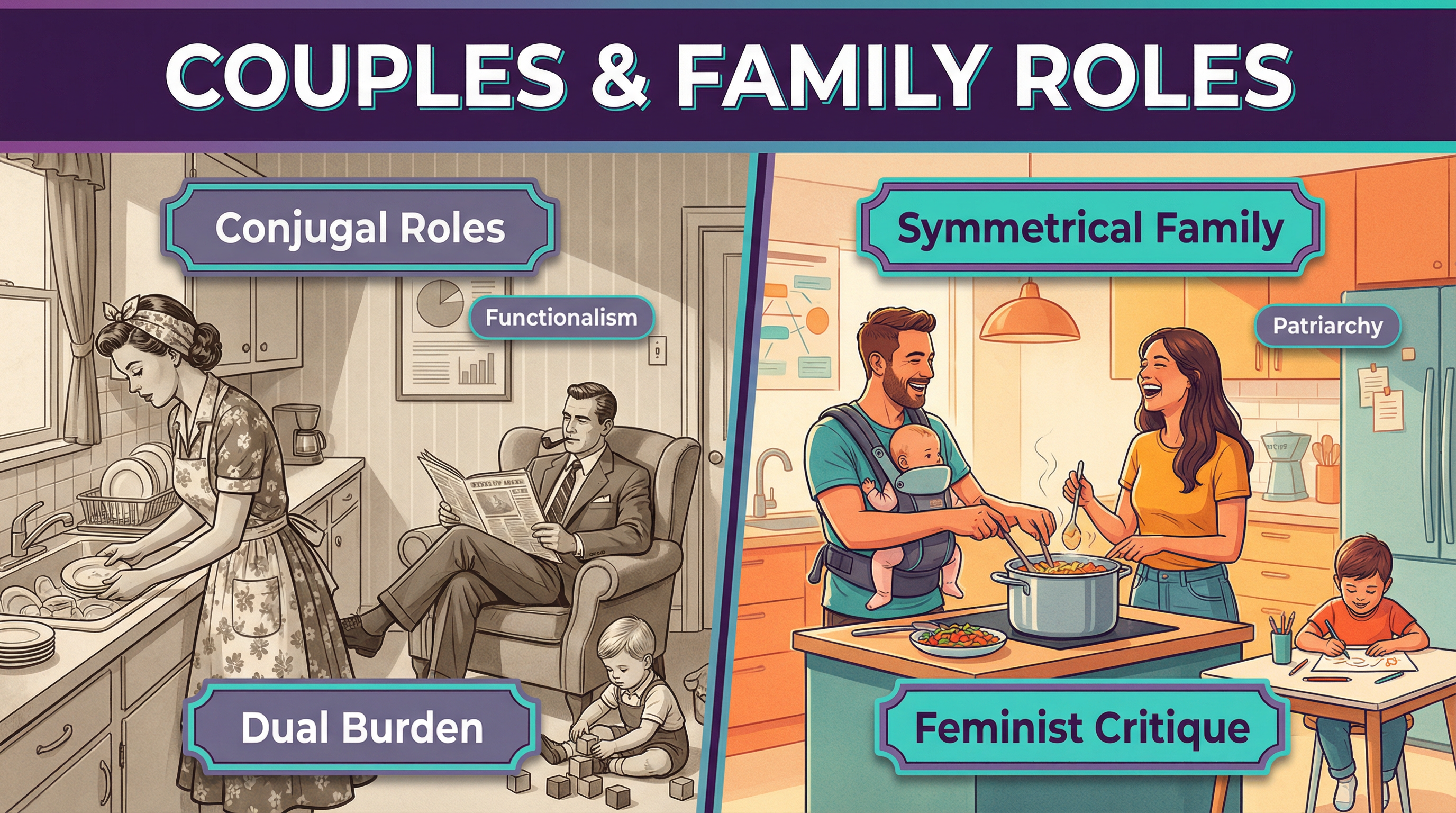
Overview
This topic explores the changing roles and relationships within couples, focusing on the domestic division of labour. For the OCR J204 specification, candidates must critically analyse the shift from traditional, segregated roles to more integrated, 'symmetrical' partnerships. Examiners expect a detailed understanding of the Functionalist 'March of Progress' perspective, which argues that family life is steadily improving, contrasted with the Feminist view that the family remains a site of patriarchal oppression for women. You will need to deploy key studies, concepts, and sociological terminology to evaluate the extent of change in conjugal roles and power dynamics within the family. This includes assessing who does the housework, who cares for the children, who makes the decisions, and who does the 'emotional work'.
Key Debates & Developments
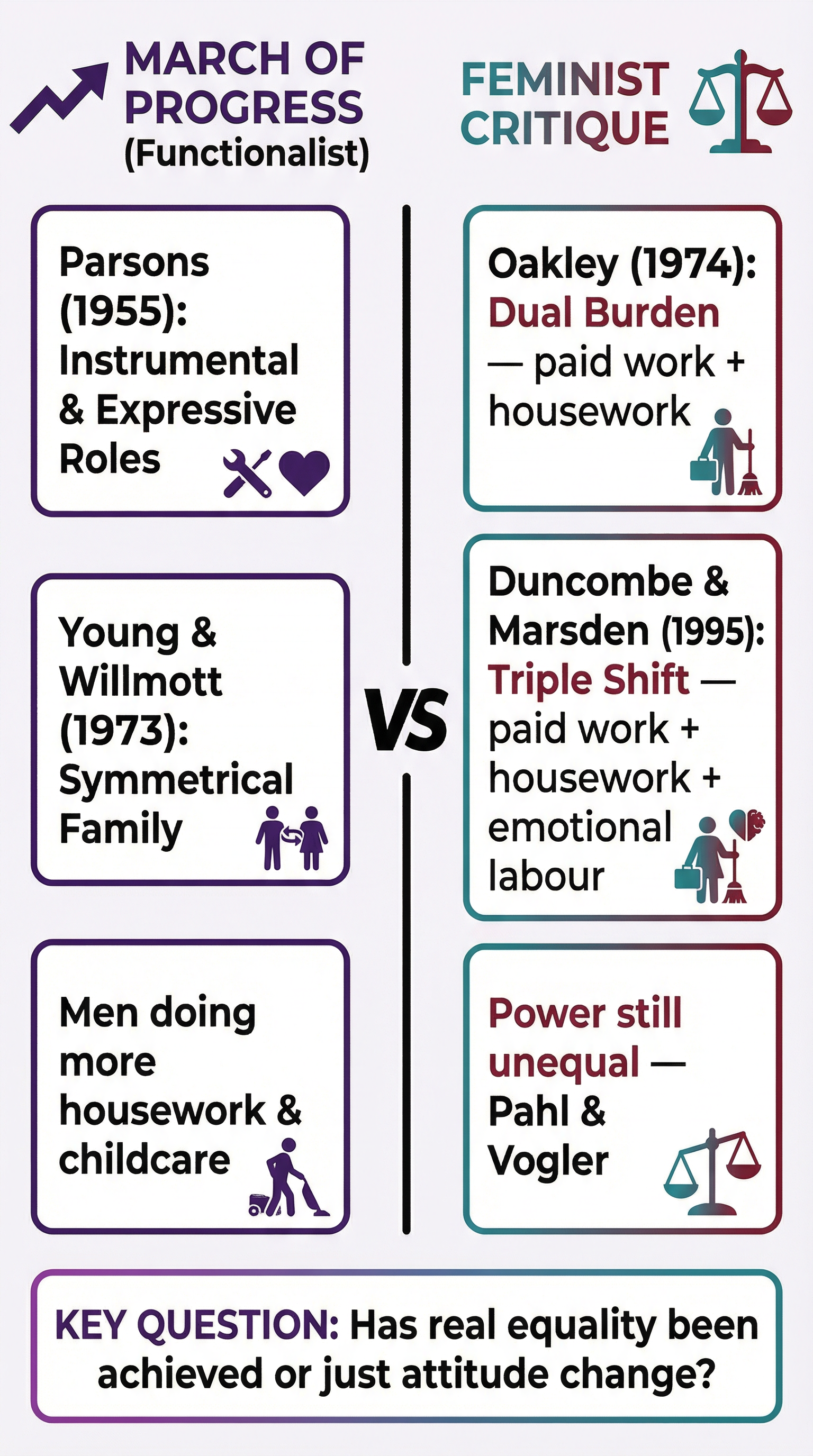
The 'March of Progress' vs. Feminist Critique
What is it: This is the central debate. The 'March of Progress' view, associated with Functionalists like Young and Willmott, argues that the family is becoming more egalitarian. They see a move from old-fashioned, segregated conjugal roles (where the man is the breadwinner and the woman is the homemaker) to modern, joint conjugal roles (where couples share tasks more equally).
Why it matters: This forms the basis of most exam questions on the topic. You must be able to articulate both sides. The 'March of Progress' provides the 'for' argument that things have improved, while the Feminist view provides the powerful 'against' argument.
Specific Knowledge: For the 'March of Progress', you MUST know Young and Willmott's (1973) concept of the 'Symmetrical Family'. For the Feminist critique, you MUST know Ann Oakley's (1974) concepts of the 'dual burden' and her criticism of Young and Willmott, as well as Duncombe and Marsden's (1995) concept of the 'triple shift'.
Segregated vs. Joint Conjugal Roles
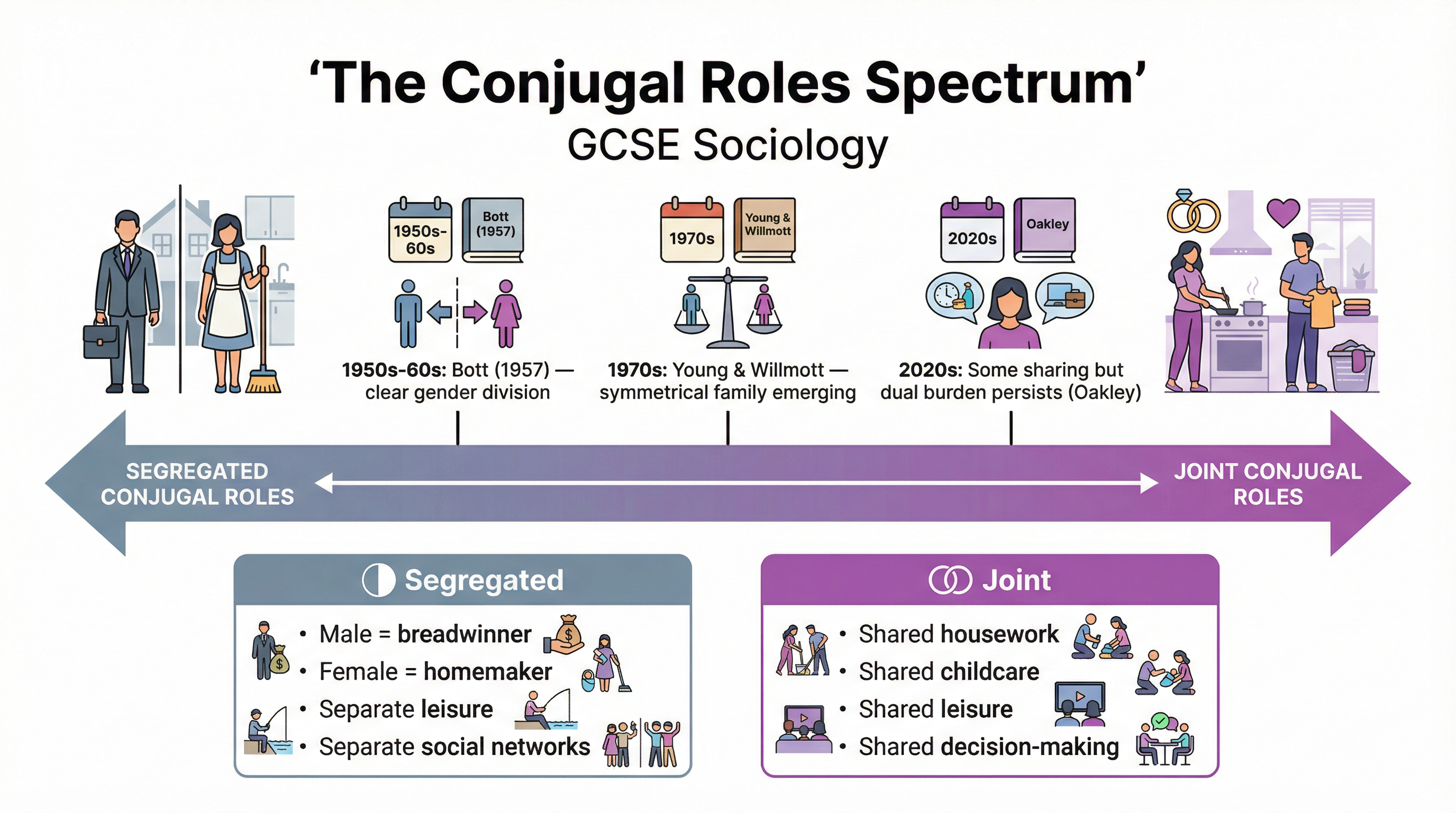
What is it: This refers to the way couples organise their household tasks, leisure time, and social lives. Segregated roles mean everything is separate; joint roles mean things are shared.
Why it matters: This terminology is essential for describing the change (or lack of change) in family life. Marks are awarded for using these terms accurately.
Specific Knowledge: Elizabeth Bott (1957) identified these two types of roles in her study of London families. Young and Willmott later argued there was a long-term trend away from segregated and towards joint roles.
Key Individuals
Michael Young & Peter Willmott
Role: Functionalist sociologists and key proponents of the 'March of Progress' view.
Key Actions: Conducted extensive research on family life in London from the 1950s to the 1970s. Their book, The Symmetrical Family (1973), is a landmark study.
Impact: They introduced the concept of the 'symmetrical family' and the idea that family life was evolving through stages, becoming progressively more equal. Their work is the essential starting point for any discussion of modern family roles.
Ann Oakley
Role: Feminist sociologist who provided the most significant critique of the 'March of Progress' view.
Key Actions: In her 1974 study, The Sociology of Housework, she interviewed women and found little evidence of symmetry. She argued that men 'helping' was not the same as equality.
Impact: Oakley's work is the cornerstone of the Feminist perspective on housework. She introduced the concept of the 'dual burden' and set the terms of the debate for decades. Her methodological critique of Young and Willmott (arguing their questions were biased) is also important.
Jean Duncombe & Dennis Marsden
Role: Sociologists who developed the Feminist critique further.
Key Actions: Their 1995 research focused on the emotional side of family life.
Impact: They coined the term 'triple shift', arguing that women are expected to perform paid work, domestic work, and emotional work, adding another layer to their burden and challenging the optimistic view of family life even more strongly.
Second-Order Concepts
Causation
What caused the shift towards more joint roles (if we accept it happened)?
- Changes in women's position: More women in higher education and paid employment.
- Geographical mobility: Families moving away from their traditional communities, weakening the hold of traditional gender norms.
- New technology: Labour-saving devices (washing machines, hoovers) reduced the time needed for housework, although feminists argue this just raised standards, creating more work.
- Higher standards of living: Increased wealth and income reduced the pressure on men to be the sole breadwinner.
Change & Continuity
- Change: There is clear evidence that men's attitudes have changed, and they believe in sharing roles more than in the past. The 'new man' who is more involved in childcare is a visible social phenomenon.
- Continuity: Despite changing attitudes, evidence from time-use studies consistently shows that women still do the majority of housework and childcare. Power and decision-making often remain unequal. The 'triple shift' suggests the burden on women may have actually increased.
Significance
This topic is significant because it goes to the heart of debates about equality in society. The family can be seen as a 'factory' that produces gender roles. If roles are unequal in the home, this will be reflected in wider society (e.g., in the gender pay gap). The debate forces us to question whether legal and economic changes (like the Equal Pay Act) have translated into genuine social equality.",
"podcast_script": "# OCR GCSE Sociology: Couples & Family Roles - The Podcast
(Intro Music - Upbeat and modern, fades after 5 seconds)
Host (Warm, engaging female voice): Hello and welcome to the GCSE Sociology revision podcast! I’m your host, and today we’re diving deep into one of the most debated topics in the sociology of the family: Couples and the Domestic Division of Labour. Who does what in the home? Has it always been this way? And are things really equal now? This isn’t just about who does the washing up; it’s about power, inequality, and social change. Examiners love this topic because it allows you to contrast different theories and use real-world evidence. So, for the next 10 minutes, we’re going to break it all down, from the ‘March of Progress’ to the ‘Triple Shift’, and give you the key knowledge you need to smash that exam question. Let’s get started!
(Transition sound effect - a gentle whoosh)
Host: Right, let’s lay out the core concepts. The big debate here is between two camps. On one side, you have the Functionalists and their ‘March of Progress’ view. They argue that family life is gradually improving, becoming more equal and democratic. The key study you need to know here is from Young and Willmott in 1973. They put forward the idea of the ‘symmetrical family’. They argued that in modern families, the roles of husbands and wives, while not identical, are becoming much more similar. Think of it like a seesaw balancing out. They found that men were helping more with housework and childcare, couples were spending more leisure time together, and decision-making was more shared. Young and Willmott saw this as a direct result of social changes like women going out to work and rising living standards. For a functionalist like Talcott Parsons, this is a positive evolution. He talked about instrumental and expressive roles back in the 50s – the man as the breadwinner, the woman as the homemaker. The symmetrical family suggests these roles are merging.
Now, on the other side of the debate, you have the Feminist critique. Feminists argue that the ‘March of Progress’ view is far too optimistic and ignores the reality of patriarchy – a society where men hold the power. The first key thinker you must name-drop is Ann Oakley. In 1974, she fiercely criticised Young and Willmott. She argued their evidence was flimsy and that men ‘helping’ wasn’t the same as true equality. Oakley’s own research found that women in paid work effectively had to do two jobs – their paid employment and the bulk of the housework and childcare. She called this the ‘dual burden’. This is a crucial term for your exam answers. Credit is always given for using it correctly.
Taking this even further, Duncombe and Marsden in 1995 introduced the concept of the ‘triple shift’. They argued that women are not only responsible for paid work and housework, but also for emotional labour – managing the family’s feelings, organising birthdays, remembering to send cards, soothing arguments. This emotional work is often invisible and unacknowledged, but it’s a huge part of keeping the family running. So, from a feminist perspective, far from being symmetrical, the family is still a place of exploitation for women.
Finally, let’s talk about power and money. Who makes the big decisions? Pahl and Vogler identified two main systems for managing money in couples: the allowance system, where the man gives his wife a budget, and pooling, where both partners have access to a joint income. While pooling might seem more equal, Pahl and Vogler found that even in couples who pooled their money, men often made the major financial decisions. This shows that even when roles look similar on the surface, power imbalances can still exist underneath. So, when you’re evaluating, you must question whether we have true equality or just a change in attitudes.
(Transition sound effect - a sharp ‘ping’)
Host: Okay, let’s talk exam tips. This is where you earn the big marks. A classic OCR question might be something like, “Discuss how far sociologists agree that the family is now symmetrical.” (12 marks). This is your cue to set up a debate.
First, start with the ‘March of Progress’ view. Lay out Young and Willmott’s argument clearly. Define the symmetrical family and explain why they believed it was happening. Use the phrase, “According to March of Progress theorists like Young and Willmott…” This shows the examiner you know your stuff. That’s your AO1, your knowledge.
Then, you MUST bring in the critique. Use a linking phrase like, “However, feminist sociologists strongly challenge this view.” Then, introduce Ann Oakley. Explain the ‘dual burden’ and use her research to argue against the idea of symmetry. For top marks, bring in Duncombe and Marsden’s ‘triple shift’ to show an even deeper level of inequality. This is your AO2, your application and analysis.
One common mistake candidates make is to just describe the theories without using them to answer the question. Always link back. For example, say “This evidence of a ‘triple shift’ directly refutes the claim that the family is symmetrical, suggesting women’s work has increased, not become more equal.”
Another pitfall is using common sense instead of evidence. Don’t say “Well, my dad does the cooking.” Examiners want sociological evidence. Name the sociologists!
Finally, your conclusion must make a judgement. Don’t just sit on the fence. You need to answer the ‘how far’ part of the question. A good concluding sentence might be: “In conclusion, while conjugal roles may have become more joint in some areas, the evidence from feminist research suggests that significant inequalities in power and the division of labour persist, meaning the family is far from being truly symmetrical.”
(Transition sound effect - a ticking clock)
Host: Alright, time for a quick-fire recall quiz! I’ll ask a question, you pause the podcast and shout out the answer. Ready?
-
Which sociologists came up with the concept of the ‘symmetrical family’?
(Pause) … Young and Willmott! -
What term did Ann Oakley use to describe women doing both paid work and housework?
(Pause) … The dual burden! -
What is the ‘triple shift’?
(Pause) … Paid work, housework, and emotional labour! -
Name the two systems of money management identified by Pahl and Vogler.
(Pause) … The allowance system and pooling! -
What is the feminist term for a male-dominated society?
(Pause) … Patriarchy!
How did you do? If you got all five, you’re in a great position!
(Transition sound effect - a final whoosh)
Host: So, to summarise, the debate over family roles is a classic clash of sociological perspectives. The Functionalist ‘March of Progress’ view sees a positive move towards the symmetrical family, with joint conjugal roles. But the Feminist critique reveals a deeper inequality, highlighting the ‘dual burden’ and ‘triple shift’ that leave women exploited. For the exam, you need to be able to explain both sides of the argument and use the key thinkers – Young and Willmott, Oakley, and Duncombe and Marsden – to back up your points. Remember to evaluate and come to a clear conclusion.
That’s all we have time for today. Thanks for listening to the GCSE Sociology revision podcast. Keep up the great work, and I’ll see you next time!
(Outro Music - Upbeat and modern, fades out)"